In Brief
- Cape Verde shocked the football community when it drew against Spain.
- Its supporters in Australia say they were shocked at the result.
Thousands of kilometres from his home in Cape Verde, Joao Costa is living one of Australia's "most exhilarating" World Cup experiences — and perhaps one of its loneliest.
"In this part of the world, mention Cape Verde and people go, 'Huh, where's that?'," Costa tells SBS News.
"I mean, fair enough. It's a small, 10 little dots or sand grains, in the middle of the ocean.
"But now we're on a map."
Cape Verde is a small island country with a population of about 500,000, located in the Atlantic Ocean off the western coast of Africa.
News that makes sense
Your trusted source for staying up-to-date with the world around you. Get free daily news updates and analysis, straight to your inbox.
The island was uninhabited until it was colonised by the Portuguese in the 15th century, and gained independence in 1975.
It's one of the smallest countries to participate in the 2026 FIFA World Cup.
The team's draw against European heavyweight Spain last week shocked many — and put the underdogs firmly on the watchlist for this year's tournament.
'Hey, we're here'
The whole country erupted into carnival-like celebrations when their team, nicknamed Tubarões Azuis or the Blue Sharks, qualified for football's showpiece event for the first time in October.
In Melbourne, Costa is almost part of a one-man fan base, as there are only 40 Cape Verdeans like him living in Australia, according to the Australian Bureau of Statistics' 2021 estimates.
The 62-year-old was born on the island of São Vicente in Cape Verde, moved to Angola when he was six, then moved to Portugal, Norway and finally to Australia when he was 19 to join his brother.
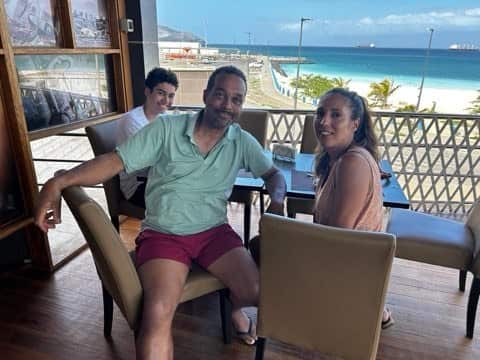
"Long story, but Cape Verde has always been in our hearts," he said. "It's one of those cultures that stays with you. You don't forget it."
For him, appearing in the World Cup is more about a sense of recognition.
"It's not arrogance or pride. It's just, 'Hey, we're here. We're part of the planet.' Come and see who we are. We have interesting [things] to share with others," Costa said.
'We are small, but we are strong'
Cape Verde's World Cup qualification was not the only surprise for Costa.
In their first match, Cape Verde, ranked 63rd in the FIFA rankings and played against Spain, one of the tournament's favourites and ranked 3rd in the world. Cape Verde held them to a 0-0 draw, shocking the whole football community.
"My goodness, the whole family woke up and, we thought, 'Well, this is gonna be a baptism of fire against mighty Spain'," Costa said.
"But I know the Cape Verdean spirit. It's like we are small, but we are strong.
"Sometimes the strongest doesn't always win. To see a little country, a small underdog, face up to a giant like Spain is incredible.
Costa said he was in "shock" watching the game, giving a special mention to goalkeeper Josimar José Évora Dias for his efforts repelling numerous Spanish shots on goal.
After the game, the online profile of the 40-year-old keeper, also known as Vozinha, blew up on social media. He now has 14 million Instagram followers.
"He's from the island where I was born. If you go there and you see the humility of the people, the way they are, they know who they are in a way," Costa said.
"It's like we're small, we're not rich, but we know who we are."
The World Cup dream for Costa and Cape Verde, however, has only just started with the team facing Uruguay on Thursday morning.
"We're gonna wake up again," Costa said.
"Uruguay is (a) top level team as well, and I hope that (we) can at least achieve a draw again. That's my hope. But in football, everything can change in a matter of minutes."
'Kids playing on the streets'
While there are only dozens of Cape Verdeans in Australia, they are not alone in cheering for the Blue Sharks in the World Cup.
Yamina Hofer, a French-Australian who lived in Cape Verde for nine years, knows all about the country's passion for football.
"It's huge. It's absolutely huge," she told SBS News.
"For as long as I have set foot in Cape Verde, I have noticed the importance of football there ... on this tiny island, you can see Tubarões Azuis everywhere.
"From a young age, most people train football on the dirt, everywhere, barefoot. Everywhere there's a little bit of space, there are kids playing on the streets.
"To be in the World Cup is huge in the fact that it shows that the team is good and competing with the giants is already a victory for Cape Verdeans."
Watching the match against Spain was an emotional moment for Hofer.
"Watching the reaction of the Cape Verdean people after that first match, it brings tears because it's so touching," she said.
"It's so touching to see how much pride they hold."
You can watch all 104 matches of the FIFA World Cup 2026™ live, free and exclusive on SBS, SBS VICELAND and SBS On Demand.
For the latest from SBS News, download our app and subscribe to our newsletter.







