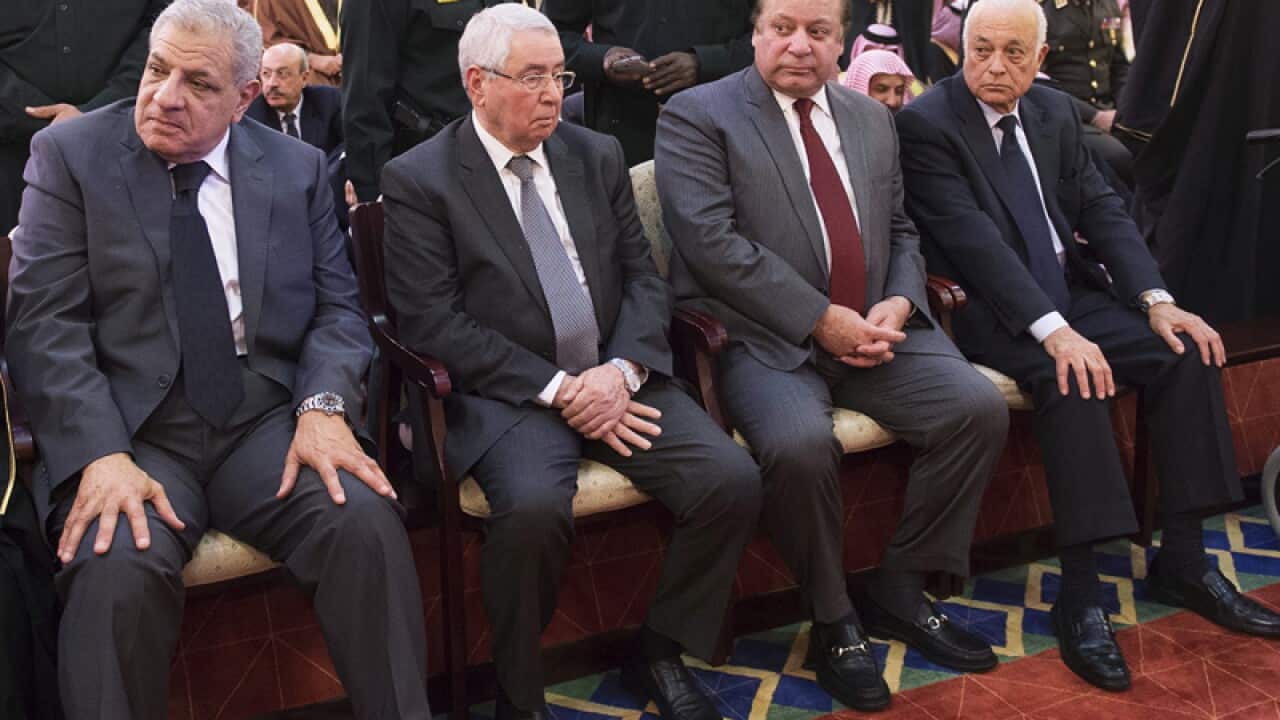
World leaders have paid tribute to Saudi Arabia's King Abdullah, praising the late monarch as a key mediator between Muslims and the West.
US President Barack Obama said on Friday that he and Abdullah, whose country has for decades been a strategic ally of Washington, had enjoyed a "genuine and warm friendship".
Russian President Vladimir Putin hailed Abdullah, who died in a Riyadh hospital earlier the same day, as a "wise politician".
Shi'ite Iran, the Sunni kingdom's main regional adversary, sent condolences to the Saudi people and announced its foreign minister would travel to Riyadh for an "official ceremony" this weekend.
Abdullah, who officially took power in 2005, guided his country through a turbulent decade in the region, with neighbours Iraq and Yemen wracked with insecurity after the 2011 Arab Spring uprisings and the growth of Islamic radicalism.
News that makes sense
Your trusted source for staying up-to-date with the world around you. Get free daily news updates and analysis, straight to your inbox.
French President Francois Hollande said Abdullah's vision of "a fair and durable peace in the Middle East remains truer than ever."
British Prime Minister David Cameron said the king would be remembered for "his commitment to peace and for strengthening understanding between faiths".
Prince Charles is to travel to Riyadh as The Queen's representative to pay his respects.
German Chancellor Angela Merkel said Abdullah's rule had been "fair and moderate", praising him for aiding "dialogue between the Muslim world and the West".
Australian Prime Minister Tony Abbott said King Abdullah was "a key architect of Saudi Arabia's economic and political development" while Canada's Prime Minister Stephen Harper praised him as "an ardent defender of peace".
At the Asian Cup in Australia, the national football team of the United Arab Emirates donned black armbands for their match against Japan.
Lebanon spoke of losing "a defender and a partner" who had stood by Beirut "in difficult times" while Tunisia, Algeria and Mauritania announced three days of mourning.
Cairo said its official grieving would run for a week.
Jordan's King Abdullah II left the World Economic Forum in Davos, before declaring 40 days of mourning for the late Saudi king.
Israeli President Reuven Rivlin praised Abdullah as an "exemplary leader ... with sound judgement".
Palestinian president Mahmud Abbas declared three days of mourning, describing the late monarch as a "sage."
Not everyone was complementary of Abdullah, with advocacy groups criticising Saudi Arabia's much-maligned human rights record.
"The Saudi regime seems insensitive to human rights and human dignity and unfortunately they are also protected by many Western countries," Amnesty International head Salil Shetty told AFP.
Human Rights Watch criticised the slow process of reform under Abdullah.
"King Abdullah came to power promising reforms, but his agenda fell far short of achieving lasting institutional gains on basic rights for Saudi citizens," said Joe Stork, HRW's deputy Middle East director.
President Recip Tayyip Erdogan of Turkey said Abdullah had contributed "to strengthening cooperation and solidarity in the Muslim world, especially concerning the Palestinian question and the situation in Syria".
Malaysian Prime Minister Rajib Razak called Abdullah a "great leader for his initiative for inter-religious dialogue", and Afghan President Ashraf Ghani pointed to Saudi involvement in his country's peace negotiations.
Indonesia, the world's most populous Muslim country, paid tribute to a man who "brought prosperity and reforms to his nation".







