
World shares jumped and the yen slumped on Friday after the Bank of Japan took one of its main interest rates into negative territory, its boldest step yet to re-inflate the economy.
The yield on Japanese benchmark government bonds plunged to record lows after the Bank of Japan said it would charge 0.1 percent for excess reserves and may cut rates further if necessary, an aggressive policy pioneered by the European Central Bank.
Most investors had believed Japan's policymakers were too cautious to ever adopt such a radical measure. The dollar surged in response, rising about three yen to an almost six-week high of 121.495. By 1230 GMT it was up 1.8 percent at 120.97.
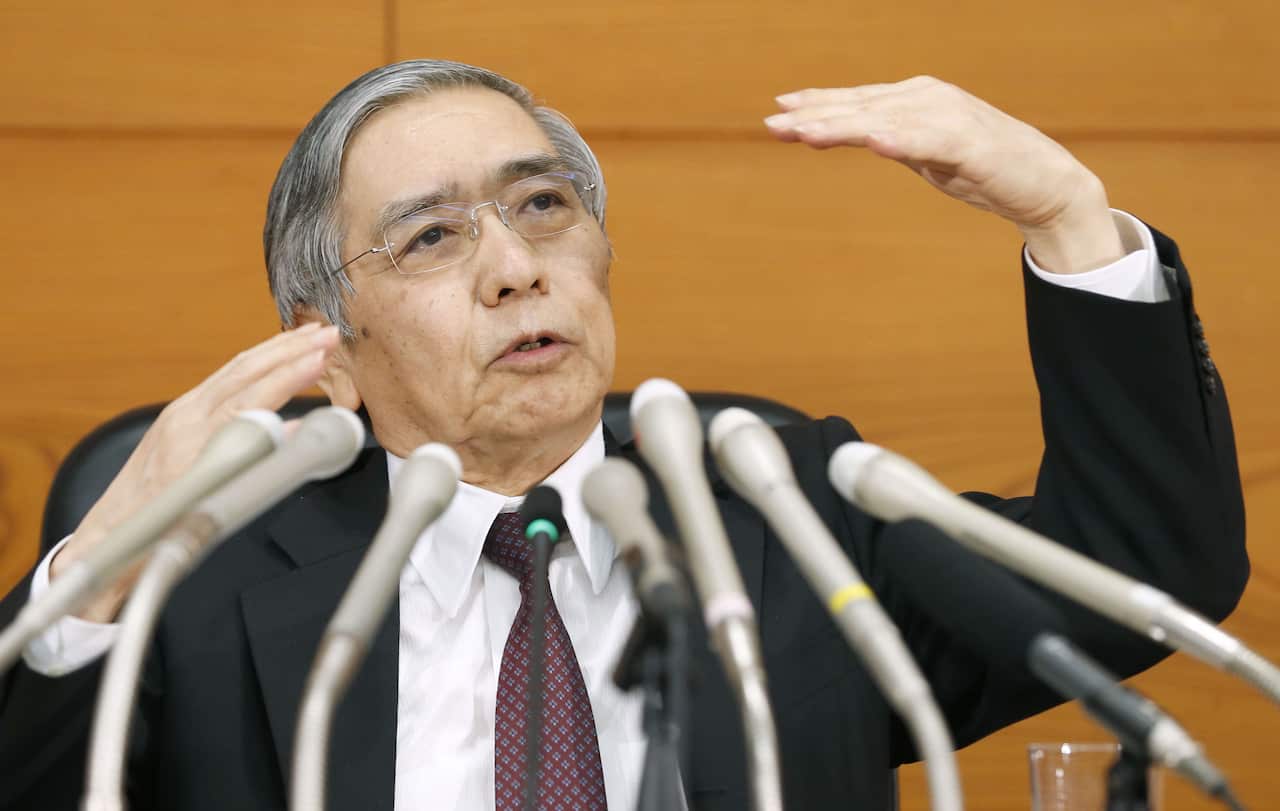
"We're only one month into the year and two of the major central banks have already surprised markets," said J.P. Morgan Asset Management's fixed income CIO in London, Nick Gartside. "The ECB has signalled more policy action in March and the BOJ has moved to negative interest rates, a policy previously thought of as unthinkable."
News that makes sense
Your trusted source for staying up-to-date with the world around you. Get free daily news updates and analysis, straight to your inbox.
European shares tracked Asian stock markets higher, with the pan-European FTSEurofirst 300 index up 0.9 percent, having fallen 1.7 percent on Thursday. Wall Street was expected to open with similar gains.
The MSCI world equity index, which tracks shares in 45 countries, rose half a percent. For the month, though, the index is down 7.5 percent - its steepest fall in almost four years.
"It has become clear that stock markets cannot stand on their own feet," said KBC senior economist Koen De Leus, in Brussels. "As long as the economy is shaky and the world is burdened with high debt, central banks and their money-printing machines are a necessary evil to keep up the markets."
The plunge in Japanese bond yields encouraged other major bond markets. Germany's 10-year Bund yield fell four basis points to a nine-month low at 0.29 percent, on track for the biggest monthly decline in two years.
Two-year German bond yields touched a record low of minus 0.471 percent. The yield on 10-year U.S. Treasuries fell 4 basis points to 1.95 percent.
The dollar was up 0.6 percent against a basket of currencies at 99.174, though still down slightly on the week.
OIL GAINS
The promise of extra global stimulus boosted oil prices, which had already risen for three sessions on talk of a possible deal to curb excess supply.
U.S. crude added about 1.2 percent to $33.61 per barrel and Brent futures also gained 1.2 percent to $34.28. That put oil on track for a second weekly gain, though volatility has climbed to its highest since 2009 as traders try to price in the uncertainty around supply cuts.
Earlier, Japan's Nikkei share index whipsawed on the BOJ announcement before ending up 2.8 percent, to mark a 3.3 percent weekly gain.
The central bank's move gave a lift to stocks across the region, even though economists at HSBC and elsewhere doubted it would do much for Japan's real economy or inflation.
"We do not think negative rates are a game changer," said Commerzbank strategist Esther Reichelt, in Frankfurt. "Pressure on the BoJ will mount to do even more in coming months to attain their inflation target."
MSCI's broadest index of Asia-Pacific shares outside Japan added 1.8 percent, up 2.7 percent for the week .
The buying spread to U.S. debt markets as investors wagered the BOJ decision and a stronger dollar would make it even harder for the Federal Reserve to raise rates four times this year, as originally envisioned by its policy board.
Fed fund futures <0#FF:> rose to imply a rate of 51 basis points by year end, compared with 90 basis points a month ago. Futures for U.S. 10-year bonds <0#TZY:> rose 5 ticks.
"With other central banks easing more, pushing their currencies weaker against the U.S. dollar ... the Federal Reserve will struggle to deliver meaningful rate hikes," said J.P. Morgan's Gartside.







