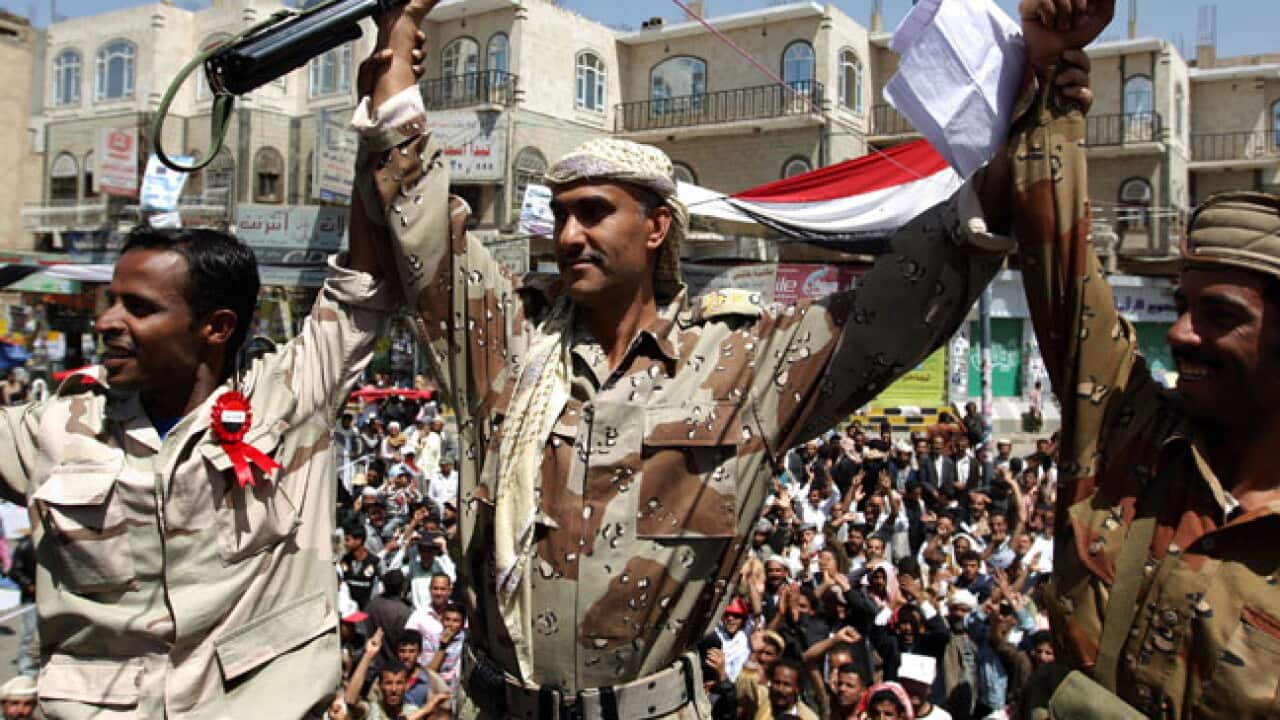
Struggling to hold power after many of his allies abandoned him,
A legislature full of his supporters granted President Ali Abdullah Saleh's request for a 30-day state of emergency, which suspends the constitution, bars protests and gives security forces far-reaching powers of arrest.
The opposition called the vote illegal and vowed to press on with its campaign to topple Saleh's regime.
The move underlined Saleh's desperation in the face of month-old protests that have attracted tens of thousands across his impoverished nation in the southern corner of the Arabian Peninsula.
This week, Saleh's regime was hit by a wave of defections by military commanders, ruling party members and others, swelling the ranks of the opposition and leaving the president isolated.
News that makes sense
Your trusted source for staying up-to-date with the world around you. Get free daily news updates and analysis, straight to your inbox.
Saleh has repeatedly sought to appease the protesters but to no avail.
This month he offered not to run again when his current term ends in 2013, then this week offered to step down by the end of this year and open a dialogue with the leaders of the demonstrators.
At the same time, he has stepped up the use of violence. His security forces shot dead more than 40 demonstrators in Sanaa on Friday, but the bloodshed only escalated the defections and hardened the protesters' rejection of anything but his immediate departure.
The state of emergency declaration appeared to signal that Saleh intends to dig in and try to crush his opponents.
The decree allows media censorship, gives wide powers to censor mail, tap phone lines, search homes and arrest and detain suspects without judicial process.
Over his 32 years in power, Saleh has masterfully played a balance act to keep just enough goodwill from the country's powerful tribes, factions within his inner circle and the military to keep the country together.
A tribal society, Yemen has at the best of times looked like a nation about to come unglued, with the authority of the central government growing steadily weaker outside Sanaa, the capital, allowing local chieftains to run provincial areas as they please.
In the latest evidence of the fast deteriorating security in the country, residents of Shabwa province on Wednesday seized the weapons and vehicles of paramilitary forces deployed at checkpoints in 13 of the province's 17 districts, according to security officials.
The officials said the residents made away with 43 vehicles, assault rifles and ammunition of the troops, whose national commander is a nephew of the president. They spoke on condition of anonymity because they were not authorised to speak to the media.
The United States has looked to Saleh as an ally, though not an entirely reliable one, in the fight against al-Qaeda, but with his ouster growing more likely by the day, there is no obvious successor to the 65-year-old leader.
The most powerful man to emerge so far as a likely successor to Saleh is Major General Ali Mohsen al-Ahmar, a longtime confidante of the president and commander of the powerful 1st Armoured Division.
Al-Ahmar defected to the opposition on Monday and deployed his troops at the Sanaa square where protesters have camped out for weeks.
However, al-Ahmar is known to have close links to militant Islamic groups and, like most Yemenis, may not see al-Qaeda as the unmitigated evil Washington believes it is.
Additionally, his close links to the regime do not endear him to the protesters, who worry that his defection and that of other top regime figures could hijack their "revolution."
"We are fully aware of what is going on around us," said activist and protest leader Bushra al-Maqtari.
"We will not accept a military man to replace another," she said, alluding to al-Ahmar and Saleh, who also has a military background.
Opposition parties allied with the youth groups in the protests said Saleh in part wanted the state of emergency as a legal cover for further crackdowns on the protests.
Opposition and independent legislators stayed away from Wednesday's parliamentary session along with dozens of MPs from Saleh's own ruling party.
Parliament officials said more than 160 of the legislature's 301 MPs were present for the vote, which was done by a show of hands amid chaotic scenes.
But the opposition insisted only about 130 attended, short of quorum, making the vote illegal.
"The vote is illegitimate," said independent lawmaker Abdul-Razzak al-Hijri.







