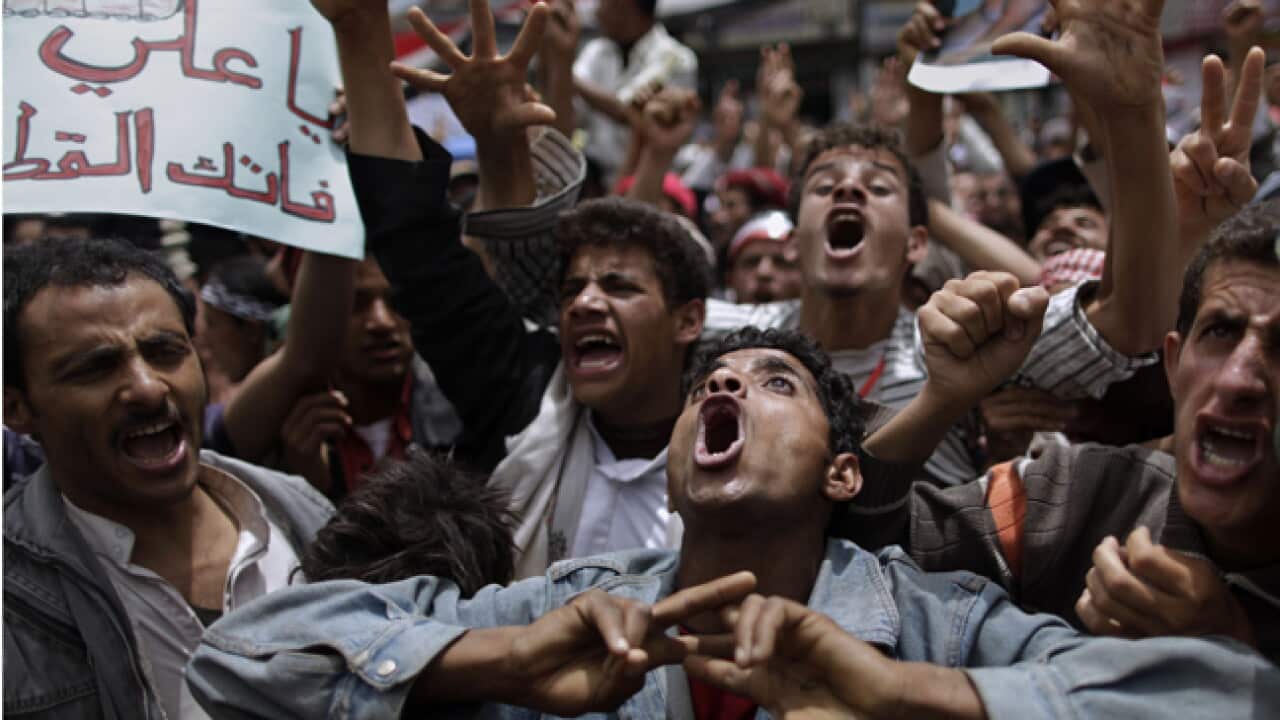
Yemen's protest movement has insisted on President Ali Abdullah Saleh's rapid exit and prosecution after his party accepted a Gulf plan for him to quit in 30 days in a move hailed by Washington.
The United States urged a peaceful transition after Saleh's ruling General People's Congress (GPC) party said late Saturday it accepted a Gulf Cooperation Council (GCC) plan under which he would quit following months of protests.
However, Saleh himself said any change of regime can only be through "ballot boxes and referendums," and said he could not give into a "coup."
News that makes sense
Your trusted source for staying up-to-date with the world around you. Get free daily news updates and analysis, straight to your inbox.
"You call on me from the US and Europe to hand over power," Saleh told the BBC in an interview. "Who shall I hand it over to? Those who are trying to make a coup? No. We will do it through ballot boxes and referendums."
He accused the West of supporting his opponents whom he said were backed by Al-Qaeda.
The opposition Peaceful Change Revolution issued a statement reiterating its rejection of the Gulf plan and demanded that Saleh be prosecuted, contrary to the GCC proposal which calls for immunity.
"The committee... utterly rejects any initiative that would not stipulate the departure of Saleh and his family (from power) and putting him and his staff on trial," it said.
The Gulf plan would see Saleh submit his resignation to parliament 30 days after tasking the opposition with forming a "national accord government" shared equally between the GPC and the opposition.
His resignation would also follow the enactment by the parliament of laws providing "immunity against legal and judicial prosecution of the president and those who worked with him during his rule," the text of the initiative says.
Saleh's deputy, Yemen's vice president, would then take over as interim president and call for a presidential election within 60 days.
The newly elected president would form a committee to draft a new constitution which would be voted on in a referendum, paving the way for parliamentary elections.
The GCC, the European Union and United States would sign the resulting agreement as witnesses.
Saleh's party said on Saturday it accepted the plan in its "entirety."
Yemen's parliamentary Common Forum opposition coalition also welcomed the Gulf plan, but insisted Saleh has to go before a national unity government is formed.
The protesters' statement on Sunday slammed the Common Forum position, however, saying it "represents only itself."
The committee urged the Common Forum "to refrain from entering into dialogue with Saleh and his regime, and to merge fully with the revolution, and call clearly for an immediate departure of Saleh and a speedy trial of his regime."
The White House on Saturday welcomed the plan for Yemen's long-time president to step down, urging all sides to "swiftly" implement a peaceful transfer of power.
Washington also urged "all parties to move swiftly to implement the terms of the agreement so that the Yemeni people can soon realise the security, unity, and prosperity that they have so courageously sought and so richly deserve."
Officials in Washington, which has regarded Saleh a key ally in its fight against terrorism, are alarmed at the fallout in Yemen, where Al-Qaeda has already exploited the violent power struggle between Saleh and his opponents.
More than 130 people have been killed in clashes with security forces and Saleh supporters since protests broke out in late January.
In Yemen's southern province of Lahij, fresh clashes broke out between armed tribesmen and Republican Guard forces on Sunday, killing nine people, six of them soldiers, police said.
The renewed fighting erupted in the same area where eight people - six tribesmen and two soldiers - were killed three days ago, police said.







