
A WARNING THAT THIS STORY MAY BE DISTRESSING FOR SOME LISTENERS. An alleged triple murder in south-west Sydney has prompted renewed calls for a Royal Commission into femicide. It comes amid ongoing strain on women's shelters and other frontline services, with calls for greater funding. The government has embraced the aim of ending gendered violence within a generation - but advocates say that won't be achieved without greater effort.
Listen to Australian and world news, and follow trending topics with SBS News Podcasts.
TRANSCRIPT:
On Tuesday morning, Australia woke to the news that a woman and two boys, aged four and 12, had been found dead by police in Sydney's south-west.
Acting Superintendent Michael Moroney says officers were called to an address in Campbelltown shortly before 8pm Monday.
"Police attended within three minutes where they were confronted with that scene with the three deceased persons."
A 47-year-old man has been charged with three counts of domestic violence related murder.
"Look at this stage, I understand that it is his wife, is one of the deceased, and the two other deceased children, I believe that they are his children."
The incident occurred one day after the end of a statewide sting targeting offenders with a history of domestic violence, which saw police charge over 900 people.
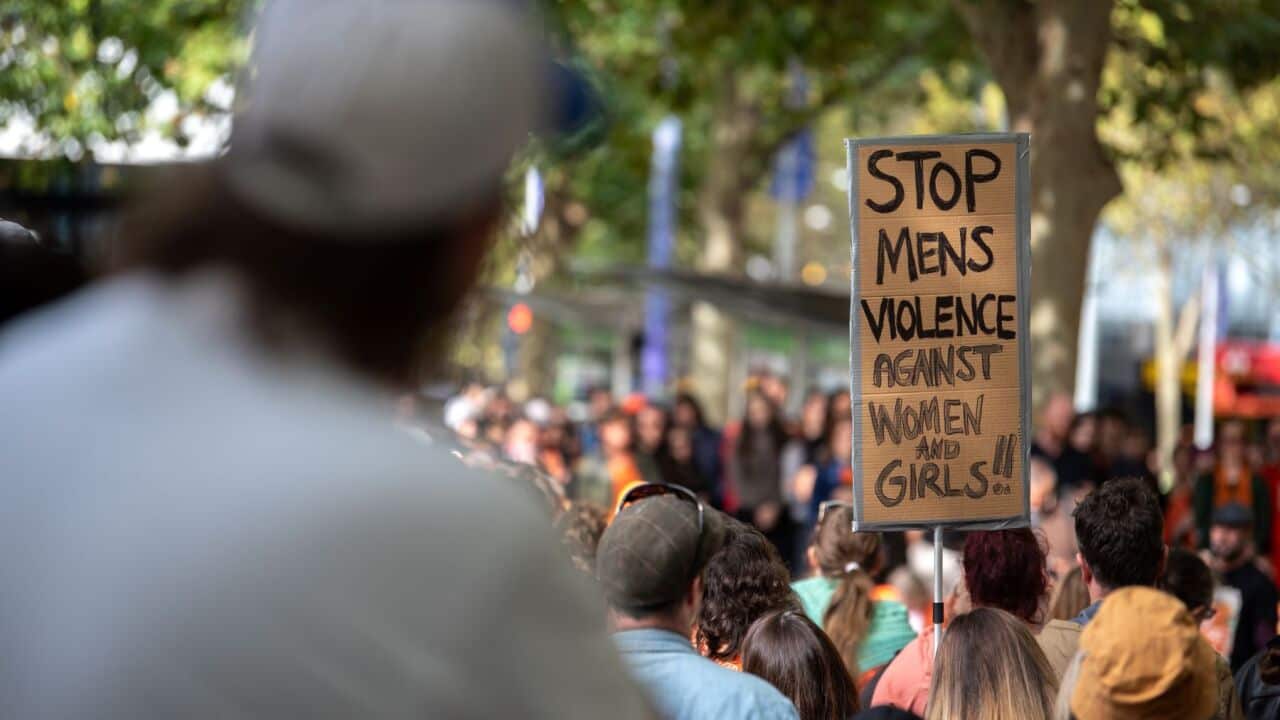
That operation has once again highlighted the prevalence of men's violence against women.
Sherele Moody is the founder of Australian Femicide Watch.
"I track the killing of all Australian women and children. So that means that while a significant number of the women killed and children killed will die as a result of domestic and family violence, around 40 per cent of the victims that I document are lost to other forms of violence, those being associate violence and stranger violence."
Her organisation has documented the deaths of nine children and 29 women already this year.
She is calling for a Royal Commission into the killing of Australian women and girls.
"It would lay bare the systemic failures that underpin the violent deaths of women and girls, and the only way we can understand those failures is to listen to the stories of the families who've lost victims. We'd look at what the reality of the funding levels that we need. We are nowhere near the funding levels that should be in place. We'd look at the flaws in the legal system, in the policing system."
Ms Moody says the Royal Commission would also allow victims and their families to tell their story, with a focus on diverse, marginalised and multicultural voices.
More than 93,000 people have signed a petition calling for a Royal Commission, but on Monday, Prime Minister Anthony Albanese dismissed the idea.
"There's calls for a Royal Commission about everything."
In an interview with Christie Hayes on Hobart's Hit 100.9, the Prime Minister has said that's the wrong way forward.
HAYES: "Well, I think deaths of women are pretty paramount, wouldn't you say?"
ALBANESE: "Yeah they are, but you've got to work out what does a Royal Commission do, besides fund lawyers. What we need here is solutions that we know, we know what they are. We know what's required here, and I understand that people, when confronted with an issue, will call for Royal Commissions, but we know that there's too much violence against women. We know what keeps women in these relationships, we know what's required in terms of the economic support to get out. We know there's a need for more alternative housing. We know there's a need for more counselling and for community workers. And we need to get on with action."
Mr Albanese says his government has invested $4.4 billion towards ending gendered violence, citing a range of measures introduced over recent years.
These include $100 million for crisis accommodation, and 10-days paid family and domestic violence leave.
The government has also introduced a $5,000 leaving violence payment, and put on an additional 500 family and children violence workers.
The PM's response hasn't convinced Sherele Moody.
"If you listened to Albo's interview, and I'm not just talking about his wholesale dismissal of a Royal Commission into femicide, I'm talking about the way he framed his language. It was really out of date."
She says years of documenting femicide and sharing the stories of women killed have shown her there are systemic failures a Royal Commission could help expose.
"I have documented more than 3,000 deaths in the 11 years that I've been documenting femicide and child deaths. This is one of the things that is very clear to me. No matter what the government has invested in keeping women safe, it's not working. It is not even touching the sides."
But not everyone in the sector agrees a Royal Commission is the right response.
The National Alliance of Domestic and Family Violence Specialists has said in a statement it understands the call, but argues there's no time to wait for another report.
National Domestic, Family and Sexual Violence Commissioner Micaela Cronin agrees.
"We have thousands of recommendations and we don't need more reviews. We need more action. I understand the call and I understand what's behind it and I am enormously supportive of the work of Sherele Moody and others that are advocating for this. It's complicated."
She says the sector has voiced its concern a Royal Commission could lead to delays while the government waits on recommendations.
The Commissioner says she's pushing for greater alignment between Commonwealth, state and territory governments; transitioning towards a whole-of-government approach; and more stable funding.
She wants to see more energy and resources invested into a second 10-year action plan that is being developed.
"The intent and the objective is to end domestic family and sexual violence in one generation. So it's a very ambitious goal."
The first plan aimed to reduce gendered violence, and Commissioner Cronin says that work laid important foundations.
"We've seen very significant investment in big infrastructure changes. So the establishment of ANROWS, the Australian National Research Organisation for Women's Safety, Our Watch, the big national organisation that is focused on prevention, 1800-RESPECT, the national helpline, and the Escaping Violence Program. So we've seen some big structural things put in place."
She says next national action plan will also increase the priority placed on prevention, and stopping gendered violence at its source.
Phillip Ripper is the Chief Executive of No to Violence - an organisation working to end men's use of family violence.
Like Sherele Moody, he's pushed back against the Prime Minister's opposition to a Royal Commission.
"It's easy for him to say, 'We know what needs to be done.' If that's the case, why isn't he getting on and doing it? That's the real question here. If he's not going to support a Royal Commission, what is he going to do? How is this government going to address the issue of women dying week in, week out at the hands of men?"
But he says while there have been a slew of reviews, inquiries, and state-based Royal Commissions, a Commonwealth Royal Commission could help shift the dial.
"They do provide a genuine point of focus. They create an urgency. They create an authorising environment for action. But if this government is not committed to act, then a Royal Commission is pointless. So the real question here is what will this government do to keep women and children safe? At the moment, it's inaction after inaction after inaction and it's simply not good enough. And if it takes a Royal Commission to get this government off its hands to take this issue seriously, then we support a Royal Commission."
The idea has garnered some support among parliamentarians too, including from two independents; senator Lidia Thorpe, and the member for Warringah, Zali Steggall.
"I strongly supported the call for a Royal Commission because I genuinely don't think we are ever going to get the scale of commitment necessary to eradicate the problem from the government until it's exposed in a Royal Commission where you have a full analysis of what is working, what is not working, and is the scale of funding and commitment even close to what is really needed."
She argues a Royal Commission elevates an issue to national prominence, and the fact there hasn't been one so far send a signal that the lives of women and children aren't being prioritised.
Ms Steggall says New South Wales has seen a 49 per cent surge in high-risk referrals, and cites financial stress, alcohol availability and gambling as factors where there should be reform.
Last week's federal budget also confirmed her view that, on the whole, the sector is being underfunded.
"Yeah, look, the 2026 budget had a good announcement as standalone First Nations domestic violence plan of 218 million, which is good. We know domestic violence is an even bigger problem in First Nations communities and they are more at risk. There was also a commitment of 182 million over four years around the weaponisation of the child support scheme. So I had been advocating for that. I very much support it. But where it's falling short is the scale of support needed."
Greens leader and spokesperson for women Larissa Waters agrees.
"It's pretty clear that what we're currently doing isn't working. We haven't seen a change in the rates of those murders and that violence, whether it's domestic, family or sexual violence against women. The rates are not coming down. And so it's pretty clear we need to do something differently. In the budget, there was absolutely no new money for properly funding the National Action Plan that we have Federally to end violence against women and children."
She says this will have material impacts on the ground.
"We hear from the women's safety sector that there's still not enough funding for them to help everyone who reaches out for their help. They are still turning away on average one in five women who reach out for help to stay safe. Now that is appalling."
On the question of a Royal Commission, she says the Greens will be led by the sector.
"If the women's safety sector wants a Royal Commission, then the Greens would support that. At the moment it sounds like they acknowledge there's been a lot of reports and inquiries already with calls for action that haven't been acted on. But I understand there's a range of views and people are worried that a Royal Commission would simply delay the urgent funding that's needed for frontline response services and for prevention programs right now."
Commissioner Cronin acknowledges stretched services are having to turn some women away, and achieving the goal of ending gendered violence in a generation will take a herculean effort.
"I think we need to direct our efforts into ensuring we have a really aligned second action plan. I think Royal Commissions are expensive. They take time. It would delay the ... I am concerned there isn't enough investment. I'm concerned that we need to invest more effort and resources into implementing the second action plan."
She says the aim is to launch it next year.
.
If you or someone you know wants to talk about family or domestic violence, call 1800RESPECT on 1800 737 732 or call Lifeline on 13 11 14. In an emergency, call 000.
For culturally appropriate Indigenous support call 13 YARN.. a 24 hour national telephone helpline on 13 92 76 which provides support across a range of issues including mental health. https://www.13yarn.org.au/
The Men’s Referral Service is operated by No to Violence, and can be contacted on 1300 766 491.