
South Australia may be facing Australia’s first mass wildlife death event linked to H5N1 bird flu. More than 80 sick or dying greater crested terns have been found on an island off the South Australian coast. Nationally, the government says the virus can no longer be eradicated. While the risk to human health remains low, native species could be hit hard.
Listen to Australian and world news and follow trending topics with SBS News Podcasts.
TRANSCRIPT
South Australia has reported what could be the first mass-mortality event in local wildlife as the H5N1 strain of bird flu establishes itself in native wildlife populations.
"What is of a concerning new news that has come through is that we have 49 dead, and 35 sick greater crested terns that have been reported off of Cape Jaffa."
State Environment Minister Emily Bourke says those cases have not been confirmed, but samples have been sent for testing and bird flu is likely the cause.
"And would provide a significant change in our response and understandings of the impact on wildlife here in South Australia. As we've always said, we knew this was going to happen. We always knew that there would be impact and significant impact potentially on our wildlife. And what we are seeing now is just this week particularly is there has been a change in those numbers going from migratory to localised spread, and now potentially into large numbers around our coastlines."
South Australia currently has 40 confirmed cases, compared with 14 across Western Australia, Victoria, New South Wales and Queensland.
That brings the national total to 54, but those numbers are expected to rise quickly as the disease spreads through local wildlife populations.
"There's a tsunami of devastation about to break over Australia's wildlife."
Jack Gough is the CEO of the Invasive Species Council.
"In particular our birds, but also many of our mammals, particularly sea mammals like sea lions, seals, and scavengers like Tasmanian devils. Unfortunately, the picture from overseas has been this is a very fast spreading, highly deadly virus when it gets into wildlife."
He says the virus swept through the entire South American continent within six months.
"Wiping out hundreds of thousands of birds, tens of thousands of sea mammals. That's the picture that we are facing in Australia."
South Australia's Chief Veterinary Officer Skye Fruean says it's likely there are more than 35 sick greater crested terns roosting on the infected island.
There are already hundreds, possibly thousands of birds at the site, as the species prepares to roost in large colonies to breed over the coming months.
With the virus transmitted by contaminated fluids, droppings and feathers, the number of deaths is expected to rise.
"So there's large numbers of these birds, and if they're congregating, it can spread quite easily. So my expectation is we will see more infection and so more sick and dead crested turns, unfortunately, yes."
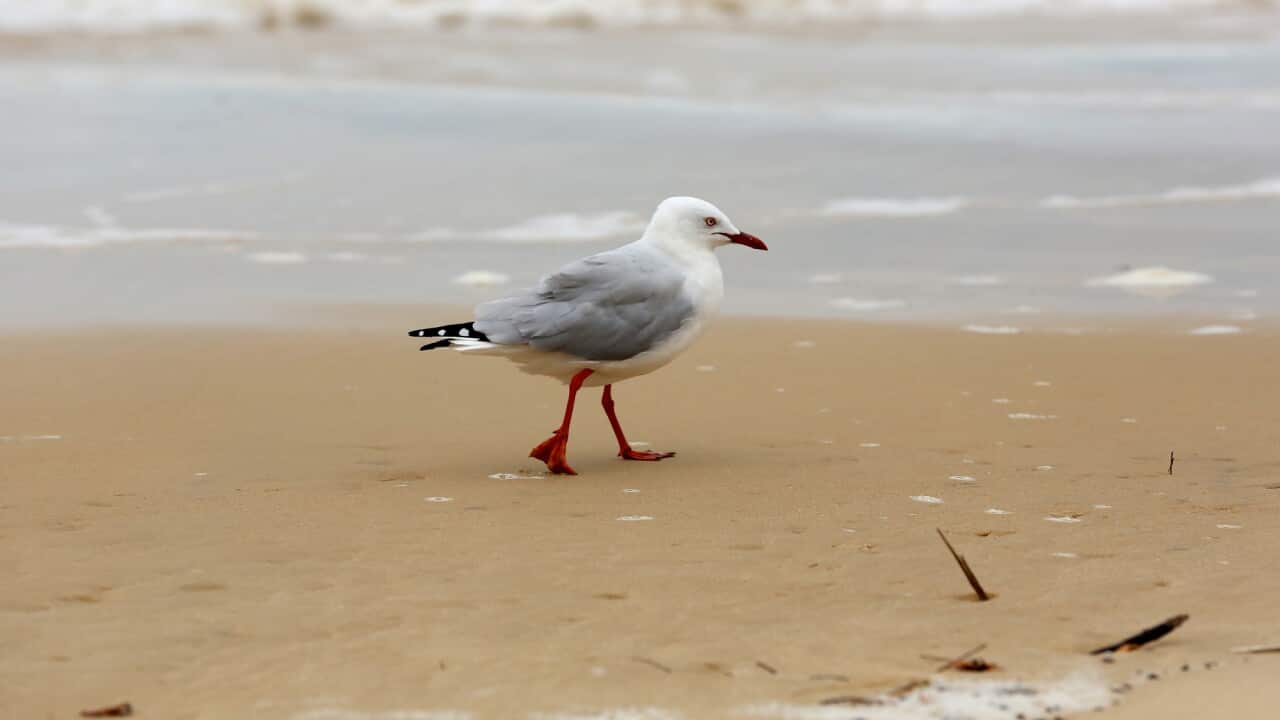
The virus has also been confirmed in a silver gull, or a common seagull, with three more suspected cases being tested for confirmation.
That's bad news, according to infectious disease ecologist at Griffith University, emeritus professor Hamish McCallum.
HAMISH MCCALLUM: "I mean, it's not surprising, but it's bad news."
TEE MITCHELL: "Why is it bad news?"
HAMISH MCCALLUM: "Well, because seagulls are ubiquitous. They're very, very common. They do scavenge. They mix with lots of other water bird species. They also, of course, you know, you see them just in the cities mixing with other birds. So when it gets loose in seagulls, it's likely to spread to a number of other bird species quite quickly."
The virus could also spread to scavenging mammals, sparking longer-term fears for species like the Tasmanian devil.
Professor McCallum says seals and sea lions are another obvious concern.
"Because there have been mass mortalities of seals on some sub-Antarctic Islands, including Heard Island, which of course is Australian territory, and also in South America. And the evidence is very good now that it does spread from seal to seal."
There have already been five positive cases among birds at Seal Bay, on Kangaroo Island, off South Australia's coast.
It's a critical colony for the endangered Australian sea lion, in an area already hard-hit by the state's algal bloom.
Jack Gough says other seal species have been severely impacted overseas.
"We saw in South America, Cape Valdés, 95 per cent of all elephant seal babies dying in one year, whereas the year before it was 1 or 2 per cent death rate. So that means you're seeing seals, sea lions dead on beaches, birds essentially falling out of the sky and turning up dead. The public won't miss this. It is going to be very visible."
A national plan covering issues like surveillance, investigation, technical assessment, and public information has now been activated.
That's based on the assessment it's no longer technically feasible to eradicate the virus.
Environment Minister Emily Bourke says South Australia is well prepared.
"So we're working really closely with the federal government. As we've heard many times in these press conferences, over $113 million has been provided by the federal government across the country to make sure that we can roll out those programs."
Jack Gough says government biosecurity responses have been strong across the country, aided by years of preparation, as Australia learned from the experiences of other countries.
But he says more needs to be done to ensure populations remain resilient against the coming strain.
"So we are calling on the Albanese government to urgently invest at least $200 million in wildlife resilience. And that's an investment in the other things you can do to protect wildlife, like removing feral foxes and cats and rats off islands where you've got large bird congregations, making sure there's good habitat connectivity, that we get good breeding events, that there's wetlands that are well watered so that bird numbers can be higher when this wave breaks across them and causes devastation that will be on the scale of the black summer bushfires."