
Australia and Vanuatu have signed a 500 million dollar strategic agreement - the first ever inked between the two countries. It positions Australia as the Pacific country's security partner of choice, but it's a weaker treaty than the Australian prime minister originally hoped for. China has expressed concern the deal targets China, warning Australia against playing "geopolitical games".
Listen to Australian and world news and follow trending topics with SBS News Podcasts.
TRANSCRIPT
"You are very welcome/ Good to be here. Beautiful. Now come in, and we'll sign the book here."
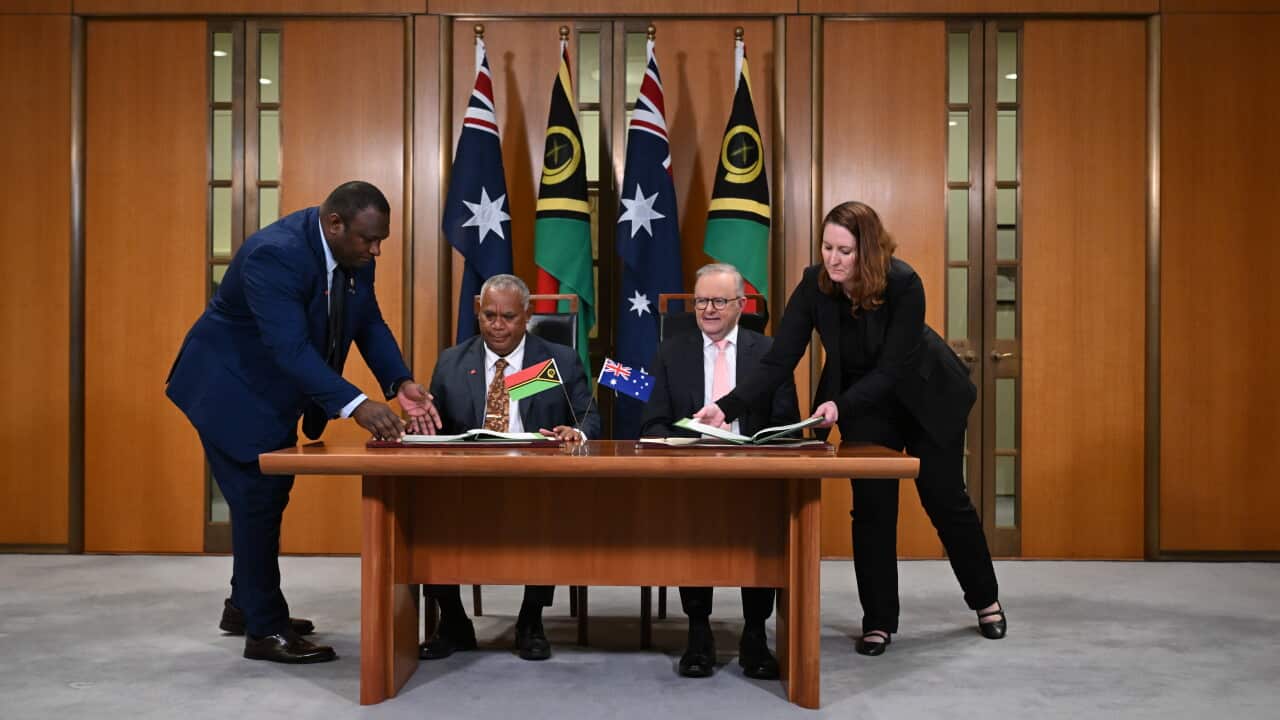
Prime Minister Anthony Albanese and Vanuatu Prime Minister, Jotham Napat, sharing a handshake ahead of signing a 500 million dollar strategic agreement.
The Nakamal Agreement has been inked almost 10 months after Mr Napat pulled out of a signing ceremony.
At the time, he expressed concerns the deal would undermine Vanuatu's sovereignty, and stifle investment deals with other nations, namely China.
But this time around, Vanuatu's Prime Minister says the deal reflects the two countries shared vision for a peaceful, stable and prosperous Pacific.
Prime Minister Albanese also says its a win for both parties.
"Australia and Vanuatu are close neighbours, trusted partners, and enduring friends. Today's meeting reaffirms our shared commitment to continue to strengthen the comprehensive partnership between our two countries."
"Above all, it is built on an equal partnership. We've concluded a balanced agreement that will protect out collective and individual security, and our sovereignty. And it will support our interest in a stable, prosperous and secure region, that we both call home."
The agreement cements Australia as the Pacific island nation's primary aid and policing partner.
It also includes a provision that Vanuatu will consult with Australia when it considers third-party engagement in its critical infrastructure, but there is no power of veto as Australia originally proposed.
Mr Napat says Vanuatu has decided, however, it will not permit its territory to be used for any foreign military base or infrastructure.
"We have as a nation, as a country, we have in fact passed an Act in Parliament not to allow any militarisation to actually be used for our critical infrastructure."
Speaking to ABC News Breakfast, Foreign Minister Penny Wong has called the deal a 'transformational breakthrough' in Australia's relationship with the Pacific.
"There will be more to come. There will be more to come and that's because we are determined to continue to engage and formalise our arrangements and relationships with the countries of the Pacific."
While the deal waters down some elements of the deal Australia initially proposed, namely to curb China's influence in the region, Ms Wong says it strengthens Australia's strategic position.
"We're in a permanent contest in the Pacific, a permanent contest for influence. We are very pleased that we have, after a lot of negotiation and discussion, signed the agreement yesterday between the two prime ministers, that confirms Australia's place as Vanuatu's principal economic, security and development partner."
Foreign policy analysts say the security deal could also strengthen Australia's ability to compete economically in the Pacific.
Both countries have agreed to facilitate links between private sectors, with Australia committing to support Vanuatu's domestic labor market through training assistance, as well as Vanuatu's participation in the digital economy.
Lowy Institute Pacific Islands Program Director Oliver Nobetau says this part of the agreement bolsters Australia's ability to rival China's economic influence.
"Something that you don't always see is that there's a strong commitment within the agreement as well for private sector linkages to assist with propping up Vanuatu's economy. And that's a key win for Australia to ensure that it has a say, or that it can direct Australian investment going into Vanuatu. And that's a key area that we've been seeing competition with other countries as well, where there's a lot of Chinese investment."
China's foreign ministry spokesperson Guo Jiakun says he's concerned that the agreement targets China, warning Australia against playing "geopolitical games."
"China has always adhered to the principles of mutual respect, equality, mutual benefit, openness, and inclusiveness when carrying out practical cooperation across various fields with Pacific Island countries, including Vanuatu. We hope that cooperation between relevant countries and Pacific Island countries will contribute to the development and stability of the island region, not target any third party or be used as a tool for geopolitical rivalry."
Vanuatu is also currently finalising a separate deal with China, the Namele agreement.
Prime Minister Napat says he will be forthcoming with the details when it is officially signed.
"It is not yet signed. We will share the agreement. There's nothing to hide. Our government is transparent."
Mr Nobetau says when this agreement with China is published, Vanuatu's regional priorities will be made clear.
"There's a risk that the Australian government does take on in that, where it can be a partner of choice on paper, but no country really is limited from engaging with other countries as well. Until we see the actual copy of the Namele agreement, we won't know the full on extent to that."