
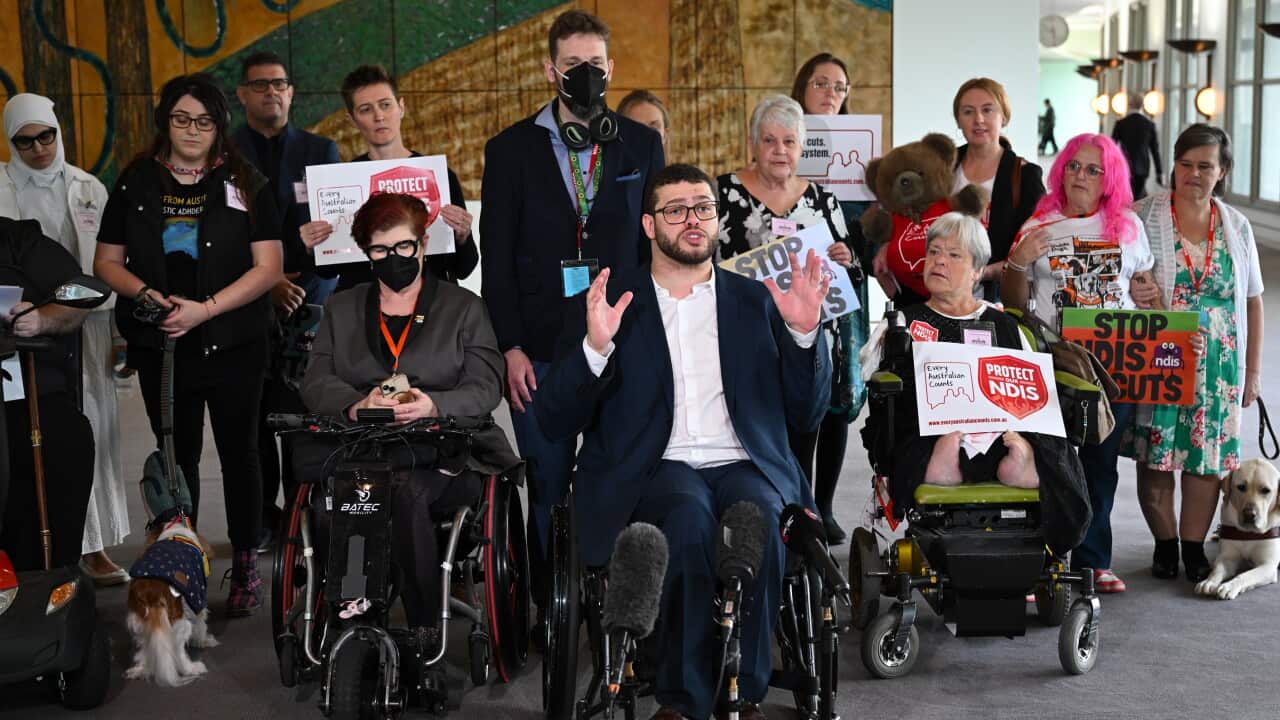

The Federal Government, Greens and Coalition are gridlocked over post-budget measures on tax and the NDIS - with just one sitting fortnight remaining before Parliament rises for a five-week Winter break. As negotiations continue, participants in the NDIS are facing an anxious wait, with the scheme set for a major overhaul, including significant cuts.
Listen to Australian and world news, and follow trending topics with SBS News Podcasts.
TRANSCRIPT
The Coalition has left the door open to work with the Greens to extend two separate Senate inquiries into post-budget reforms looking at tax changes and the National Disability Insurance Scheme.
The Greens want more time to scrutinise structural changes and cuts to the NDIS; the Coalition is keen to air concerns around negative gearing, the capital gains tax discount, and trusts.
Jane Hume is the deputy Liberal leader.
"Well, the government's approach to scrutiny of these bills has been nothing short of scandalous. This is a government that promised transparency and accountability. It was one of its commitments on returning to government, and yet it has done the exact opposite. All the Senate is expecting is the opportunity to scrutinise legislation, which is what the Senate's job is. That's our job."
She says the Coalition broadly supports overhauling the NDIS but doesn't see why major reform should be rushed.
"I don't think that we should be afraid of having longer inquiries and better scrutiny, deeper scrutiny of any legislation, whether it be the tax reforms that have gone through, so-called reforms, the tax increases that have gone through, or whether it be through quite far-reaching changes to the NDIS. Now, let me be really clear, the Coalition supports improving integrity around the NDIS, it's a program that has run out of control and is becoming unsustainable. It's going to cost Australians too much and potentially put those that are most vulnerable at risk, but at the same time we want to make sure that the way that that integrity is being imposed is appropriate and isn't leaving anybody behind."
For the government, the pressure to pass the reforms largely comes down to savings banked in Treasurer Jim Chalmers' fifth federal budget.
Dr Sam Bennett is the Disability Program Director at the Grattan Institute.
"Well, it's going to have a very significant impact. As you said, I think whilst there's been a lot of focus on other aspects of the most recent federal budget, the tax reform elements in particular perhaps, there's a strong argument that the NDIS savings in that budget are the single biggest component of it. As you said, more than 37 billion, I think it is. It's more than a third of the overall savings in the budget. And obviously if those savings don't materialise over the forward estimates as is expected, then that will have a significant knock-on impact."
Dr Bennett says there are good elements in the government's reform package, and structural reform is necessary to constrain runaway spending growth.
On Friday, NDIS Minister Jenny McAllister told Senate estimates structural changes are needed to secure the scheme's sustainability in the long-term.
"At the outset, I want to establish that the Albanese government remains committed to the long-term sustainability of the NDIS and ensuring that it continues to provide life-changing supports for people with permanent and significant disability."
The government has introduced a bill that would see at least 160,000 people moved off the scheme by 2030 - and wants to pass the legislation before Parliament rises on July 2.
SBS News understands the Greens have told Labor that it would cross a 'red line' for them if the bill passes within that time.
On Friday, Greens Senator Jordan Steele-John accused Minister McAllister of framing the overhaul as measures to tackle fraud, rather than cutting supports for participants.
Jenny McAllister: "It is not correct, Senator Steele-John, to assert, as you have done, that this package doesn't tackle fraud.
Jordan Steele-John: "What the community is doing, and what I am doing here on their behalf, is following the money as detailed in your documents presented to the Senate in response to my OPD, which demonstrate that far less than $5 billion of the overall amount of money that is placed and bookmarked as going back to the budget from NDIS cuts come from anti-fraud measures."
Jenny McAllister: "I'm struggling to understand your logic, because as I've said a number of times now, when we tackle fraud, the saving goes to the participant rather than to government. That's why you don't see those numbers in the budget, Senator."
Jordan Steele-John: "It's been noted not only by myself but across the parliament that there's been a lot of rhetoric around anti-fraud and a lot of focus on it, and while we welcome the focus, we question why there is so little substance in this bill when it comes to anti-fraud measures."
Sam Bennett agrees fraud and integrity have been central to the government's narrative around the need for reform, but says this only accounts for around two per cent of the projected savings.
"But I think it is also really important to know that whilst these measures are important, it doesn't really amount to a hill of beans in terms of the cost trajectory, because fraud is not the reason the NDIS is unsustainable. The reason the NDIS is unsustainable is some of those other big structural problems that some facets of the current legislation seek to fix."
He says most of the savings proposed within the next two years - around $13.2 billion - will come from cuts to social and community participation.
"And that's because some of those other measures, those ones that are really fixing big structural problems with the NDIS are going to take longer to design and to implement and to enable that cut that I've just described to happen, the bill that's with the Senate at the moment would give the minister or indeed any future minister essentially a power to arbitrarily reduce funding for whole groups of support anytime they deem it necessary for the schemes financial sustainability. So, the focus at the moment might be on those social and community participation budgets, but it could be anything within the scheme really in future."
The government is proposing a 50 per cent cut to those social and community participation supports, which allow NDIS participants to leave the house, connect with others, or take part in everyday life.
Foundational supports for people who don't meet NDIS eligibility criteria are being restructured as well, notably through the Thriving Kids program for children with autism or developmental delays.
States and territories expected to provide services by the time a new assessment methodology starts in January 2028.
"It places a huge onus on states and territories and the federal government getting their skates on to ensure that these services are in place in time for those changes, because people will fall through the gaps if that doesn't happen."
The Senate inquiry into the NDIS will hold public hearings next week and report back by June 16.