
China has successfully docked its Shenzhou-23 spacecraft with the Tiangong space station, after a dramatic overnight launch from the edge of the Gobi Desert. The mission carries three astronauts into orbit, including the first astronaut from Hong Kong, and one crew member expected to remain in space for a full year, double the usual duration of previous Chinese missions.
Listen to Australian and world news, and follow trending topics with SBS News Podcasts.
TRANSCRIPT
China has successfully docked its Shenzhou-23 spacecraft with the Tiangong space station, after an overnight launch from the edge of the Gobi Desert.
The mission has carried three astronauts into orbit, including the first astronaut from Hong Kong, and one crew member expected to remain in space for a full year, double the usual duration of previous Chinese missions.
At the Jiuquan Satellite Launch Centre in northwest China, a ceremony is held before launch.
Like the mission itself, it is precise, tightly choreographed and deeply symbolic.
Minutes before blast-off, mission commander Zhu Yangzhu formally reports to senior officials that the crew is ready to fly as crowds look on, waving Chinese flags.
MISSION COMMANDER: "Comrade commander-in-chief, we are following the order to implement the Shenzhou-23 manned spaceflight mission. And we are now ready to go, please give instructions! Astronaut Zhu Yangzhu. ... Astronaut Zhang Zhiyuan. ... Astronaut Lai Ka-ying."
OPERATIONS COMMANDER: "Proceed!"
ZHU: "Yes!"
Moments after boarding vehicles bound for the launch pad, Commander Yangzhu says the support from ordinary Chinese people is what uis driving the mission forward.
"We can really feel everyone's enthusiasm, and we are deeply grateful to our motherland. As we embark on our space mission representing our country, we will spare no effort to succeed."
Fellow astronaut Zhang Zhiyuan promises the crew will live up to expectations.
"Thank you to our country and the people for your support. We will certainly live up to our mission. Let's do our best!"
And Lai Ka-ying, the first astronaut from Hong Kong to fly for China, says the moment still feels surreal.
"I feel great, and I can really feel everyone's enthusiasm. China's space station, here I come."
The astronauts then board the rocket, are strapped in and ready for the blast-off sequence leading up to the final countdown.
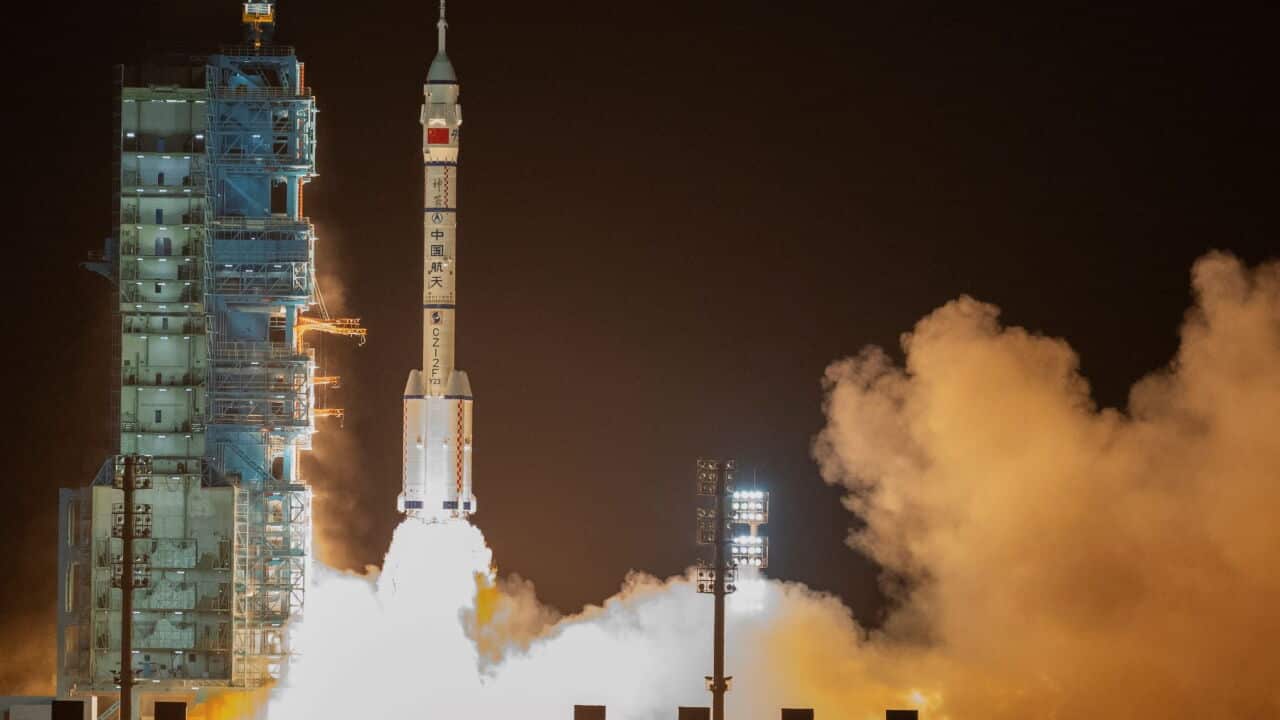
Then the Long March-2F rocket ignites beneath Shenzhou-23 - and lift-off.
The spacecraft lifts into the night sky at 11:08pm Beijing time.
Just minutes later, the rocket boosters peel away.
Inside the capsule, the crew monitors systems and flight data as Mission Commander Zhu Yangzhu radios back to Earth.
"Shenzhou-23 crewed mission is reporting that the atmosphere in spacecraft cabin is normal and the astronauts are in good condition. Over."
At the Beijing Aerospace Flight Control Center, engineers and scientists erupt in applause as telemetry confirms the spacecraft has entered its planned orbit.
Then comes the official announcement from the Jiuquan launch centre.
"Distinguished superiors and comrades, according to the rocket's flight data and calculations by the Beijing Aerospace Flight Control Center based on monitoring data, the Long March-2F Y23 carrier rocket has accurately sent the Shenzhou-23 manned spacecraft to the predetermined orbit. The spacecraft is functioning normally. I hereby announce the Shenzhou-23 manned spacecraft launch mission a complete success."
But the launch is only the start.
Just three-and-a-half hours later, Shenzhou-23 docks with China’s Tiangong space station, where the new crew takes over from astronauts who’ve already spent more than 200 days in orbit.
Their mission includes spacewalks, maintenance work and experiments on everything from human health to life in microgravity.
And in a first for China’s space program, one astronaut is expected to remain aboard for a full year, a major test for Beijing’s long-term goal of putting astronauts on the Moon by 2030.
Tiangong, meaning “Heavenly Palace”, became fully operational in 2022, after China was effectively shut out of the International Space Station over U-S security concerns.
Now, with NASA also racing back to the Moon, Shenzhou-23 is another sign China’s space program is no longer experimental, it’s operational.