

The latest Closing the Gap report from the Productivity Commission reveals that just one of 19 socio-economic targets has been achieved. At the halfway point of the agreement, Indigenous organisations say community collaboration and investment in children are both crucial to addressing disadvantage.
Listen to Australian and world news and follow trending topics with SBS News Podcasts.
TRANSCRIPT
Upon hearing the progress of the government's Closing the Gap agreement, Indigenous organisations say one thing is clear: successfully Closing the Gap requires investing in children and listening to the community.
"If we fail, then we have failed children. That's the truth of it. And we have not only failed children, we've failed their families, and we've failed the communities that they live in."
Speaking to NITV, Arrernte and Luritja woman Catherine Liddle is the CEO of SNAICC, the national non-governmental peak body for Aboriginal and Torres Strait Islander children.
At the halfway point in the agreement, the Productivity Commission report shows that only one of the 19 targets laid out has been met.
The one target surpassing goals is pre-school enrolments, reaching over 95 per cent in 2025.
Catherine Liddle says while this is promising, it's far from enough.
"So the preschool figures are good, and they should be celebrated, but it is an example of the tale of two stories. So one is, on the outside, preschool enrollment looks fantastic. So think about that as the outside of the car. If you lift up the hood, that's where you see the failings in early education and care, and that means that we didn't invest soon enough."
While the pre-school enrolment rates are being welcomed, the report shows that childhood development is going backwards.
In 2024, just 33.9 per cent of First Nations children were assessed as being on track when they started school, down from 35.2 per cent in 2018.
Catherine Liddle says disadvantage can't be addressed unless children are invested in early.
"So if children are not enrolling with all the skills that they need to be successful on their early learning journey, then you can expect that those gaps and the cost of the impact of those gaps gets increasingly bad throughout that child's journey, throughout that family's journey, throughout that community's evolution. So it is actually really, really critical that the government pay attention to that. It's why SNAICC fought very hard for early education and care to be one of the critical statistics. So what it shows us is government can change, government can lean in. Aboriginal communities value early education and care, and when they have access to it, they use it, but we're not getting in soon enough."
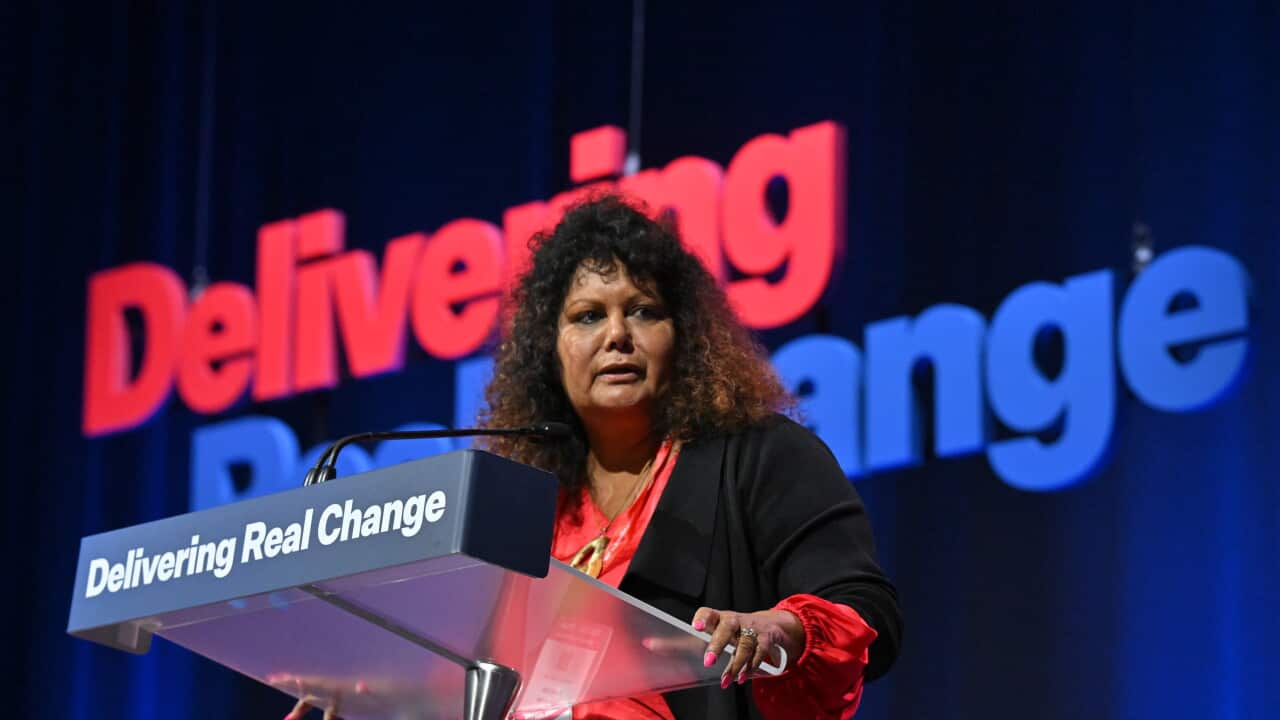
Speaking to ABC Radio National, Indigenous Affairs Minister and Yanyuwa and Garrwa woman Malarndirri McCarthy says success in this area would not have been possible without the work of community organisations.
"It is important to see this milestone achieved, and that is because of the work of the Aboriginal community controlled sector and those involved in the preschool sector. So it is a contribution that shows it can be done. Clearly, the challenges with all the other targets remain, but I do take heart at the fact that this has been achieved for target three."
One of the four areas going backwards is out of home care.
In 2025, almost 21,000 Aboriginal and Torres Strait Islander kids were in out-of-home care, a rate of 52.2 per every 1,000.
According to figures from SNAICC, that's roughly 9.5 to 11.5 times the rate of non-Indigenous children.
"Those targets that are off track, and most of them relate to children or families, they're the socioeconomic targets. They're the ones that require real grunt. They mean that you've got to invest early enough and you've got to be working with your communities to solve that. But until you start investing early enough, then we will continue to see those targets fail. Again, when we look at things like out-of-home care, we know that children coming into contact with out-of-home care systems or any tertiary intervention like juvenile detention, and that includes not only the child but the family themselves, we missed a critical opportunity as a country to get in fast enough."
Data from SNAICC also shows that in out-of-home care, Aboriginal and Torres Strait Islander children experience higher rates of abuse and are more likely to come into contact with the youth justice system.
With rates of incarceration for both Indigenous children and adults worsening, justice is also among the target areas falling behind.
The rate of First Nations prisoners increased to more than 2500 per 100,000 adults in 2025, around 15 times higher than non-Indigenous adults.
Commissioner at the Productivity Commission and Gungarri man Selwyn Button spoke to NITV about the findings.
"What we need to be doing is not looking at these things in isolation. There are definitely government decisions and certainly legislative decisions that are being made in jurisdictions that are impacting upon the data. You can certainly see that impact where we have seen a rise in the age of criminal responsibility, where we have seen a different approach to looking at tough on crime type of approaches by different governments. We can see that in the data as well. But what we're also asking is, whilst you're thinking about that, you've also got to think of an alternative. Irrespective of what's happening in local communities, you can't actually just arrest your way out of an issue."
In May 2026, a United Nations report expressed alarm over the persistent over representation of Indigenous children in Australia's criminal justice system.
The report noted that on an average day in 2023-2024, 65 per cent of children in detention were Aboriginal or Torres Strait Islander, noting also that the minimum age of criminal responsibility in several jurisdictions is lower than the threshold under international human rights law.
Malarndirri McCarthy says the government must keep pushing states and territories to improve justice outcomes.
"Well, it's very, very difficult to deal with these situations where you have particular pieces of legislation that see the high incarceration rates of First Nations people. What that means is that we have to go harder. We have to keep pushing the states and territories around the justice factors. Clearly, that is a real concern. I have certainly seen that in the jurisdictions that I travel, but also the one I live in with the Northern Territory."
Suicide rates among First Nations people have also reached crisis levels, with self-harm the leading cause of death among those aged 15 to 39.
Selwyn Button says to address many of the failing targets, the government must hand over some control.
"Everything's concerning, but certainly when you're seeing significant increases in suicide rates for Aboriginal and Torres Strait Islander people, that is something that we do want to make sure that we're having a concerted effort around. And again, what it does require is parties to come to the table. It requires government to actually start to share decision-making and share power and control with community organisations. What we have seen, and certainly this is something that I was involved in last year when we undertook the review of the National Mental Health and Suicide Prevention Agreement. All too often, governments are making decisions in vacuums and not including those who are most affected by those policy decisions in the ultimate design and development of what those programs and initiatives need to look like."
Five targets, including education and housing, are improving, but are still not on track to reach targets by 2031.
Areas like employment and land and sea rights, however, are on track.
In the areas showing most improvement, Selwyn Button says the government works in collaboration with community.
"If we then look at other places, and certainly similarly where we're going backwards, what's not happening in those instances is effectively that. Is government actually sitting at the table with community control organisations and community to then work out, well, what are the things that are necessary to actually improve outcomes? How do we invest in community-led decision-making to ensure that we can actually get a better outcome? And you only have to look at things like, I guess youth detention and certainly adult incarceration. Those things are done in isolation. So we're seeing decisions made in isolation of partnership arrangements, and that's why we're seeing things go backwards."
Kids Helpline - 1800 55 1800
13 YARN - 13 92 76
Beyond Blue - 1300 22 4636









