

.
Listen to Australian and world news and follow trending topics with SBS News Podcasts.
TRANSCRIPT
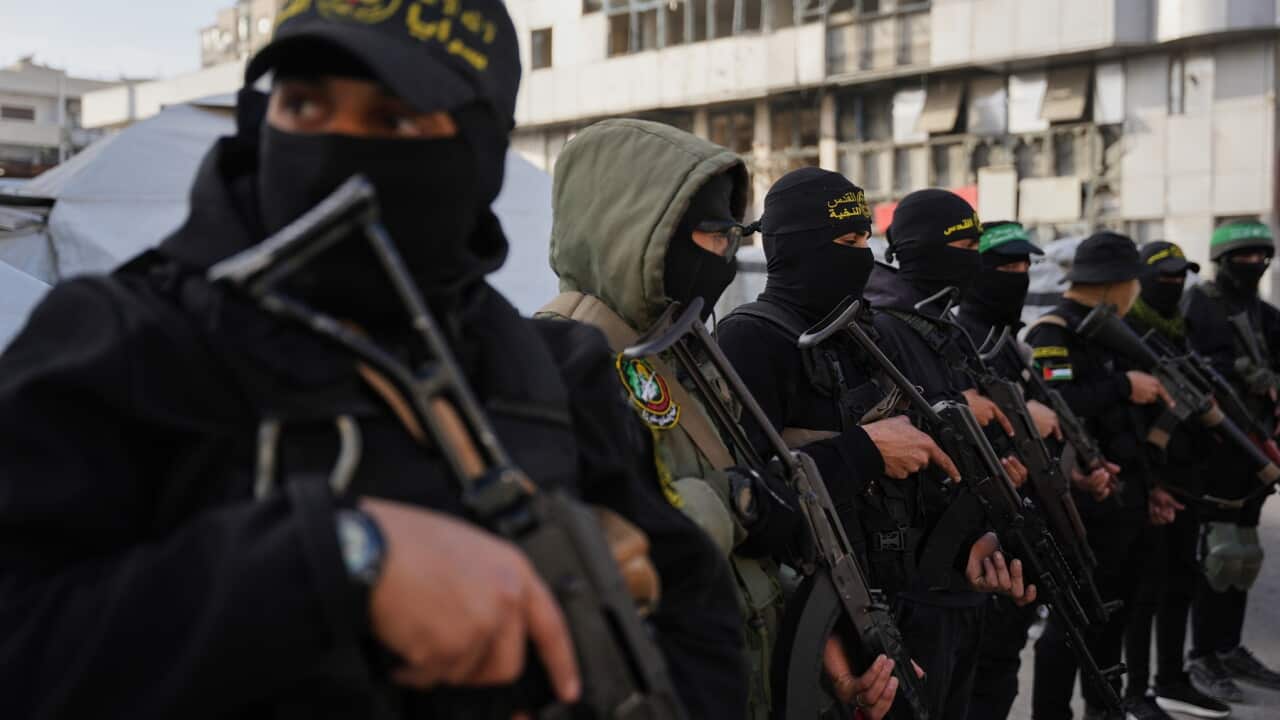
US President Donald Trump says a newly formed “Board of Peace” has reached what he called a historic agreement to disarm Hamas and other armed groups in Gaza.
In a post on Truth Social, he said weapons would be handed over in phases under international supervision, with Israeli forces withdrawing step by step as each stage is completed.
The statement reads:
“Today, the Board of Peace reached a HISTORIC agreement for the COMPLETE DISARMAMENT of Hamas and all other armed groups in Gaza. This is a monumental step toward lasting PEACE and SECURITY.”
Mr Trump says the territory would ultimately be administered by a new Palestinian government working alongside the Board of Peace and international partners.
He says the agreement would improve security for Israel while giving Palestinians a path to rebuild Gaza.
In that Truth post, he also said:
“Israel will have the security it deserves, with Gaza no longer used as a base for terror attacks. This is a major milestone in the implementation of the Trump 20-Point Plan. The agreement will be carried out in carefully structured phases. As disarmament is completed, Israeli forces will withdraw, and the International Stabilization Force will work with a new Palestinian police force to take responsibility for Gaza being safe for its residents and its neighbours.”
Hamas has reportedly confirmed negotiations over a disarmament agreement, but neither Hamas nor Israel released public statements.
While diplomacy appears to be gaining traction on that front, the situation elsewhere in the Middle east is deteriorating.
Iranian attacks targeting American military positions in Jordan and Kuwait have been followed by a fresh wave of U-S strikes inside Iran.
Meanwhile, US and Saudi forces have also launched strikes against Iran-backed militias in Iraq.
Iran says one of the latest U-S strikes hit a residential building on Qeshm Island.
United Nations spokesperson Farhan Haq says the latest wave of attacks has affected several Iranian provinces, with civilians increasingly caught up in the fighting.
“In Iran, a new wave of strikes was reported today in the provinces of Fars, Hormozgan, Bushehr and Khuzestan, including the country's main oil-producing region. According to local sources, a strike in Qeshm, in Hormozgan Province, hit a residential building, killing three civilians, including a two-year-old child. Two other children were reportedly injured.”
Iran’s Revolutionary Guard says it targeted American military positions in Kuwait and Jordan.
Jordan says it intercepted the incoming missiles, while the United States says the attempted attacks failed to hit American aircraft or cause the damage claimed by Tehran.
Egypt says it's investigating an unidentified drone strike that caused fires aboard two natural gas vessels at the Mediterranean port of Damietta.
Prime Minister Mostafa Madbouly says investigators are examining debris recovered from the scene before Egypt decides how to respond.
“The state is taking its own procedures to calculate and evaluate the situation. It has to be based on facts. We dealt with this situation in a professional way. The security group is now investigating this issue and its source to find out what would be the reaction of the Egyptian state in the coming period.”
Some analysts believe the pattern suggests Iran is trying to widen the conflict to increase pressure on the United States and its allies.
Ali Vaez, Iran Project Director at the International Crisis Group, explains.
“The Iranian strategy at this moment is to demonstrate to the United States that it cannot get away with limited tit-for-tats that would be costly for Iran and not very costly for the U.S., that they would externalize the pain and even escalate into new territory in terms of both the scale and scope of attacks. This is why we have seen Iran attacking Jordan, a country that it did not attack in the past. We have also seen Iranian allies in the region putting more pressure on energy routes like Bab al-Mandab or even with the recent attack in Egypt.”
The escalation is also fuelling political tensions in Washington.
The US Senate has again rejected a War Powers Resolution that would have required congressional approval before President Donald Trump could continue military action against Iran.
Democratic Senator Kirsten Gillibrand says the administration has failed to deliver on its promises.
“We were told that Iran's nuclear program would be eliminated. Instead, Iran still holds nuclear material and its leaders may be more determined than ever to build a weapon. We were told that the Iranian regime would crumble. Instead, it now holds new leverage over the world's energy supply in the Strait of Hormuz. We were told this president would bring peace and lower prices. Instead, he has given us war, pain, and higher prices.”
The United Nations is warning the humanitarian toll is worsening across the region, with civilians increasingly at risk and infrastructure under strain.
“Since yesterday, civilian casualties have been reported in Iran and Kuwait, while damage or disruption to infrastructure has been reported in Iran, Kuwait, Saudi Arabia and Egypt. Jordan and Egypt remain vital lifelines for humanitarian operations, including medical evacuations and aid deliveries. *OCHA continues to monitor the humanitarian impact and calls on all parties to uphold their obligations under international humanitarian law, including by protecting civilians and vital infrastructure.”









