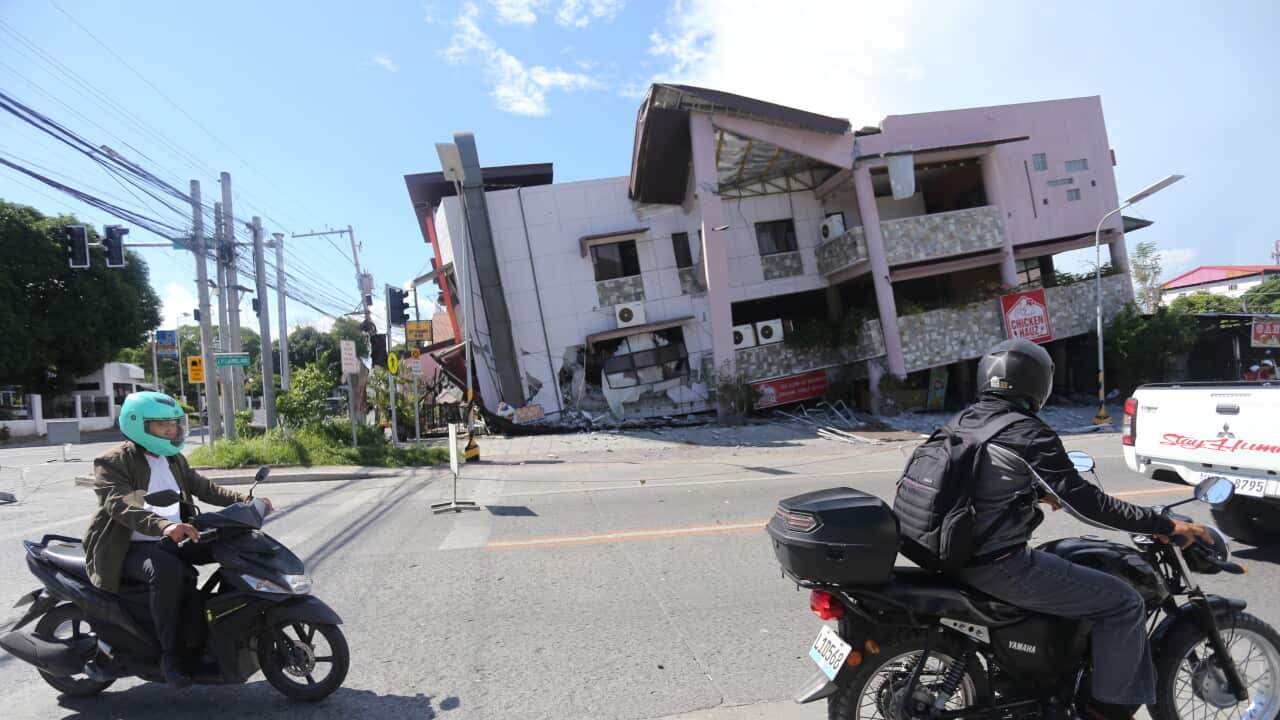

At least 35 people have been killed and 12 people are missing, after an earthquake in the southern Philippines on Monday. Rescuers continue to search for survivors near the epicentre of the 7.8 magnitude quake, which triggered a one-metre tsunami.
Listen to Australian and world news and follow trending topics with SBS News Podcasts.
TRANSCRIPT
At least 35 people have been killed and 12 people are missing, after an earthquake in the southern Philippines on Monday [[8 June]].
Rescuers continue to search for survivors near the epicentre of the 7.8 magnitude quake, which triggered a one-metre tsunami.
Emergency crews are scouring the rubble of destroyed buildings on Mindanao.
There are grave concerns for 12 people who are unaccounted for, who may be caught under the debris of collapsed buildings near the quake's epicentre.
Deoslinda Deluvio has been waiting and watching for news of her son, who was trapped in a collapsed supermarket where he had been working.
After several hours, her fear turned to devastation.
“The last message I received was that the search team will arrive the next day for the retrieval but it’s not a rescue, because there’s no longer any heartbeat detected. One of the rescuers went there and there was no heartbeat. It’s difficult to accept, as a mother, to know that my son is still trapped there now. I don’t know. It’s difficult to accept.”
Around 700 thousand people live in the area hardest hit by Monday's major earthquake - General Santos City.
More than 24 hours after the first tremors, homes are still without power and residents like Jayson Manarca are worried.
“There is no water, no electricity, and there's been a blackout. When I got home there was no electricity and water. We are all affected, we don’t have anything to drink. "
The death toll has climbed into the dozens and most fatalities have occurred due to a landslide in the Sarangani Province.
At least 200 people have been injured.
President Ferdinand Marcos Junior has vowed the national government is moving and will not leave Mindanao behind - pledging assistance with this emergency response.
Quakes are nothing new here- but locals say the latest tremors are some of the strongest they've experienced.
That sound is from footage of a branch a popular food chain - Jollibee - collapsing onto the street in front of horrified onlookers in General Santos City on Monday.
Elizabeth Delgado of World Vision Philippines, says the shakes there, in the hardest hit area - were longer and more powerful than the last major quake in October.
"Terrifying so terrifying because it seems that it's keep on ongoing and the aftershock is also so strong. Anxious because of the aftershocks. Because we have experienced that last year. I think we experience almost 1,000 aftershocks."
The first wave of tremors came as a shock at 7:30 on Monday morning, when children at an elementary school at the epicentre of the quake on Mindanoa Island were settling in for their first day of school after the holidays.
Ms Delgado says the timing of the quake was protective; many children were outside before class began.
We are so worried with our children. You know the children that we are working with because they are in the school. Again and they experience another trauma."
The impact was immediate and widespread; buildings shook and collapsed near the epicentre.
There, buildings were seen cracking and swaying, as panicked residents and workers rushed into the streets.
And the destruction extended further north to Davao city.
SBS Filipino spoke with Elizabeth Joy Serrano Quijano, a teacher at Davao Occidental State College who was at home with her young daughter when the tremor hit. Ms Quijano says despite the area experiencing repeated earthquakes since 2019, panic set in as she rushed to protect her child.
"Trauma was there and the fear because my two sons were at school, so it was really difficult to think a lot of things in one time so we have to think about our safety at home and our children at school. When we decided to go out, it was also difficult decision because were surrounded by coconut trees and we’re afraid it might fall to us.”
A tsunami advisory warning soon followed the first shocks - initially issued widely across the Pacific, as far as Japan and Taiwan.
Residents in eastern Indonesia were warned to brace for Tsunami impacts - neighboring Indonesia and Malaysia were put on high alert.
Teuku Faisal Fathani of Indonesia's Meteorology and Geophysics Agency issued this guidance:
"Residents are advised to move away from the coast to safer, higher ground."
Small waves and strong currents were observed in Indonesia's Sulawesi Island before most warnings were lifted, hours after the quake.
The Philippines, one of the world's most disaster-prone countries, is often hit by earthquakes and volcanic eruptions due to its location on the Pacific "Ring of Fire," an arc of seismic faults around the ocean.
The archipelago is also lashed by about 20 typhoons and tropical storms each year.