
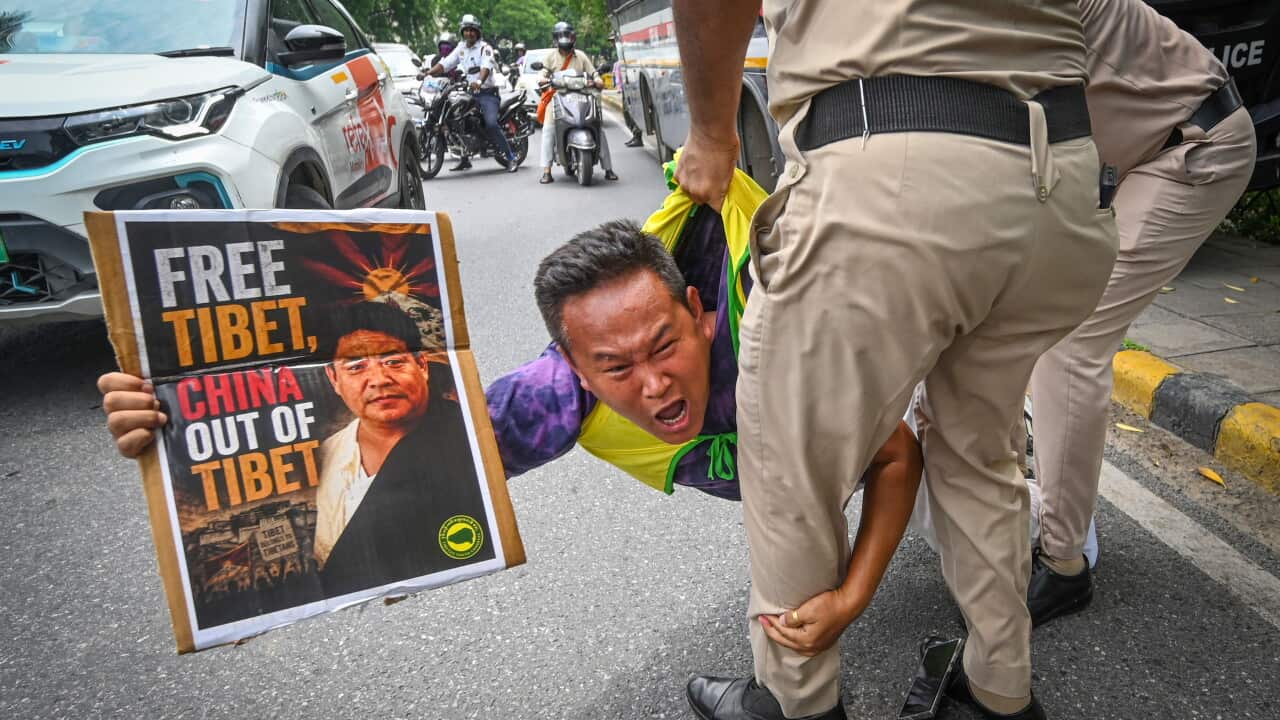

A new law in China requires parents to guide their children to love the Chinese Communist Party, schools to teach a government-approved version of Chinese history, and all citizens to refrain from doing anything the government deems not conducive to promoting a unified Chinese ethnicity. With the laws extending to critics abroad, minority ethnic groups like the Uyghurs and Tibetans say the laws codify and expand longstanding policies of forced assimilation and threaten to silence critics around the world.
Listen to Australian and world news and follow trending topics with SBS News Podcasts.
TRANSCRIPT
On July second, outside the United Nations building in New York, Lobga Rangzen set himself on fire.
The 52-year-old Tibetan exile spent years trying to make the world pay attention to Tibet.
"He was always at protests and organizing community events. His friends would, in fact, joke that he was happier at protests than on his birthday. And he was so committed to the Tibetan independence that he put Rangzen, meaning independence in Tibetan, in his name."
Kyinzom Dhongdue is a Tibetan human rights advocate and strategy and advocacy manager at Amnesty International.
"He wasn't just an activist. He was a very cheerful person who loved partying, sharing jokes, singing, and dancing. And really, that's how Tibetans in exile navigate our lives, protesting, singing, dancing, all while carrying a very profound hurt of watching the international community accommodate the Chinese government."
The day before his self-immolation, on July 1, the Chinese Government's so-called 'Ethnic Unity' laws came into force.
According to officials, the sweeping new laws aim to create a 'shared' national identity among all of China's 56 ethnic groups.
The Han Chinese are China's largest and most dominant ethnic group.
But for the 55 non-Han ethnic minorities, the laws entrench longstanding practices of forced assimilation.
"What has changed this time around is the fact that they've legalised it, showing to the rest of the world that it's not just a human rights issue; it's a legal issue. So it's a legal matter, so we can hold people at will, at our disposal because we deem fit that it is a legal matter."
Ramila Chanisheff is an Uyghur-Australian rights advocate and the president of the Australian Uyghur Tangritagh Women’s Association.
The majority Muslim Uyghur population are the predominant ethnic group in a region known formally as Xinjiang, which in Mandarin means 'New Territory'.
To the Uyghur people, the historical and preferred name for their homeland is East Turkestan.
For years, human rights groups have documented China's persecution of the Uyghurs, with reports more that than a million have disappeared, many placed in forced labour camps.
"We are being ethnically cleansed and no one is seeing it. Just because you don't see bombs on your phone, you don't see people dying, doesn't mean that it's not happening. You know? It is happening. It's happening behind the Iron Curtain. People are disappearing, and every Uyghur here has been affected, but people are too scared to speak up."
Under the new laws, schools are required to teach in Mandarin and educate the youth on what the government calls the "correct perspectives" about a unified and single Chinese culture.
In Article 20, it says parents and guardians must raise their children in accordance with the law through educating and guiding minors to love the Chinese Communist Party.
La Trobe University Emeritus Professor James Leibold says that under President Xi Jinping, China's policy towards ethnic minorities has shifted.
"I think it's important to kind of go back to how the PRC was founded back in 1949 as a multinationality state with eventual recognition of 56 formally equal nationalities and special provisions to protect indigenous national minorities by providing them with autonomous powers that would allow them to become masters of their own home. That is still part of the law. It's embedded in the constitution, but what Xi Jinping has done is kind of overlay another agenda on top of that, which is all about pursuing assimilation, emphasising commonality over difference."
He says that in an effort to stifle independence efforts among minority groups, Xi Jinping is seeking to transform China into what he describes as an 'authoritarian monoculture'.
"It's kind of a whole-of-system approach to forging this collective consciousness, that begins, you know, from childhood, you know, with parents required to educate their children to be good patriotic followers of the Chinese Communist Party, all the way to using artificial intelligence to forge this common consciousness, and so what is lost in that process is well, collective rights that people like the Tibetans and the Uyghurs and the Mongols used to have. The ability to be masters of their own home and to preserve their identities, their languages, their cultures, their religious practices, and to transmit those from generation to generation-all of that is now not only at jeopardy, but now being kind of completely undone."
Chinese officials say criticisms of the law stem from ideological bias in the West and argue they fundamentally misinterpret the law's intent.
While the law does state that diverse languages and cultures shall be respected, they also firmly and repeatedly state that all levels of government, media, and educators must give prominence to Mandarin and pursue a unified Chinese culture.
"It hasn't outlawed diversity when it can be mobilised for the consumption of tourists or visiting officials. You know, so you can continue to see Tibetan songs sung and Mongolian dance troupes perform, but that's kind of a sideshow that is increasingly inauthentic even. Where on the main stage, and if you go through the law, which is very long and detailed, you can see that the provisions to emphasise commonality, to actually enforce commonality, or to create what Xi Jinping has called the forging of a collective consciousness is embedded across the entire bureaucracy as well as society."
Not only has the law raised major concerns for minority rights within Chinese territory, but also for activists and diaspora abroad.
"A lot of these communities, and here I'm not only talking about the minority communities, but also the Han community, have been subjected to transnational repression if they do anything that irritates the the party state. You know, the party has a very long arm and has a whole toolkit of course of tactics that it can use, particularly for people who do have relatives back in the PRC or want to travel back to the PRC, they can bring an enormous pressure to bear."
Article 63 of the law states that organisations and individuals outside mainland China that undermine ethnic unity or create ethnic division can be held liable.
Ramila Chanisheff says this raises the risks for the few still speaking out.
"The other thing that is really concerning for us Uyghurs in the diaspora, and especially here in Australia, is that the activism that Uyghurs are doing outside of China, such as myself or other Uyghur activists, that we could be legally held by Chinese government, whether in absentia or when we are traveling. So, the fear comes in when we are speaking up in Australia, how we are being monitored by cyber footprints and cybersecurity and transnational repression, which we've already felt."
The law also stipulates that all religious groups must pursue the sinicisation of religion and follow what the government deems the correct perspectives on religion.
As well as strengthened control over religious affairs in Tibet, Kyinzom says reports have already emerged of the demolition of Buddhist Institutions.
With tight controls on media in the region, she says it's difficult to know the extent of the crackdown.
"We have to remember that Tibet is one of the most tightly controlled places in the world when it comes to independent access and information. Yourself as a foreign journalist, you are banned from visiting Tibet... So, Tibetans are taking enormous risk to share information with the outside world, with journalists and human rights organisations, and we are seeing some very worrying signs."
Both the Uyghur and Tibetan communities in Australia are calling on the government to speak out publicly against these new laws.
A spokesperson for the Department of Foreign Affairs and Trade told SBS they are concerned about the human rights implications.
The department says it has raised this with China directly and publicly and will not tolerate governments interfering with the rights or freedoms of people in Australia.
For activists like Ramila, leaving Australia comes with serious risk.
"Not only will they say that I am a separatist and a traitor or disuniting the Chinese government, and this is the reason why they've got a legal case against me. What they might do if I, should I land in a country, is place a drug in my luggage, hold me on other charges to be able to hold me back and to put me on a no travel notice. We have known Uyghurs that are on the Interpol that can't travel to certain countries because of China's hand. This is what I'm scared of. As an Australian, as a free person, am I not only scared of being monitored and tracked and attacked, I'm also afraid of losing my freedom to travel and talk and speak out for my people so that they don't completely disappear off the face of the earth."
In Tibetan Buddhism, the 49 days after a person dies are a crucial mourning period - marking the time it takes for the soul to transition to the next life.
Marking the end of that period for Lobga Rangzen, the Tibetan community in Canberra will gather on August 20 to commemorate his life.
While he was far from the first Tibetan to take his life in this way, Kyinzom Dhongdue says she hopes he will be the last.
"In his final statement, he condemned the law and said China's occupation was the root cause of Tibetan suffering, and he called on Tibetans to unite for a free Tibet. We also remember self-immolations that have been happening in Tibet for the last many, many years. It is an incredibly tragic form of protest. More than 170 Tibetans have done this over the past 2 decades, calling for freedom in Tibet. So really, the question is, what is happening to Tibetans, or what is happening in Tibet under China's occupation, that someone feels that this is the only way left to make the world listen?"









