
A second seal dies of suspected bird flu, as the virus spreads into mammals; world first treatment for an Australian baby with for a rare form of epilepsy; Australian men's cricket team turns focus to upcoming South Africa tour.
Listen to Australian and world news and follow trending topics with SBS News Podcasts.
TRANSCRIPT
In this bulletin:
- A second seal dies of suspected bird flu, as the virus spreads into mammals
- World first treatment for an Australian baby with for a rare form of epilepsy
- And in cricket, focus turns to the upcoming South Africa tour.
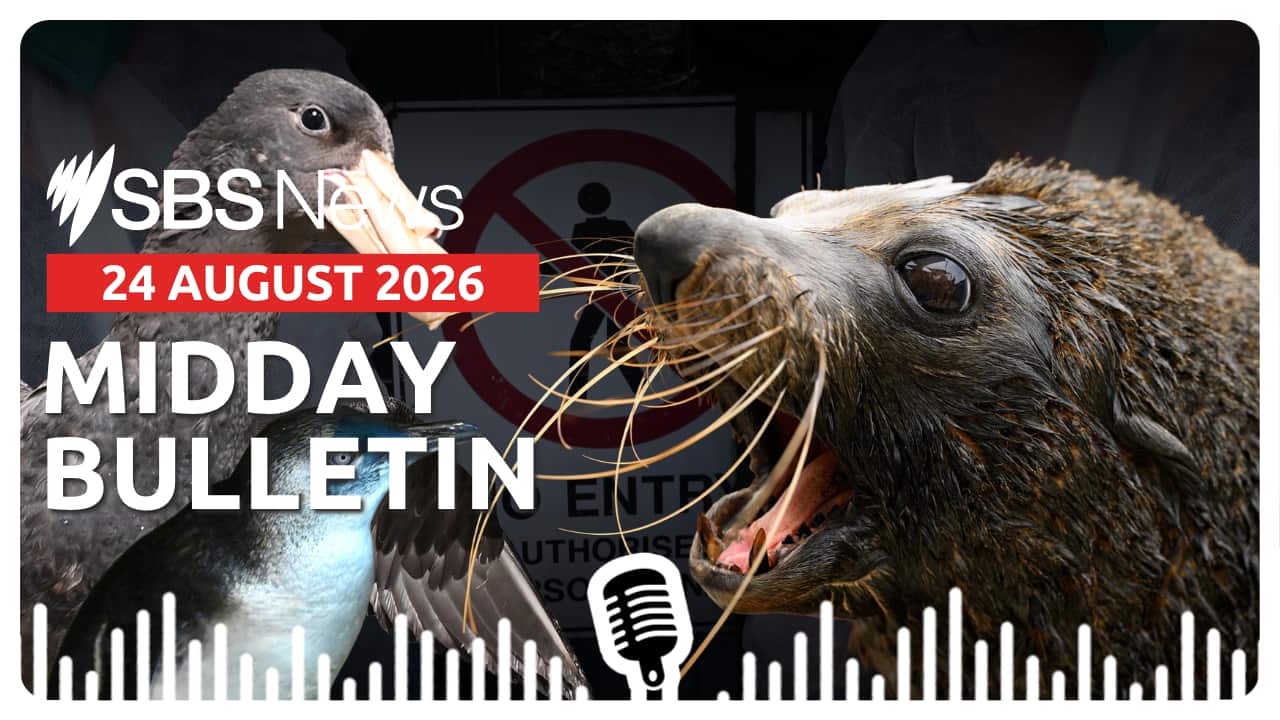
A second long-nosed fur seal is suspected to have died from the H5N1 strain of bird flu in South Australia.
The seal was found offshore at the Pages Conservation Park – a special protected area in the state.
Samples have been sent to a lab in Geelong for further testing.
The first mammal death from this wave of bird flu on the Australian mainland was confirmed over the weekend, also in a long-nosed fur seal in South Australia.
The state's Chief Veterinary Officer, Skye Fruean, says options are being considered to source a vaccine that can be used on native mammals.
"There is a lot of consideration, from both a science perspective as well as a regulatory perspective, before we can get to the point of actually putting vaccines into sea lions."
-
An inquiry into the nation's skilled migration program has heard temporary visa holders are being relied on for services in regional Queensland, but there is not enough adequate housing.
Hearings for the parliamentary inquiry into the value of skilled migration to Australia are taking place in Brisbane today and tomorrow.
The General Secretary of the Queensland Council of Unions, Jacqueline King, says regional infrastructure projects are creating enormous demands on limited housing supply.
"Just two examples, we are going to need 46,000 additional healthcare workers, so that is doctors, nurses, healthcare professionals by 2032 for Queensland alone. In 2027-28 the construction workforce is expected to peak, and we will need around another 38,000 construction workers. Currently facing a deficit of about 17,000."
A baby from the New South Wales Central Coast has become the first person in the world to receive a new treatment for a rare form of child epilepsy.
Eight-month-old Bodhi was born with an often-fatal genetic disorder called K-C-N-T-1-related catastrophic epilepsy.
The condition meant he was having up to 60 seizures a day, and the Sydney Children's Hospitals Network used its innovative therapies pathway to deliver a world-first precision medicine treatment to the eight-month-old.
Within days of starting the new medication, Bohdi's seizures stopped and for the first time in months he no longer required around-the-clock care.
Bohdi has since begun smiling again, and has been able to return home.
Dr Michelle Lorentzos, at Sydney Children's Hospitals Network, says the model could be replicated globally, showing how highly personalised therapies for ultra-rare diseases are increasingly possible.
-
The US is warning Canada it would lose a trade war, as the two countries fail to reach a deal over tariff negotiations.
The Trump Administration imposed new 50 per cent tariff on around A$28 billion worth of Canadian products, or about 5 per cent of Canadian exports.
Canadian Prime Minister Mark Carney retaliated with new tariffs on US goods, walking away from bilateral talks.
US Transportation Secretary Sean Duffy has told Fox News Mr Carney should sign a deal because the consequences of not doing so would be devastating for Canada.
"And the fact that we provide their security for them and they take advantage of us, I think President Trump was the first one to go, you know what? That is not the kind of relationship friends should have. And so, the president is calling them out. I think you're going to see Mark Carney come to the table."
-
To sport now, and cricket.
Australia is turning their focus to South Africa, after the team levelled the two-Test series against Bangladesh.
Beaten by nine wickets in the series opener in Darwin in one of Test cricket's greatest upsets, Australia responded in Mackay to win by an innings and 51 runs in two days, tying the series 1-all.
Mitchell Starc says the team is looking to build on the momentum created and apply it to the upcoming three-Test tour of South Africa in October.
"I don't think we've changed anything really, certainly as a group. We're a team that can bounce back really quickly. We have done in the past. We're probably a group … you mentioned calmness there … and to not get too phased when things don't go our way. I think this week is a reflection of that. And hopefully onwards and upwards to South Africa now."