

The United States and Iran have paused missile strikes, but the wider Middle East remains gripped by conflict. As mediators urge Washington and Tehran to return to diplomacy, the international community has raised concerns over regional security, energy supplies and the humanitarian cost of war.
Listen to Australian and world news and follow trending topics with SBS News Podcasts.
TRANSCRIPT
Just weeks ago, diplomacy between Washington and Tehran collapsed into 13 days of missile and drone attacks that killed Americans and Iranians, damaged critical infrastructure and disrupted one of the world's most important energy corridors.
Now, with direct fighting paused, both sides have indicated they will give diplomacy another chance.
US President Donald Trump says the talks are going well.
“You know, we're having good talks. So we'll see what happens. I think there's a good chance that something could happen. And if it does, good. If it doesn't, we go back to doing what we were doing two days ago.”
Iran is taking a more cautious approach.
While discussions continue via third party intermediaries, Iran denies holding direct talks with Washington and says any future agreement will be on its own terms.
“No agreement can be unilaterally implemented; this is natural. Therefore, Iran has ceased fulfilling its commitments. When the time becomes right, we will discuss future development directions. But one thing is certain: Iran will never compromise on its national interests and security principles.”
Tehran says the Strait of Hormuz remains closed, disrupting one of the world's busiest oil shipping routes.
Saudi Arabia has redirected some exports through its East-West pipeline to the Red Sea.
But that route is also under threat as Iran-aligned Houthi rebels issue a warning.
Houthi adviser Taher Anam says the group will target Saudi oil infrastructure if the kingdom continues strikes inside Yemen.
“We are now entering a new phase of targeting the Saudi oil industry. The confrontation is continuing inside Saudi territory, outside Yemen, and we will continue with it. We have set a clear objective in this confrontation: lifting the siege on Yemen, both the closure of airports and the political blockade imposed on our country. Therefore, we will continue targeting the Saudi oil industry, airports and ports until this goal is achieved, regardless of how long it takes.”
The Houthis insist commercial shipping remains unaffected, but the fresh threats are fostering uncertainty in global markets.
In Australia, higher crude prices are now beginning to flow through to motorists.
Beyond the energy crisis, civilians continue to bear the cost of conflict from Lebanon to the occupied West Bank.
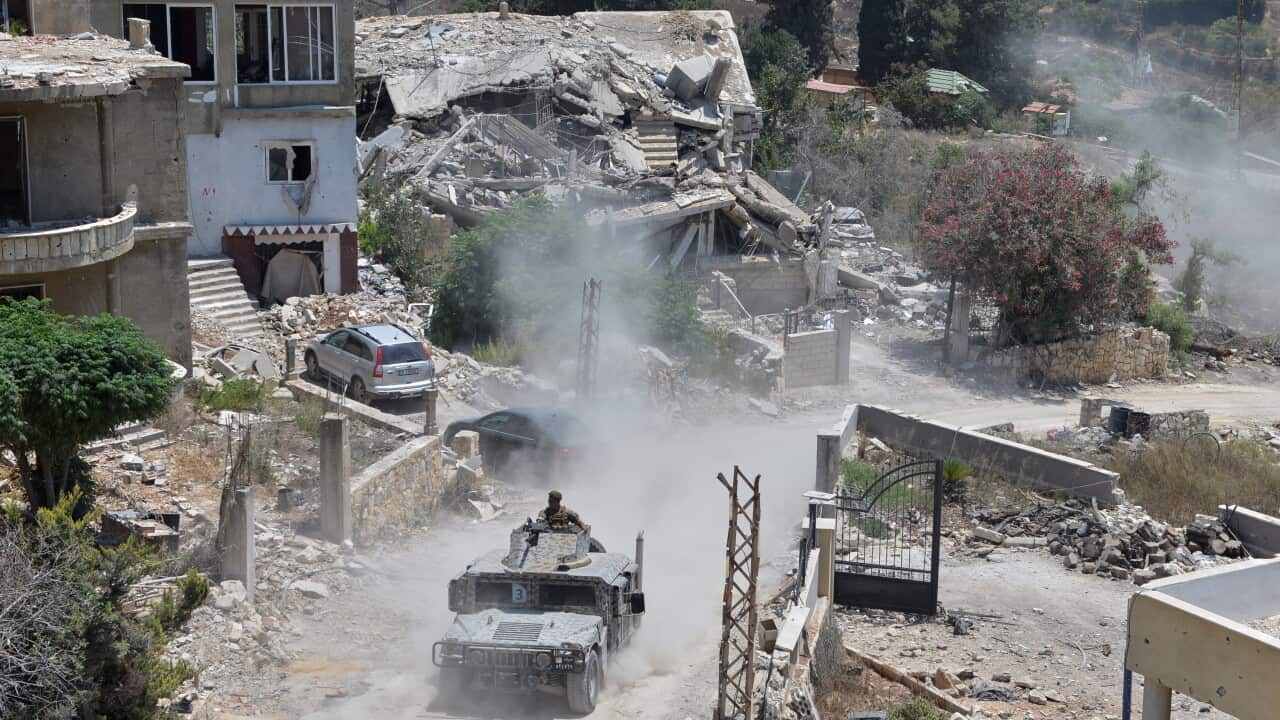
In southern Lebanon, families returning home are finding villages reduced to rubble after months of fighting between Israel and Hezbollah.
The United Nations High Commissioner for Human Rights, Volker Turk, says much of the destruction appears difficult to justify under international humanitarian law.
“Demolition of this type raises huge flags about compliance with international humanitarian law because you cannot use military necessity when it comes to civilian objects. That seems to be the case here. Wholesale destruction just doesn't make any sense under international humanitarian law.”
Elsewhere, tensions are also rising in the occupied West Bank, where violence involving Israeli settlers, Palestinian residents and Israeli forces has intensified in recent months.
Last Friday, four Palestinians and two Israelis were killed during a confrontation near the village of Tal, southwest of Nablus.
Israel says Israeli civilians came under attack, while Palestinians say armed settlers entered the village before the violence escalated.
Israel's military says it is investigating.
Since then, Palestinian officials say Israeli forces have bulldozed farmland, uprooted trees, carried out raids and road closures have been imposed around Tal and nearby Nablus.
Israel describes the incident as terrorism, while Palestinians say villagers were defending themselves against settlers.
Farmer Ahmed Shtayya says many residents fear the situation is reaching breaking point.
“I am patient and will be patient, like the poet said once: I will be patient until patience runs out, and I will be patient until God will allow things to happen. And I will be patient until all patient people are aware that I had more bitter patience. But after this, after what is bitter patience what comes, comes the explosion.”
From threats to global energy supplies to continuing conflicts in Lebanon and the occupied West Bank, instability continues to shape daily life across the region.