

The federal government says Labor’s long-awaited immigration reforms are designed to bring net migration down, ease pressure on housing and close what it describes as loopholes in the visa system. But what does that look like for farmers, current international students and migrant workers?
Listen to Australian and world news and follow trending topics with SBS News Podcasts.
TRANSCRIPT
[[UPSOT National anthem: "Our land abounds in nature’s gifts, of beauty rich and rare. In history’s page...In joyful strains then let us sing..Advance (Australia Fair)"]]
That’s the Australian national anthem, being sung at a citizenship ceremony.
For people taking the pledge, becoming an Australian citizen can be the culmination of years of work, study and building a life here.
[["And I'm so blessed to be in Australia. And now that I'm citizen, I'm so on top of the moon, I'm so blessed, so I thank all of you, for accepting us as citizens of this country."]]
There’s a line in the second verse of the anthem that reads: "For those who’ve come across the seas, We’ve boundless plains to share".
It’s a familiar idea, but, does that still hold true following the government's recent immigration changes announcement?
Australia’s migration system is changing - and for people already here, or hoping to come here, the pathway is becoming more complicated.
The federal government has announced a package aimed at reducing migration and tightening the visa system.
In March, net overseas migration was around 292,000.
Home Affairs Minister Tony Burke says the government is aiming to bring it down to 245,000 this financial year, falling to 225,000 in 2027–28.
"We just need to make sure it is targeted for the needs of Australia in numbers, and across the different categories that work for our economy."
The changes target so-called visa hopping, restrict secondary applicants on most student visas, and strengthen measures to ensure people without valid visas leave Australia.
Visitor visas will also carry a no further stay condition, while the government says it will crack down on migration agents who knowingly support applications without merit.
And there are changes to working holiday visas - a pathway relied on by some regional industries for seasonal labour.
Home Affairs Minister Tony Burke says the government cannot shield individual sectors from the consequences of reducing migration.
He says the government wants to reduce migration because of pressures including housing supply, while trying to give the economy the "softest landing possible".
But in the Northern Territory, that landing is being watched closely.
[[NATSOT Farm atmos]]
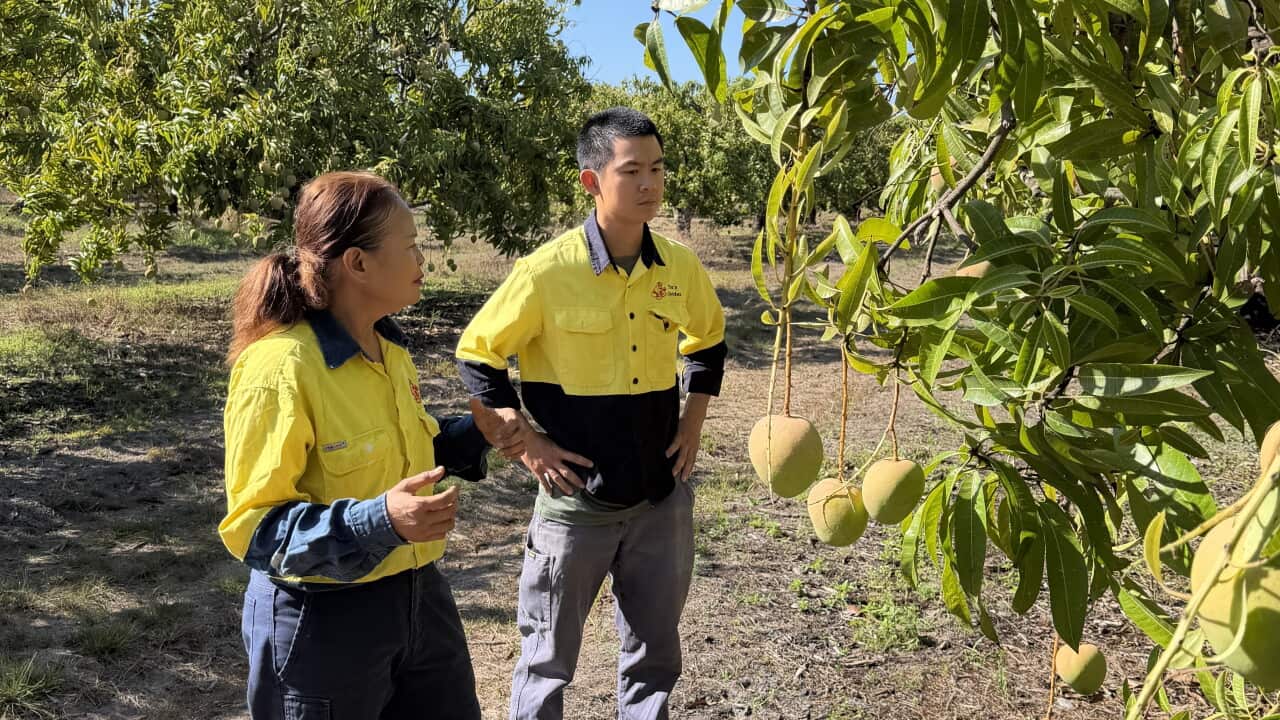
About an hour from Darwin, mango growers are preparing for harvest.
For Mango exporters like Saramat 'Tou' Ruchkaew [[Se-rah-mat Rash-khew]] or better known as Tou [[Too]], the problem is straightforward: There is fruit to pick, and not enough people to pick it.
"The current government or the government going to come in the next election, it doesn't matter who in power, they continue to sabotaging the farming community. If the food is going to be the source of energy for humans, why is it so hard to understand that this is going to hurt us badly. Why is it so hard to understand? These people are supplying food and fruits to Australians."
Tou says finding enough workers for the critical six-to-eight-week period is becoming harder.
And one group of workers commonly used in seasonal agriculture - people on working holiday visas - is being affected by the government's changes.
Under the new system, the number of working holiday-makers able to remain in Australia for a second or third year will be reduced.
The government is also introducing a ballot system for some backpackers seeking to stay beyond their first year.
For growers, timing matters - Tou says Pacific workers are an important part of the agricultural workforce.
But workers coming through the Pacific Australia Labour Mobility scheme are not necessarily available for the short seasonal periods some growers need.
"We're battling this support... forever, for thirty five years and now we have to go backwards."
The government’s preferred alternative is precisely that Pacific workforce.
But farmers say the issue isn't simply about whether workers exist.
It is about whether they are available, when they are needed, and under what visa conditions.
"Without immigrants, I don't think mango industry will strive, look around, in the Northern Territory, the Vietnamese, the Thais, the Malaysians, we are the backbone. Without immigration then Northern Territory would not strive."
And that tension is playing out across the migration system.
One of Tou's full-time workers was once in Australia on a working holiday visa.
He returned years later with his wife, this time on a sponsored skilled visa, and is hoping to transition to permanent residency.
"That's gonna make things harder for the backpackers and to me I don't think that's going to be good at all for this country. For example like me working in the farm right, of course we have people from PALM scheme visa, which is really hard worker, but sometimes we are working in the farm right, we need someone with good communication skills, also soft skills like IT staff using computer, or even driving a tractor, or something like that, which relate to more skill rather than just picking and working hard. The immigrant, they can do those job compared with the PALM scheme visa."
For people like Panyawut [[Pan juh woot]] Pongyuen, Australia's migration system isn't an abstract policy debate.
It's a pathway that can connect temporary work with a longer-term future.
A similar uncertainty is being described by international students.
Will they now still choose Australia to pursue their education?
Bashshar Khalid arrived in Australia as an international student in 2017.
He completed a bachelor's degree, then a master's, before entering the workforce.
After moving through a temporary graduate visa, he recently secured a sponsored 482 work visa.
But getting there wasn't straightforward.
"One of the most difficult thing is when you're on your 485 visa, which is your temporary work visa, you try to work harder from the beginning because you obviously want to prove to your employer that you have certain skillset that are beneficial to the business."
At one point, his graduate visa was approaching expiry while his employer-sponsored application was still being processed.
He was on a bridging visa, waiting for an answer.
"Every day when you wake up, or every day you're going into the office to work, you're not sure whether the application will be approved or not ... It's basically a struggle every day."
Now the government is trying to stop what it calls "visa hopping" - people moving between visas or courses primarily to extend their stay.
But some advocates say there there is a line between exploiting the system and legitimately changing the direction of one's studies.
Kon Karapanagiotidis [[kah-ruh-pun-yah-yio-tee-dees]], CEO and founder of the Asylum Seeker Resource Centre [[ASRC]], argues the contribution of migrants is sometimes overlooked in the broader political debate.
"None of this is to do with restoring integrity in our migration system. We're one of the most livable countries in the world and in the top ten globally for all critical indicators from wealth to health to security and stability as a nation. This is about a triple major party race to the bottom, the Liberal Party, the Labor Party, and One Nation, and trying to, outflank each other to win back right-wing voters and to appeal to the far right. Who's gonna pay the cost of this are going to be migrants, international students, people seeking asylum, and refugees."
Khalid says students who genuinely change careers or progress through study should not necessarily be treated the same way.
And there is another part of the reforms that directly affects international students and their families.
Most international students will no longer be able to bring family members with them under the proposed changes.
PhD students and some Pacific and ASEAN students are exempt.
Some are upset by the changes..
"I feel like in Australian cultures, family is such a valuable thing, and it would go the same for any other culture that is present right now, so I think it'll send the message that they aren't welcome here when in reality Australians are pretty welcoming."
..and some aren't as affected.
"Josh van Staden, NT correspondent: So you would still pick Australia, even with the changes?
Voxie: Yes. for me at least now I'm single so, I'm not quite worried about the new policies."
The government says around 19 per cent of international students bring family members to Australia.
Muath Alqarni is from Saudi Arabia and has master's degree student at the University of Melbourne.
He tells SBS Arabic the government needs to adopt a data-driven approach rather than applying broad measures to all international students.
“There are certain countries [that] never had immigration issues with international students’ families. I’m really concerned now. It’s a lifetime chance for me to bring my family to Australia and spend a good time with them in Australia."
For ASRC founder, Kon Karapanagiotidis, the message is clear.
"I would like to, for a single day, ask every post-World War II migrant, refugee, and child or grandchild of migrant refugee to stay home for 24-hours and watch the entire nation come to a halt, not from a place of malice to hurt the Australian community, but just for 24 hours to remind Australia of a couple of things. One, we are the engine room of this nation. Two, we are predominantly a migrant nation and First Peoples nation."