
Many people are still missing after Venezuela’s devastating earthquake; the government says fuel supplies remain stable; Cape Verde moves to the knockout stage after its nil-all draw against Saudi Arabia.
Listen to Australian and world news, and follow trending topics with SBS News Podcasts.
TRANSCRIPT
- Many people still missing after Venezuela’s devastating earthquake
- The government says fuel supplies remain stable.
- Cape Verde move to the knockout stage after it's nil-all draw against Saudi Arabia.
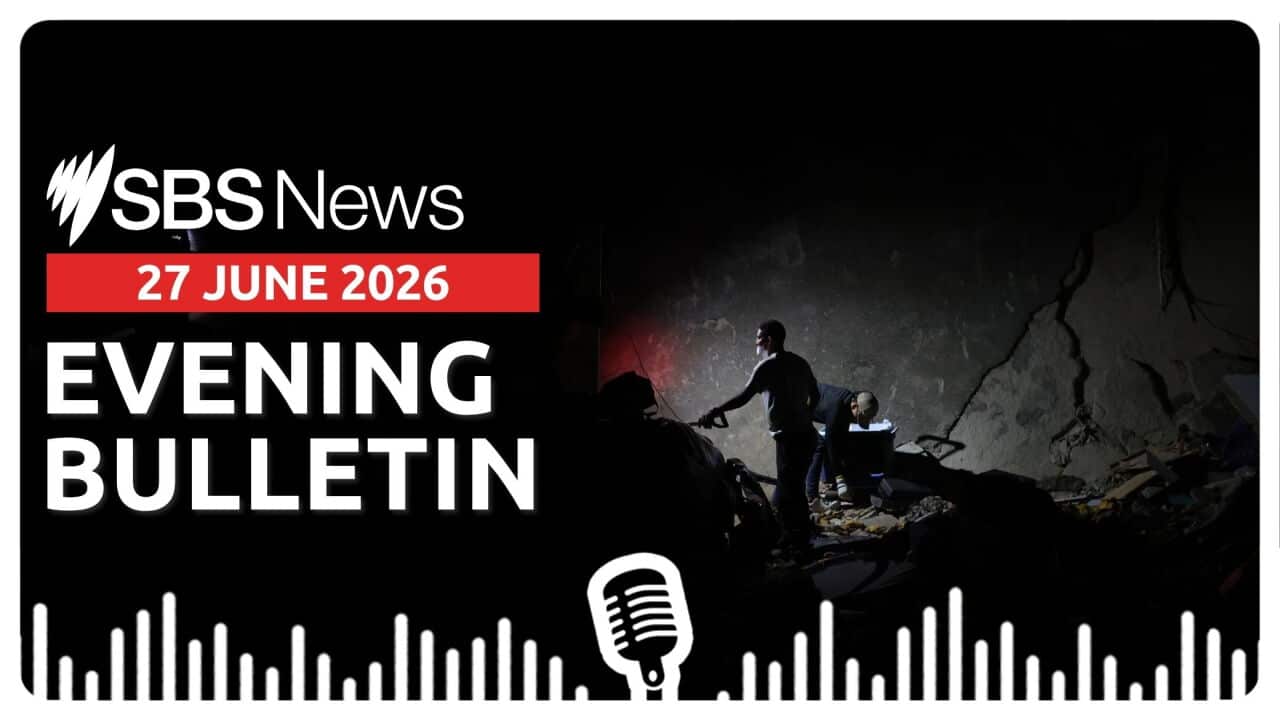
Rescue teams in Venezuela are racing to find survivors trapped under rubble as the death toll from twin earthquakes nears 1000.
Foreign aid and support have reached the hardest-hit areas nearly two days after magnitude 7.2 and 7.5 tremors devastated parts of Caracas and surrounding areas.
The government estimates at least people 172 people remain trapped under the rubble, but one unverified website is reporting the number at just over 50,000.
Speaking to the BBC Christina Garcia the Regional Director for Latin America Save the Children says the charity is doing what it can to support children.
"Many families and children, have spent already two nights in open spaces, so temporary shelter is starting to be a critical need together, with safe water, food, and other critical needs. We are especially concerned, about children and the wellbeing of children. They've been through a lot. This is a very traumatic event."
--
The head of the Iranian parliament's national security committee Ebrahim Azizi has accused the United States of having no commitment to a ceasefire after US strikes on Iranian targets.
The US has carried out missile and drone strikes on a cargo ship in the Strait of Hormuz as well as coastal radar locations in response to an attack on a commercial ship that was transiting the Strait of Hormuz.
President Donald Trump earlier blamed Iran for the attack.
Iranian state media reported the initial strike by Iran at the port of Sirik after vessels reportedly violated Iranian Strait of Hormuz regulations.
--
An Israeli official says Lebanon, Israel and the United States have reached a trilateral framework agreement for the withdrawal of Israeli forces from parts of southern Lebanon.
According to the agreement, Israeli forces will remain deployed in the security zone in southern Lebanon, until Hezbollah is disarmed.
Yechiel Leiter, Israeli ambassador to the United States says the agreement was reached after four days of lengthy negotiations.
"It's important for me to reiterate, Israel and Lebanon are not at war. Israel is at war with Hezbollah because Hezbollah is a proxy of Iran, and Iran is still committed to the destruction of Israel through its proxies. We will not allow that to continue. We will not allow them to succeed."
It is not clear how the plan will be enforced and a spokesperson for Hezbollah said it would not cooperate.
--
Energy Minister Chris Bowen says Australia's fuel storage is full and tankers are waiting for storage to become available before they can come into dock.
Mr Bowen made the comments in his weekly fuel update adding that Australia currently has 44 days of petrol, 37 days of diesel and 29 days of jet fuel in storage.
Mr Bowen says while there are encouraging signs the dispute in the Middle East looks like it could be resolving, it was too early to say when.
"We just want this dispute to end. We want this dispute to come to a close so that the world can go back to much more normal arrangements. We again call on all sides to see this dispute resolve. We have seen some progress, some encouraging signs but there is a lot more to go and we need to be focused on our own task and our own fuel security during this international uncertainty."
Mr Bowen has also called on all airlines to make sure their pricing is fair in response to current fuel prices.
--
The government says it will ban supermarket price gouging from July 1, 2026, to protect Australians from artificially inflated prices.
The Albanese government says under new rules it will be illegal for very large retailers, like Coles and Woolworths, to charge excessive prices.
The new laws will be enforced by the Australian Competition and Consumer Commission and retailers found breaching the rules will face financial penalties of at least $10 million.
Assistant Minister for Competition Andrew Leigh says these new laws will improve fairness in the sector.
"The ACCC supermarket report made clear that when you've got significant market concentration, you have the potential for excessive pricing. So, what these new laws will do is to say to the two major supermarkets, if you're engaging in excessive pricing, that is pricing that's above the cost of supply plus a reasonable margin, then the ACCC will be empowered to come after you. This is all about protecting consumers at the checkout."
--
And in sport, Cape Verde will now make it to the knockout stage of the World Cup, after its nil-all draw against Saudi Arabia.
This marks a historic moment for the third smallest nation - with more than 500, 000 people - playing at the global stage for their first time.
"They have stood firm against Uruguay, and now they have finished the job. The men from the tiny island, in the Atlantic, are through the knockout phase, of the FIFA World Cup, on their World Cup debut."
Meanwhile, Spain secured its top spot in Group H with a 1-nil win over Uruguay, as they now head to the Round of 32.