
Almost 400,000 people in Australia claim Dutch ancestry. Yet many of their migration stories remain hidden. An exhibition and a new book aim to change that. This story was produced in collaboration with SBS Dutch.
Listen to Australian and world news and follow trending topics with SBS News Podcasts.
TRANSCRIPT
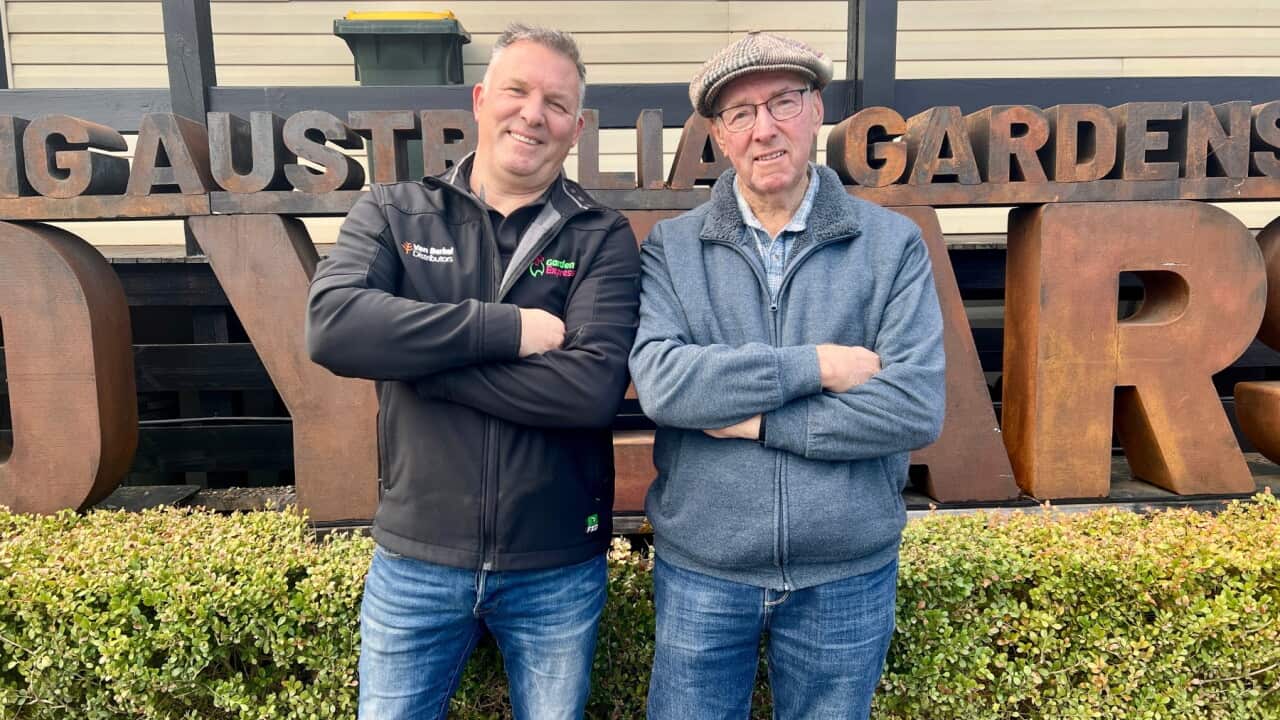
Cultivating colourful tulips is a passion for David Van Berkel, a third-generation flower grower in Victoria.
“One of the most popular products at the moment is tulips. They're having a major resurgence and they're very popular amongst our Dutch migrant community.”
It’s a family tradition Mr Van Berkel’s proud to continue on his 4-hectare property in the Dandenong Ranges.
“When my Opa came out, he brought that passion for flower bulbs with him and [became] one of the largest tulip and hyacinth growers in his time.”
Grandfather Henk van Berkel handed over to son Jos, who is now watching new generations cultivate the business, building on their Dutch heritage.
“I'm very proud. I mean, Monbulk used to be known as a little Holland. There were so many migrants that came out here. I guess because of the Dutch migrants that had already migrated and established businesses, it seemed to be natural for a lot of the other migrants to come to this area to find work and then eventually they would move on and start their own business as well.”
While their garden centre is flourishing, David van Berkel’s concerned that other aspects of Dutch culture are slipping away.
“I wish that we learned Dutch growing up. Dutch language is sort of slowly disappearing from our family and also from the district.”
To help change that, an exhibition is shining a light on the hidden histories of 33 Dutch families from across Victoria’s Dandenong Ranges. Monbulk Historical Society’s Maria McCarthy explains.
“The Dutch that migrated here were called invisible migrants because they assimilated into the local Australian culture as quickly as they could.”
It’s a view shared by anthropologist Dr Nonja ((non-YAH)) Peters from Curtin University in Western Australia. She arrived with her Dutch parents in 1949, still dealing with the impacts of war.
“My parents were forced labourers in Strasbourg, sent to a factory to make bullets for the Nazis. In 1943, anyone that had been a soldier, a Dutch soldier was then designated a POW because they were running short of labour at the Nazis. So, they were rounding them up in the hall of Rotterdam. They had to stand outside with a case and they were just taken away.”
Like many post-war arrivals in Australia, Dr Peters spoke little English and found education a challenge.
“Once you entered the school yard, you were Australian. No ESL as a second language, no help with anything. You just had to deal with it. It was a sink or swim education policy. So, very strict indeed.”
For others like Gerry van Horick who arrived in the 60s with his family, assimilation began at the Bonegilla ((BONNA-GILLA)) migrant centre in Northern Victoria.
“There were all .. people from all sorts of backgrounds and nationalities at that centre. It seemed to be in the middle of nowhere with an old military camp. And in some ways it was a culture shock because accommodation was very sparse, just enough for a bed, communal shower blocks.”
Mr van Horick’s father eventually found work – and a place to live - at the Van Berkels’ garden business in Monbulk.
“Dad worked for Van Berkels 13, 14 years where the family lived in that house. They formed a very big part in early experience and their migration journey. So, we do remain very grateful to them.”
Monbulk Historical Society’s Jill A’Vard is collating these migration journeys – and many more - for a new book due out next month.
“This exhibition will help to bring Dutch stories to light. They came from very poor areas after the war and coming here was a whole new life. So, I think they just wanted to bring their heritage with them.”
Grassroots initiatives like this are welcomed by Nonja Peters.
“Our children and our grandchildren, need to feel pride in their backgrounds, pride in what we did achieve and that has to be conveyed and what a better way to do it than exhibitions and talks and books.”
For David Van Berkel, whose business Garden Express now exports Australia’s ancient Wollemi pine to the world, it’s all about preserving the past for future generations.
“We're very proud of our culture and we want as many people to know about that as possible. And it's really important to understand how we got to be where we are and living in this lucky country, but from the hard work of others.”