
A landmark trial in the United States is putting the relationship between children and social media under renewed scrutiny. Twenty-nine US states are taking on Meta, alleging the technology giant designed features on Facebook and Instagram to keep young users engaged, despite risks to their well-being. Meta strongly rejects allegations its platforms were designed to addict or harm children and says it has spent years developing safeguards for younger users. But beyond the legal arguments are families who say their children paid the ultimate price.
Listen to Australian and world news and follow trending topics with SBS News Podcasts.
TRANSCRIPT
A warning - This story contains references to suicide.
"Owl didn't die by accident. She died by design. It wasn't an accident. My son did not take his life. Emmy didn't want to die. She loved her family. She loved her pets. He was almost 16 when he took his own life, forgive me. I'm here today because my daughter should still be alive. Anna Lee was 18 years old."
Riley was 15. Annalee, 18. Emmy and Coco, both 17. And Elijah and Owl, both 16.
They lived different lives in different parts of the United States, but they had at least one thing in common.
They all had social media accounts.
What remains of their short lives are memories and photos, along with digital archives of the social media profiles they once used.
Now, their parents are among the families demanding accountability from social media companies, with Meta facing a landmark trial over allegations Facebook and Instagram were deliberately designed to keep children addicted, despite risks to their well-being.
Lori Schott, lost her 18-year-old daughter Annalee.
"She was a rural Colorado farm girl. She loved her family, her God, her horses and every four-legged creature she could haul into our farm. But behind my daughter we knew and loved, she was fighting a battle we could not see. A battle within the world of social media."
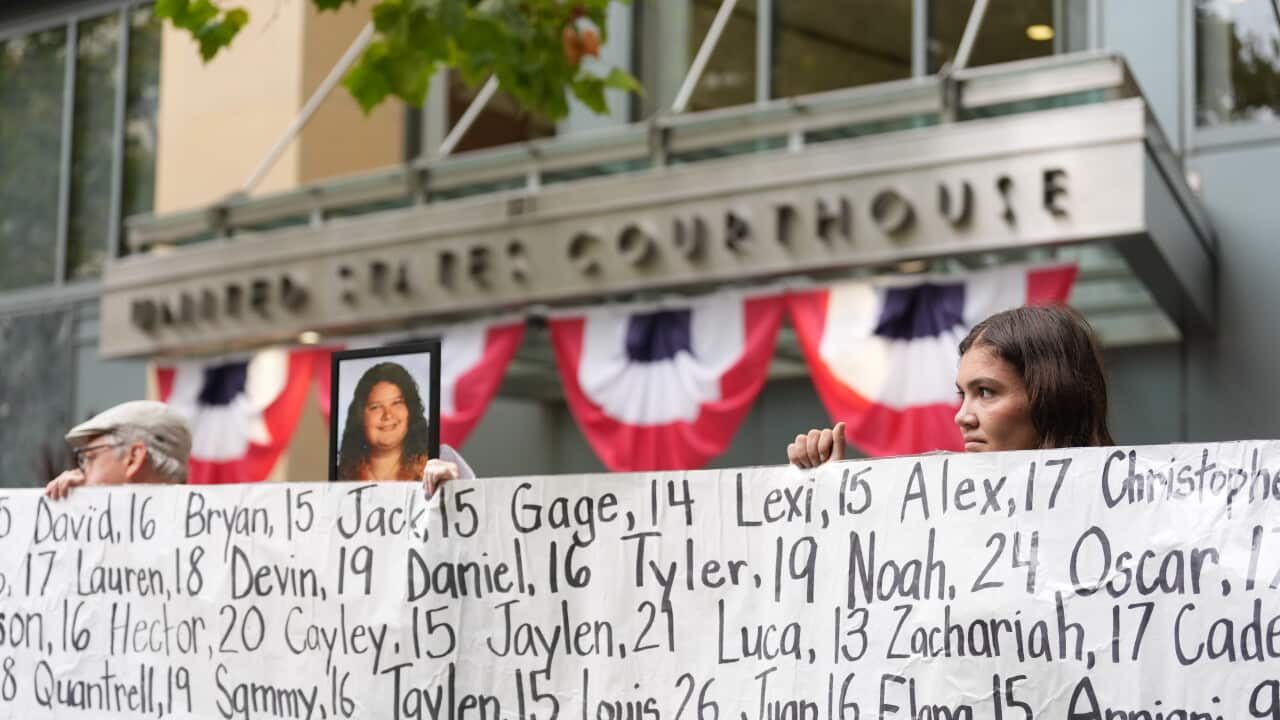
Ms Schott is one of several grieving parents who gathered outside the federal courthouse in Oakland, California, as a bipartisan group of 29 U-S states takes on one of the world's biggest technology companies.
California, Colorado, Kentucky and New Jersey are leading the first trial.
The lawsuit also alleges Meta collected personal data from children under the age of 13 without their parent's consent.
Mary Rodee's son, Riley Basford, was 15 when he died by suicide, following an online encounter with someone he believed was a young woman.
"He was almost 16 when he took his own life after a five-hour encounter with an adult criminal posing as a beautiful young woman. He was from the Ivory Coast. They call it spontaneous suicide. I call it what it was. The predictable outcome of a system that protects corporations instead of children."
For Julianna Arnold, the story began when her daughter Coco was just 12 and opened an Instagram account.
"Coco was 12 when she opened Instagram for the first time in 2017, four years before the world learned what Meta already knew. Instagram was harming teenage girls. By her teens she could not look away. The scrolling became depression, then anxiety she could not escape."
Coco died at 17 after, according to her family, an older man she encountered through Instagram sold her pills laced with fentanyl.
The parents believe social media played a role in their children's deaths, but Meta strongly disputes allegations its platforms were deliberately designed to addict or harm young people.
Meta's lawyer, Paul Schmidt, acknowledged that some users were harmed by the networks, but argued that the company had "tried to come up with tools to help them".
He argued research showed no clear link between adolescent's social media use and a lack of well-being.
The company says it is proud of its record protecting teenagers and the safeguards it has developed for younger users.
The states accuse Meta of knowing more about the potential risks to children than it disclosed, and that keeping young users engaged was profitable.
It's a claim echoed by Shannon Heacock, whose son Elijah died by suicide at 16.
"This wasn't an accident. My son did not take his life. My son was killed. It's a design choice. A company that builds its platforms to maximize a child's engagement, click after click, at the cost of the child's safety. They knew what they were doing."
Victoria Hinks makes a similar claim about her 16-year-old daughter Alexandra, known as Owl.
"Owl didn't die by accident. She died by design. Meta's own engineers built an algorithm that knew exactly what to show a struggling 16-year-old girl to keep scrolling and what that content could do to her. They knew and they did it anyway."
Erin Popolo's daughter Emmy was also 17, and her mother remembers a teenager who loved her family, her animals and their time together at the lakehouse.
"Emmy didn't want to die. She loved her family. She loved her pets. She loved her frogs, her geckos and our time at the lakehouse. She loved her life. What she could not survive was the hopelessness and the helplessness that was created and amplified by the design choices that Meta put in front of her."
The six-to-eight-week trial is expected to hear from Meta chief Mark Zuckerberg and could lead to major penalties and changes to Facebook and Instagram if the company is found liable.
It comes amid growing international scrutiny of social media's impact on children.
Australia has already introduced world-first restrictions requiring major platforms to prevent under-16s from holding accounts, with other countries considering similar measures.
What happens in the Oakland courtroom could now help shape how social media platforms engage with children around the world.
As for the parents, they have those photographs, memories and the digital footprints of the lives their children once lived.
To seek crisis support, you can ring Lifeline on 13 11 14 or text 0477 13 11 14, the Suicide Call Back Service on 1300 659 467 and Kids Helpline on 1800 55 1800 (for young people aged up to 25).
More information and support with mental health is available at www.beyondblue.org.au and on 1300 22 4636.