
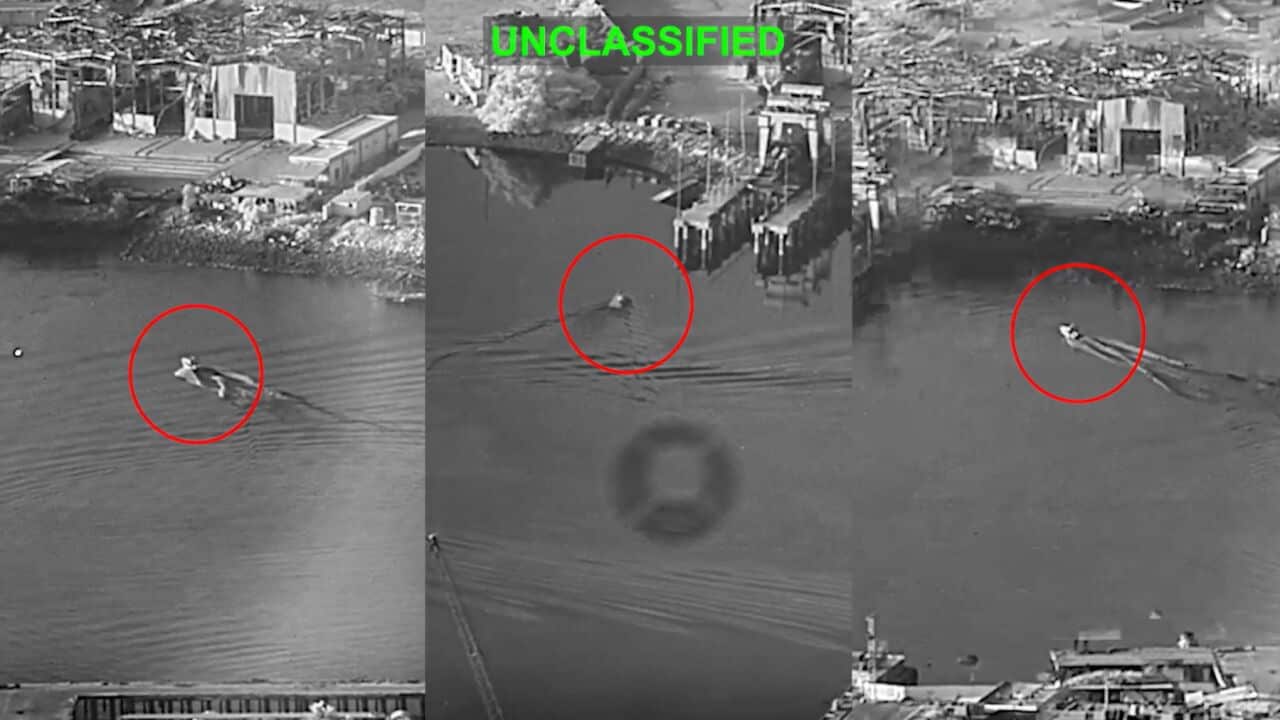

Donald Trump has abandoned plans to charge ships using the Strait of Hormuz, just a day after announcing the controversial proposal. His administration has pressed ahead with a renewed blockade of Iranian shipping and another round of military strikes, but the U.S. President says that instead of the fee scheme, Gulf states will instead invest in the United States. Iran insists the ceasefire agreement reached last month has effectively collapsed, as both sides continue to exchange attacks.
Listen to Australian and world news, and follow trending topics with SBS News Podcasts.
TRANSCRIPT:
Donald Trump has abandoned plans to charge a 20-per-cent fee on ships passing through the Strait of Hormuz, after Gulf leaders urged him to reconsider.
Instead, the U.S. President says regional allies will invest billions of dollars in the United States, while Washington maintains its blockade of Iranian shipping.
The reversal comes as the United States launched another round of strikes on Iranian targets linked to the Strait of Hormuz, with Iran responding by claiming attacks on U.S. military bases in Bahrain, Kuwait and Jordan.
Just 24 hours earlier, Trump had defended the proposed fee as compensation for protecting one of the world's busiest shipping lanes.
“I want to be reimbursed because we're protecting a very rich portion of the world. We're spending money. And so what we've done is we are going to be reimbursed for protection. We're protecting, by the countries that we're helping. For instance, you look at five countries - Sauri Arabia, you have UAE, you have Qatar."
But after speaking with Gulf leaders, Trump reversed course.
"I was called by different people, different countries, kings and Emirs - and they said we'd love to do it a different way we'd love to invest in the United States with billions and billions of dollars and we would like to invest tremendously in the United States, as opposed to charging a fee. And I like that, actually, because I don't think anybody should be able to charge a fee for the -- for the strait. But we were doing it as a reimbursement. The Gulf states are going to invest a tremendous amount of money, and that was very satisfactory to me. I think it's actually much better."
The policy shift has done little to ease tensions.
The U.S. military says it has launched fresh strikes against Iranian military sites used to target commercial shipping, while maintaining a naval blockade of vessels travelling to and from Iranian ports.
Iran says the blockade breaches the memorandum of understanding signed last month to halt the conflict and reopen the Strait of Hormuz, effectively rendering the agreement void.
President Masoud Pezeshkian has rejected what he describes as Donald Trump's "rude language", insisting Iran will continue to defend its territory.
"They (U.S.) continue this language. But have they reached their goals on the ground? The people who wanted to turn Iran to pieces, what have they reached? We respond in action and protect what we believe in, every inch of our soil. The rude language they are using is worthy of themselves, not us."
The latest escalation has left last month’s memorandum of understanding between Washington and Tehran effectively in tatters.
The agreement was intended to halt the fighting, reopen the Strait of Hormuz - and begin negotiations towards a broader settlement within 60 days.
But the two sides interpreted the terms differently, particularly over who would control shipping through the Strait.
The renewed fighting has also prompted fresh international concern.
The United Nations says freedom of navigation through the Strait of Hormuz must be protected.
"The Secretary-General's position is consistent that we believe that there must be free movement of shipping across the Strait of Hormuz. We stand against any efforts to restrict the freedom of movement of shipping. And you will have seen that the International Maritime Organization has also come out, with a statement against any imposition of tolls by any party."
The Strait of Hormuz connects the Persian Gulf with the Arabian Sea and normally carries around a fifth of the world's oil and gas supplies.
Recent attacks on commercial shipping have slowed tanker traffic dramatically, fuelling concerns about global energy markets.
Middle East analyst Sina Azodi says the conflict is being shaped by a fundamental difference in how Washington and Tehran view time, power and political survival.
"I think that they believe that even is this war continues that they can rebound in a decade or so but as for the United States, not only can they defeat Trump politically but they can push the United States out of the region for a very long time. An average American policy maker thinks in terms of election cycles Iranians don't think in election cycles they think in decades from now - 10 years from now - 20 years from now so that's the difference in the outlook of their thinking."