
A warning - the following story contains elements that may distress some people. The UK could become the latest country to bring in major restrictions on children’s use of social media. Campaigners say the platforms can be so damaging to under 16s that some have harmed themselves or even taken their lives.
Listen to Australian and world news, and follow trending topics with SBS News Podcasts.
TRANSCRIPT:
15-year-old British teenager Christoforos Nicolaou passed away in March 2022.
His mother Areti still struggles with the loss.
“He’s there. I can’t see him but he’s always here."
The teen's parents say that after his death they examined his phone and computer and discovered evidence they believe showed he had been manipulated online over several weeks through dangerous internet challenges and threats linked to online platforms and gaming spaces.
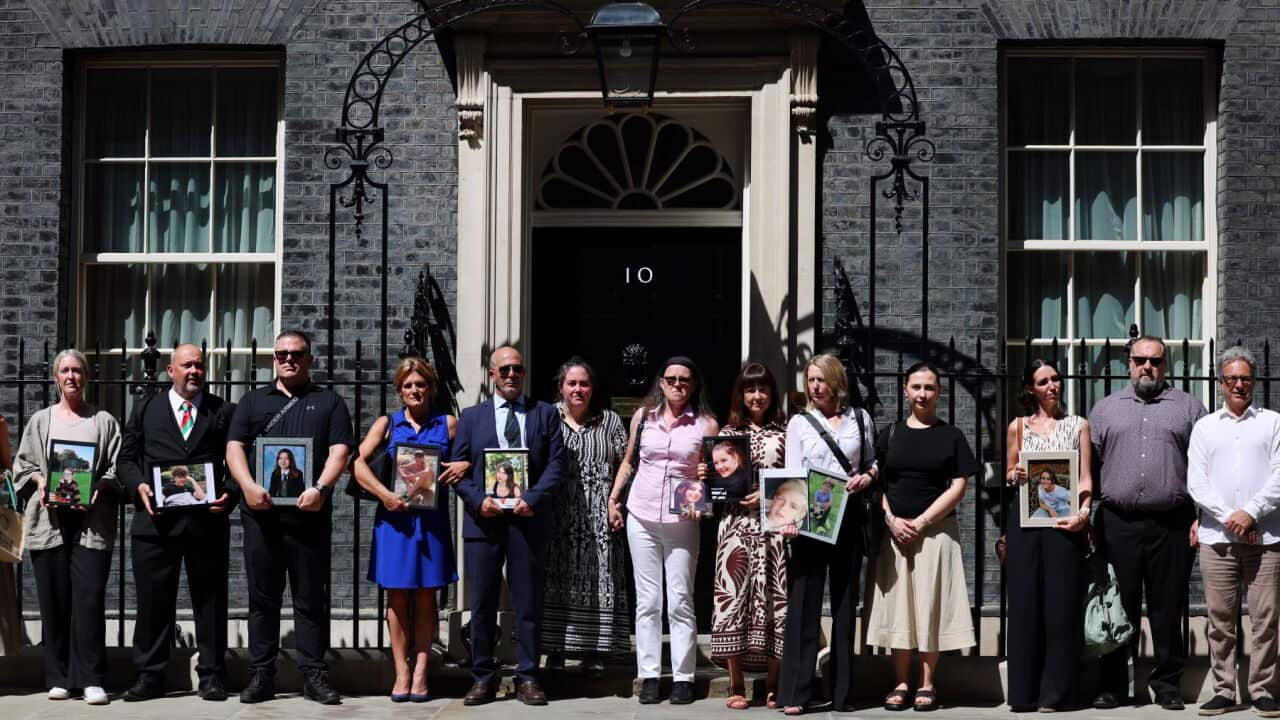
The family are among a group of bereaved parents who have gathered outside 10 Downing Street in London, carrying framed photographs of children whose deaths they say were linked to online harms, including cyberbullying, coercion, harmful online challenges and exploitation.
"Christoforos was voice and life in this house. Only we know how we live in this house. But again, we’re here to now save other kids’ lives and try to stop other parents crying."
The UK already introduced the Online Safety Act in October 2023, requiring platforms to remove illegal content and strengthen protections for children.
But Christoforos' father George Nicolaou says the families want Britain to go much further - and introduce a legal social media age ban for under 16s.
“We’re having a chat with the Prime Minister and we’re telling him, listen, enough is enough. We don’t want no more lives lost and we’ve got to save our children. So by banning social media, then this means that we are at least minimising the dangers they can foresee happen. Just like the way I lost my son Christopher and all the other parents that have lost their sons and daughters."
The government has come under pressure from others too to take stronger action.
The Academy of Medical Royal Colleges represents 23 medical bodies across the UK and Ireland.
In submissions to the government’s consultation on potential changes to the Act, they have warned that excessive exposure to social media and online content is contributing to worsening mental and physical health among children and teenagers.
They say doctors report regularly seeing cases linked to online violence, self harm material, eating disorder content, dangerous internet challenges and sleep deprivation.
There's been internal pressure too from Health Secretary Wes Streeting, who recently resigned, government saying he had lost confidence in Prime Minister Keir Starmer.
He has publicly backed calls for a ban on social media for under 16s.
“I hope and believe the government will introduce a ban on social media for under 16s. That’s certainly what I and others are calling for. I think the evidence is now overwhelming. The precautionary principles apply and I think it’s something that will be welcomed not just by parents, by teachers, but also young people themselves who know they’re in the wild west and need someone to get them out of it."
If Britain follows that route, it would join Australia – which has passed legislation banning children under 16 from holding social media accounts.
France also introduced rules in 2023 requiring parental consent for children under 15 to create social media accounts, while Norway and Spain have announced plans to ban social media for children under the age of 16.
Other countries, including the Netherlands, Italy and Chile, have tightened restrictions on smartphone use inside schools.
FDM CCS Insight tech analyst Ben Hatton says smartphones themselves are now deeply integrated into everyday life for teenagers, making them hard to discard.
“Smartphones are so embedded into modern life for teenagers and kids as much as you and I and every other adult. And if you look at things like payments and using maps and getting around, these are things that you would need a smartphone for. You can’t just move to a feature phone where you can still communicate, but a lot of those important functions for life are lost. And that is why there’s a real challenge with banning smartphones for young consumers, because they do still need them to a large degree, even just in terms of getting to and from school or other aspects.”
The UK government’s consultation on tougher online safety measures closed on the 26th May [[2026]].
Ministers are now expected to decide in the coming weeks whether Britain introduces a full social media age ban, stricter age verification rules or wider restrictions on how technology platforms recommend and distribute content to children.
Ben Hatton says the government should avoid introducing a blanket ban, arguing it could risk pushing children towards less regulated online spaces.
“A blanket social media ban just very simply prevents anyone under the age of let’s say 16 from using social media. The challenge is with that is it may push them towards more dangerous, less regulated sites. With restrictions, the idea is that you can phase the amount of usage or limit the usage that users can take. So you can offer a blanket ban for under 13s whilst restricting the access that under 16s or under 18s may get towards some of the more harmful content while allowing them the ability to search through these platforms and use these platforms as they wish."
The Prime Minister has not unveiled the details of what the government intends to do.
But he says tougher action can be expected.
“The question now is not whether we do something, we are going to act. I’m absolutely clear that this needs to be something where there’s a game changer. So we will be acting. The question is only what we do and that will be coming very quickly."
If you or someone you know needs crisis support, contact Lifeline on 13 11 14, the Suicide Call Back Service on 1300 659 467 and Kids Helpline on 1800 55 1800 (for young people aged up to 25). More information and support with mental health is available at beyondblue.org.au and on 1300 22 4636.
Embrace Multicultural Mental Health supports people from culturally and linguistically diverse backgrounds.
For culturally appropriate Indigenous support call 13 YARN.. a 24 hour national telephone helpline on 13 92 76 which provides support across a range of issues including mental health. https://www.13yarn.org.au/