
Millions have gathered in Saudi Arabia's Mecca for this year's Hajj pilgrimage. Scores of Muslim faithful make the trip every year with the intention of performing religious rites as taught by Islam's Prophet Mohammad to his followers 14 centuries ago.
Listen to Australian and world news, and follow trending topics with SBS News Podcasts.
TRANSCRIPT:
"The feeling a person has during Hajj is different. I've never felt this way before; it's a very different feeling because, as you say, it's a ritual, an obligation for those who are able to undertake it, but we all love to do it, and thank God, He made it easy for us to perform Hajj this year."
Meet Jordanian pilgrim, Hisham Al-Matarneh.
He's at Mecca's Grand Mosque, one of many to arrive in the city for this year's Hajj pilgrimage, an annual religious gathering.
Some pilgrims have spent years hoping and praying to one day perform the Hajj or save up money and wait for a permit to embark on the trip.
Among them is 64-year-old Palestinian, Najia Abu Lehia.
“We registered and our names got selected for Hajj before the war, and then the war broke out here and it became a barrier between us and travelling for Hajj. By now we should have performed Hajj, our name was selected from before the war. But the war broke out and there is nothing we can do.”
A quota system for visitors to Mecca was introduced in 1987, agreed by member countries of the Organisation of Islamic Cooperation, to limit the number allowed by each country to 0.1 percent of its population.
Among the arrivals is Bosnian Orhan Mocevic.
He is among an estimated 2,200-plus Bosnians expected to join more than 1.5 million worshippers from around the world.
"It is the greatest project in life (of a Muslim), the most important pilgrimage and the crown of worship and I am not at all concerned, especially as we are going to holy sites, so I do not expect any problems.”
The kingdom of Saudia Arabia has spent hundreds of billions of Saudi riyals on ambitious projects to expand and facilitate traffic in Islam's holiest sites.
Shariar is a pilgrim from India.
"Today I got the chance to visit the Mount of Noor and the cave of Hira, where our beloved (Prophet Mohammad), peace be upon him, received the first revelation of Koran through God, glory be to him and (Prophet) Gabriel, peace be upon him. This was one of the most memorable journey of my hajj. Apart from Umra, tawaf (Islamic ritual of walking around the Kaaba in Mecca) and sa'i (going back and forth seven times between Safa and Marwa during hajj)."
Celebrations also take place in the home countries of devotees, including Iraq.
Eid al-Adha, one of Islam's two main festivals and due midway through next week, marks the climax of the annual hajj pilgrimage.
It commemorates the willingness of Ibrahim, or Abraham, to sacrifice his son on God's command - often distributing meat to the poor.
This Iraqi, Mustafa Ali, is looking to buy sheep at markets in Baghdad to mark the occasion, but like so many others, soaring livestock prices are putting the tradition somewhat out of reach.
"Every year, we have to offer a sacrifice - we are forced to offer a sacrifice, but now (the sheep) that used to cost 200 thousand Iraqi dinars ($152.67), now costs 600 thousand (Iraqi dinars; $458.02), or 500 thousand ($381.68), or 400,000 ($305.34). So where are we supposed to get the money?"
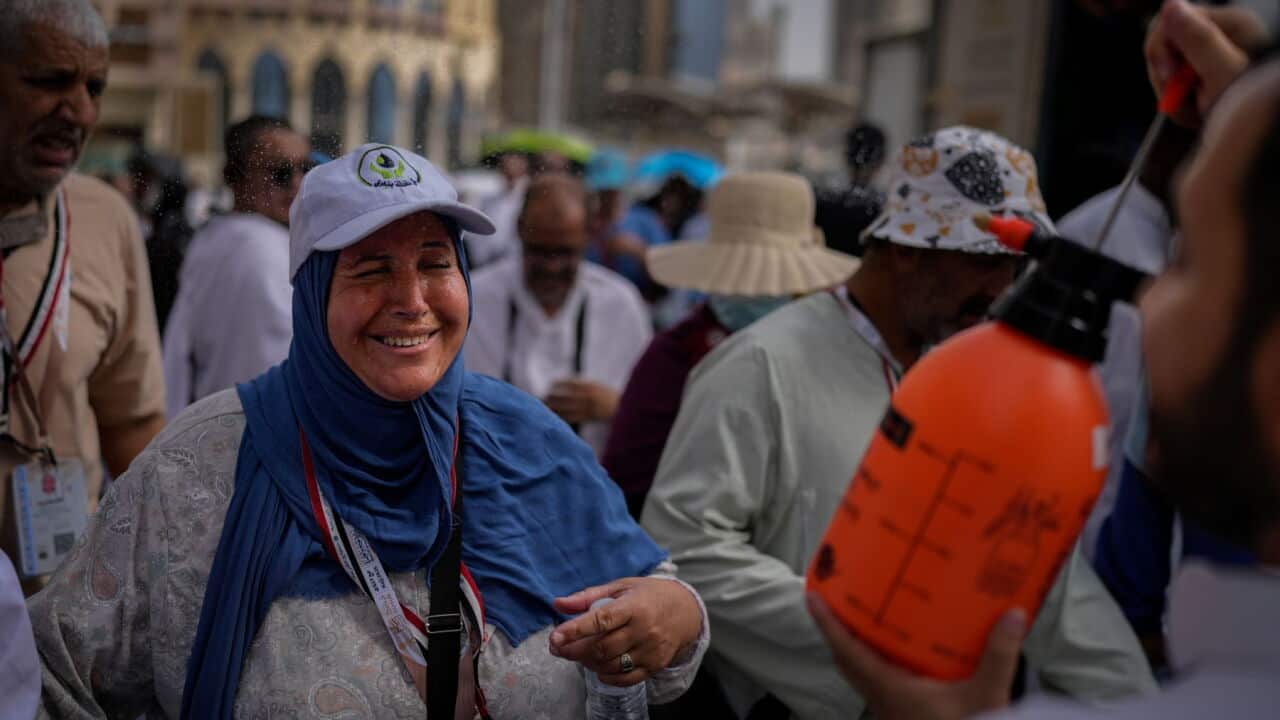
Back in Mecca, pilgrims are facing scorching temperatures reaching around 48 degrees Celsius as they perform the Hajj rituals.
It's a deadly concern after more than 1,300 people died during the 2024 Hajj.
The country’s health minister said at the time that most of those who died were unauthorised pilgrims who had walked long distances in the sun.
But Baraa Anwer - who is there for the Associated Press - says that's not the only thing overshadowing the pilgrimage.
"This year’s pilgrimage comes as the region remains on edge following conflict involving Iran, Israel and the United States, with a fragile ceasefire raising concerns over wider regional stability. Despite the tensions, Muslim pilgrims from around the world have arrived to unite in religious rituals and acts of worship... the Hajj unites Muslims of diverse races, ethnicities, languages and economic classes from around the world. This leaves many with a feeling of unity, connection and humility."