
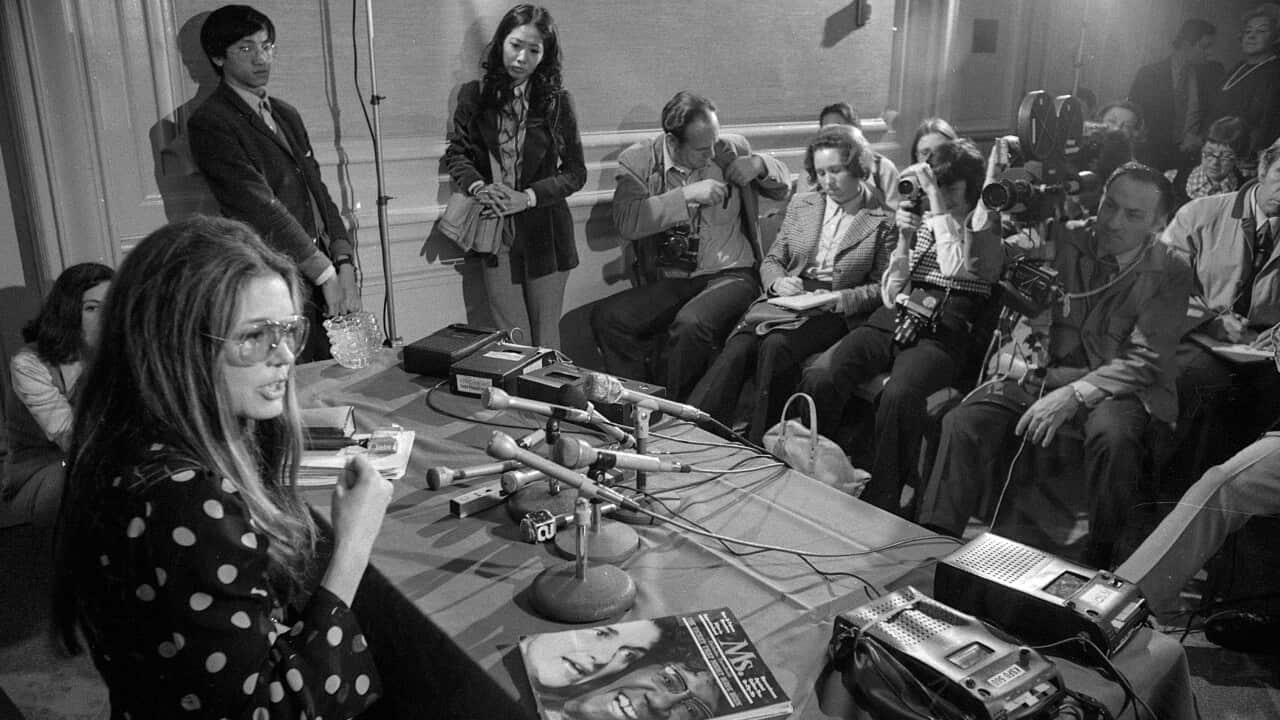

Tributes have poured in from around the world hailing Gloria Steinem as a "hero" after her death at the age of 92. Steinem is being remembered as one of the trailblazers for women's equality.
"She was my kind of feminist."
That's Linda Bubon, the co-founder of the Women & Children First book shop in the US city of Chicago.
She's referring to Gloria Steinem, who came to the store in 1990 to do a reading of her books.
"Shortly after we moved to this location in 1990, we got the call to host Gloria Steinem."
Gloria was well established by then as a feminist icon, a trailblazer for women's equality.
The first wave of the movement that came to be known as feminism came in the early 20th century when women campaigned for the right to vote.
"London, by the statue of their famous leader Mrs Emmeline Pankhurst, suffragettes meet again to celebrate the 50th anniversary of the birth of their movement which fought unceasingly for votes for women."
Gloria became a prominent voice of the second wave of the movement- the core focus of which was on workplace equality, reproductive freedoms, and family roles.
And that is how she is being remembered in this book shop, following her death in New York City at the age of 92.
Customer Carol Brook says Steinem changed her life.
"I actually unexpectedly met Gloria 20 years ago at Hedgebrook. Hedgebook is a writer's residency on Whidbey Island outside of Seattle... So I had dinner with her every night for two weeks. I was terrified. She was amazing. She was welcoming and generous."
Similar tributes are pouring in from many others in the US and around the world.
New York resident Annie Jean is among hundreds to lay flowers outside Steinem's residence.
"I think it was, we all felt very inspired by Gloria's choice to spend her life standing up for women."
Born in Toledo, Ohio, her parents separated when she was 11, after which point, Steinem took care of her mother, who had a mental breakdown and suffered from depression.
The experience impacted Steinem's views on social injustice and marriage, which she believed robbed women of choices and many of their civil rights.
She began her professional career as a freelance journalist in New York City and first gained prominence in 1963 after going undercover as a Playboy Bunny to produce an expose - for Show magazine - on the working conditions at Hugh Hefner's Playboy Club.
But despite making a name for herself, Steinem once said she was still not taken seriously by the heavily male-dominated newsroom.
"It almost destroyed me. It was a big mistake. I was just beginning to be taken seriously, and once you're seen as a bunny, you're finished. At least then, and pretty much now, too."
In 1968, Steinem helped found New York magazine, where her essay titled "After Black Power, Women's Liberation" established her as a feminist leader at a time of significant social change.
She went on to write as a columnist for the magazine where she reported on political campaigns and progressive social issues.
Jocelyn Noveck from the Associated Press says it was a meeting in 1969 that launched Gloria's career as an activist.
"She attended a meet where women spoke out about their illegal abortions. And Steinem herself had had an illegal abortion when she was in her 20s. And hearing the stories of these women really motivated her to make a career change from being a journalist to being a full-fledged activist. And she really became a leader of the feminist movement."
Gloria went on to champion a range of causes.
She founded the National Women's Political Caucus in 1971 with former US Representatives Bella Abzug and Shirley Chisholm and writer Betty Friedan, whose 1963 book "The Feminine Mystique" also helped to usher in the second wave of feminism.
Among other groups, she also created the Coalition of Labor Union Women, the Women's Media Center, Voters for Choice and the Ms. Foundation for Women.
Another one of her early seminal decisions was to establish Ms Magazine, tackling topics like abortion and other issues such as sexism, equal pay and domestic violence.
It was a far cry from the diet of beauty, cookery and supporting-your-husband topics that were the staple of magazines then aimed at women - and bookstore customer Carol Brook says it had a massive impact.
"Ms. Magazine came out in 1972, when I was much younger. And Ms. Magazine changed all of our lives."
With her trademark streaked hair parted down the middle and large aviator glasses, Steinem ultimately became a hugely recognizable presence wherever she went - and she went everywhere for decades, to college campuses and community centres, rallies and marches.
Gloria had no children of her own and it was not until she turned 66 that she decided to wed - to South African businessman and environmentalist David Bale, the father of actor Christian Bale.
Her life was closely observed by women like New York City resident Meg Winslow, who is 68.
She says her mother was the first in the family to feel the positive impact of Gloria's activism.
"She had six kids by the time she was 30, and then went back and got her degree and got her B-A (Bachelor of Arts degree) at 40 when my sister got her B-A So - and it opened up her life, reading and connecting with Gloria Steinem. So I'm younger, but it - her work really impacted my life.”
Steinem’s death come as some New Yorkers reflect on the issues she championed — from gender equality to reproductive rights.
The feminist movement has now developed into debates around what feminism looks like for individual women, while combatting lingering issues including sexual harassment and gender pay gaps.
Some have argued that the principles and rights Gloria Steinem fought for have come under threat through pushback from conservative voices, citing the US Supreme Court decision to unwind the seminal Roe versus Wade ruling and continued attacks on access to abortion.
But Meg Winslow says the issues championed by Gloria Steinem remain central to the national debate about women's rights.
"I did read the (obituary) article this morning in The (New York) Times and found myself thinking back to my mother and also wondering who's going to step forward? Who's going to be able to greet this... this era of backwards thinking?”









