
As the government works to attract greater investment from AI companies, its commitment to strong copyright protections for Australian creatives has come into focus. An opt-out model is being considered, which would require copyright holders to take active steps to prevent their content being scraped and used to train AI. It comes as the government negotiates with big tech companies in an effort to attract investment and data centres.
Listen to Australian and world news and follow trending topics with SBS News Podcasts.
TRANSCRIPT
"Australian writers, musicians, artists and journalists must retain ownership and control of their work. Our laws will spell that out, plain as day."
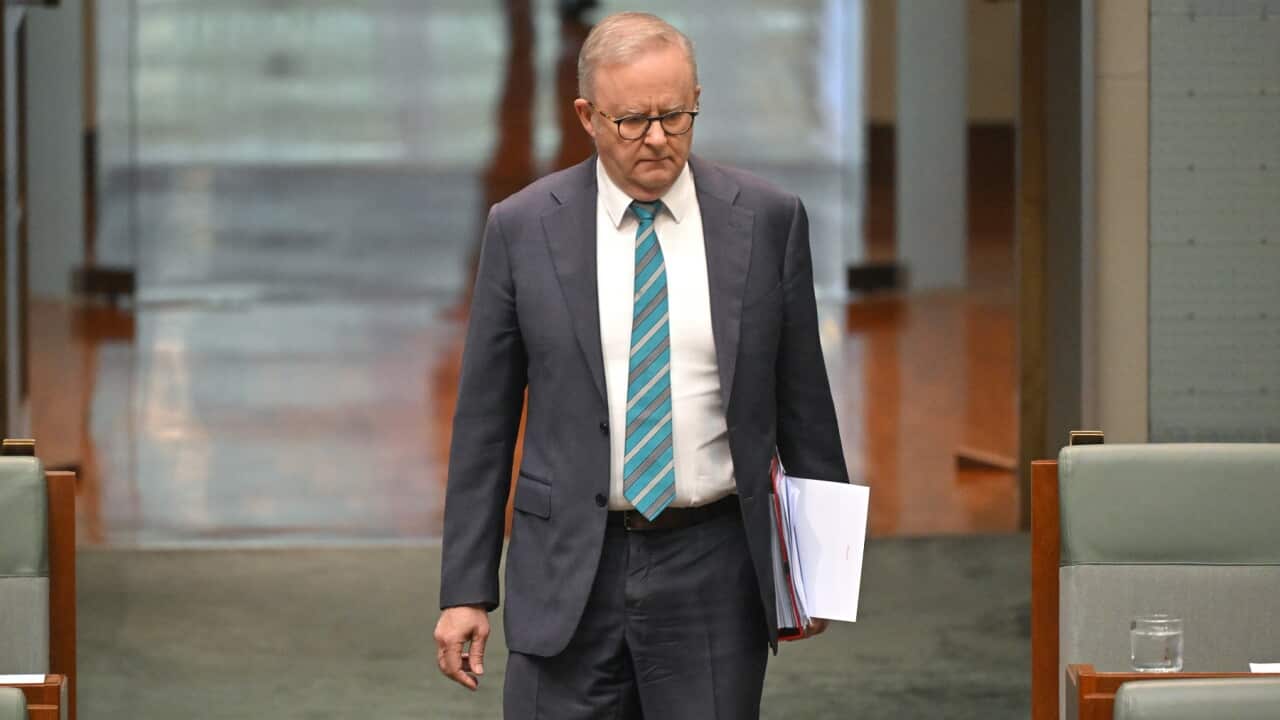
It’s a promise Prime Minister Anthony Albanese made two months during a speech in Sydney where he outlined the government's approach to AI.
"An artist’s creative endeavour is their work and their property. No company should use Australian books, music, art or news to build or train AI without the artist’s control. And that includes the artist’s control of the price and value of their work. Anything less is theft."
Now, new details have emerged about consultation on how creatives will be given control over whether companies use their content to train AI models, and compensate them if they do.
Documents tabled in the Senate provide an overview of options prepared by the Attorney-General’s department.
They've been met with criticism from independent Senator David Pocock.
"What the government's proposing would upend copyright as we know it in this country, and it would put the onus on copyright holders and every Australian to protect their own copyright, their images from AI companies, rather than actually relying on the Copyright Act."
A spokesperson for Attorney-General Michelle Rowland said in a statement the government will deliver meaningful control and fair compensation.
Amid negotiations for AI models to be trained in Australia, consultation continues with AI companies, creatives and media groups.
David Pocock says the government appears to be making too many concessions.
"They're constantly making the case that we have to have access to these latest models, that there's national security implications. What I say to that is not at any cost and not behind closed doors. Let's actually have this conversation as a country. What do we value? And I know that Australians value our creatives, the authors, the artists, the journalists. We have to value their work as a country, and we should be saying to these AI companies, we have something that you want, and you need to go and negotiate with these copyright holders to use their works."
The consultation document sets out two proposals, both based on an opt-out system that would require rights holders to take active steps to protect their material.
Tech companies would need to satisfy set conditions before they could legally train AI models on the material of copyright owners who had not opted out.
One proposal would see AI companies pay into a central fund, which would then distribute compensation to copyright owners.
Another would require tech giants to do deals with a minimum number of companies over a minimum period before they could legally scrape the internet for training data.
Senator Pocock says the government needs to do more to make big tech companies pay.
“And they've been consulting on this for a long time, and I don't understand why it all happens behind closed doors. Let's have this conversation. Let's actually use the leverage that we have as a country to force these companies, you know, that are heading for trillion-dollar valuations on the US stock market, and then turning around and saying, ‘Oh, we can't actually afford to pay creatives to use their work.’”
The conversation around copyright comes as the Albanese government actively pushes to attract greater investment through data centres.
In July, the prime minister proposed a federal framework of national standards to govern issues like energy, water and site selection.
He said data centres would need to be net generators of electricity, and contribute to the renewables roll out – a proposition that has attracted significant pushback from Queensland and the NT.
On Wednesday, Nationals leader Matt Canavan has also weighed in, saying he wants to see more investment.
"But one of the biggest barriers, though, for our own country taking those opportunities is part of the parlous state of our energy market, and that's why these related reforms we're doing to unleash energy resources like coal, oil, and gas, another piece of legislation we're pushing to remove the ban on nuclear energy, can all help make sure that our country can take opportunities as they arise."
For one of the world’s biggest AI companies, OpenAI, those opportunities could be contingent on weakening copyright laws.
On Tuesday, The Australian reported that senior vice president Ann O'Leary had delivered an ultimatum, in an article headlined: "dilute creatives' rights or we won't discuss renewables".
It's a position that will be fiercely resisted by many high-profile Australian artists, who've mounted a sustained campaign for stronger protections.
The government hopes to legislate its new AI framework early next year.