
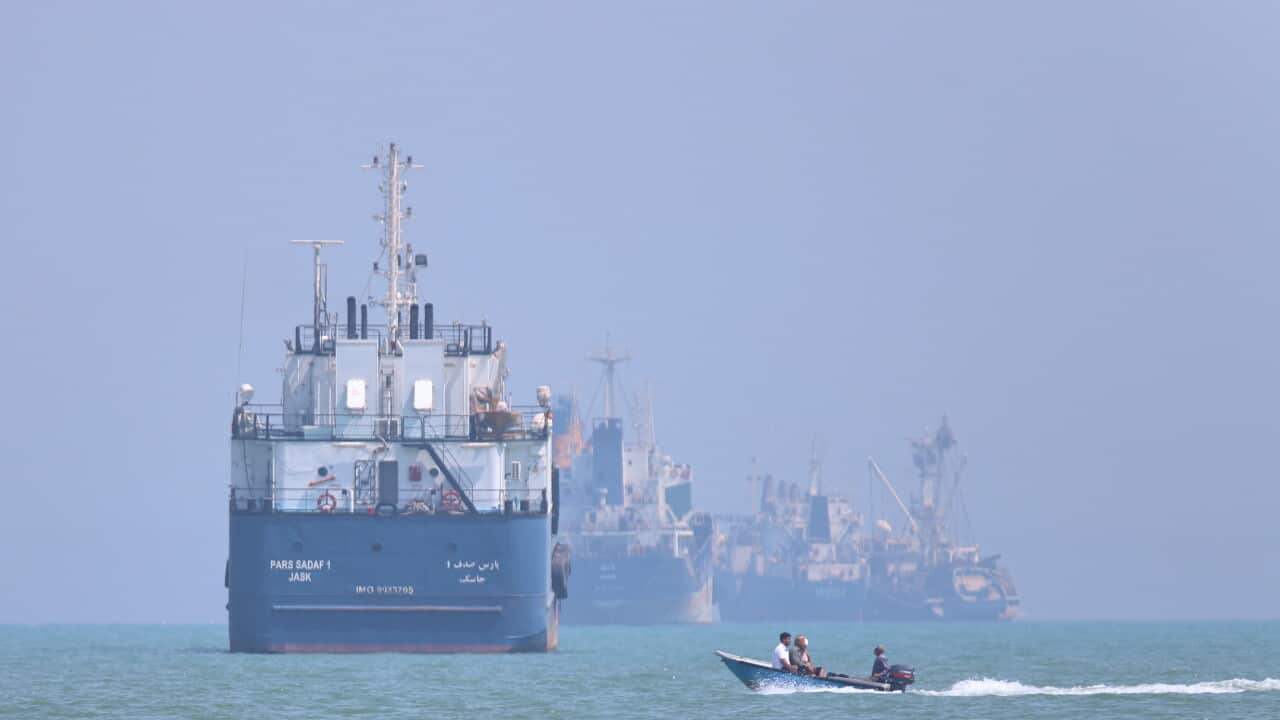

Just hours after threatening to launch what he described as a bigger and more powerful attack on Iran, US President Donald Trump says a deal may now be within reach. The dramatic shift has raised hopes that a wider regional conflict could be avoided. But while diplomats talk about agreements and ceasefires, families across the Middle East and beyond are still counting the cost of a conflict that continues to reverberate across the region.
Listen to Australian and world news and follow trending topics with SBS News Podcasts.
TRANSCRIPT
Just hours after threatening to launch what he described as a bigger and more powerful attack on Iran, US President Donald Trump says a deal may now be within reach.
The dramatic shift has raised hopes that a wider regional conflict could be avoided.
But while diplomats talk about agreements and ceasefires, families across the Middle East and beyond are still counting the cost of a conflict that continues to reverberate across the region.
"Most importantly we have a deal that Iran will never have a nuclear weapon, which was the whole purpose of what we had to go through to get this so it's a very big thing but we have a signing soon and the documents are pretty final shape so we'll see, we'll see, very good. Should be done, should be done pretty quickly, they want it every but as much as everybody else wants it."
He says maritime traffic will resume once the agreement is formally signed.
Just hours before announcing the breakthrough, the US president had threatened to strike Iran "very hard" and suggested the United States could take control of Kharg Island, the terminal that handles most of Iran's oil exports.
Iran's response was swift.
Officials in Tehran warned that any American attack would trigger a severe retaliation.
Ebrahim Azizi, who heads the Iranian Parliament's National Security Commission, accused Mr Trump of repeatedly making threats and said Iran's military was ready to respond.
"The delusional President of the United States ... has always made these kinds of threats, but without a doubt the Islamic Republic of Iran will certainly deliver a decisive, crushing, painful, and regret-inducing response to these actions and behaviours."
Meanwhile in India, families are mourning the deaths of three sailors killed during a U-S operation that targeted an oil tanker off the coast of Oman.
The vessel was among several ships intercepted as part of Washington's efforts to enforce a blockade on Iran-linked shipping.
One of those killed was deck cadet Aditya Sharma from the northern Indian state of Himachal Pradesh.
His family is now demanding answers.
His uncle, Himanshu Sharma, says the United States should be held accountable and has appealed directly to Indian Prime Minister Narendra Modi to help bring his nephew's body home.
"First of all, who will be accountable for all this? Will the U.S. government take responsibility for this and admit... It was their mistake. They should have blockaded the ships. If they were forcefully trying to pass through, then they could have blockaded the ship. I feel attacking a commercial vessel is really against humanity."
The deaths come just days before India's Prime Minister, Narendra Modi, is expected to meet President Trump on the sidelines of the G-7 summit.
The rapid swings between threats and diplomacy have left many observers struggling to predict what comes next.
Meanwhile, at the United Nations, Secretary-General Antonio Guterres is warning that the Middle East remains dangerously close to a much wider war.
His deputy spokesperson, Farhan Haq, says recent attacks and increasingly aggressive rhetoric risk undoing months of efforts to contain the fighting.
Mr Haq says the Secretary-General fears the region could soon return to full-scale conflict.
"The Secretary General warned the Security Council this morning that the Middle East is being pulled deeper into crisis and the consequences reach far beyond the region. This week has brought wider attacks and further deterioration. He is profoundly concerned it could trigger a full resumption of conflict. We should not minimise the risk of lesser fire becoming full fire, in other words, full scale war."
Meanwhile, fresh Israeli strikes sent smoke billowing across southern Lebanon, according to Lebanese state media.
Mr Haq also expressed the UN Secretary-General's concerns about the situation there.
“On Lebanon, he warned that since March we have witnessed a serious escalation, as Israel intensified its operations in Lebanese territory and Hezbollah fired deeper into Israel. All parties must work towards a diplomatic settlement that fully respects the territorial integrity, sovereignty, and political independence of Lebanon within its internationally recognized borders.”
The attacks came just two days after a wave of airstrikes and drone strikes reportedly killed at least 16 people and wounded dozens more.
The deadliest strike hit a residential neighbourhood in the southern city of Tyre, where eight people were killed and 32 others injured.
Lebanon says Israel has carried out nearly 3,500 strikes since the truce was announced, while more than 3,600 people have been killed and over one million displaced since the conflict escalated.
Police in Tel Aviv have clashed with ultra-Orthodox protesters opposing plans to expand military conscription, with demonstrators blocking major roads before being removed by officers.
The dispute centres on long-standing exemptions that have allowed most ultra-Orthodox Jewish men to avoid compulsory military service.
But after nearly two years of fighting in Gaza and Lebanon, many Israelis argue those exemptions are becoming increasingly difficult to justify.
From the streets of Tel Aviv to the ports of Oman, from Gaza to the Strait of Hormuz, the consequences of war continue to shape lives across the region.
Whether the latest diplomatic push brings lasting stability may become clear in the days ahead.
At the same time, divisions are growing inside Israel.









