
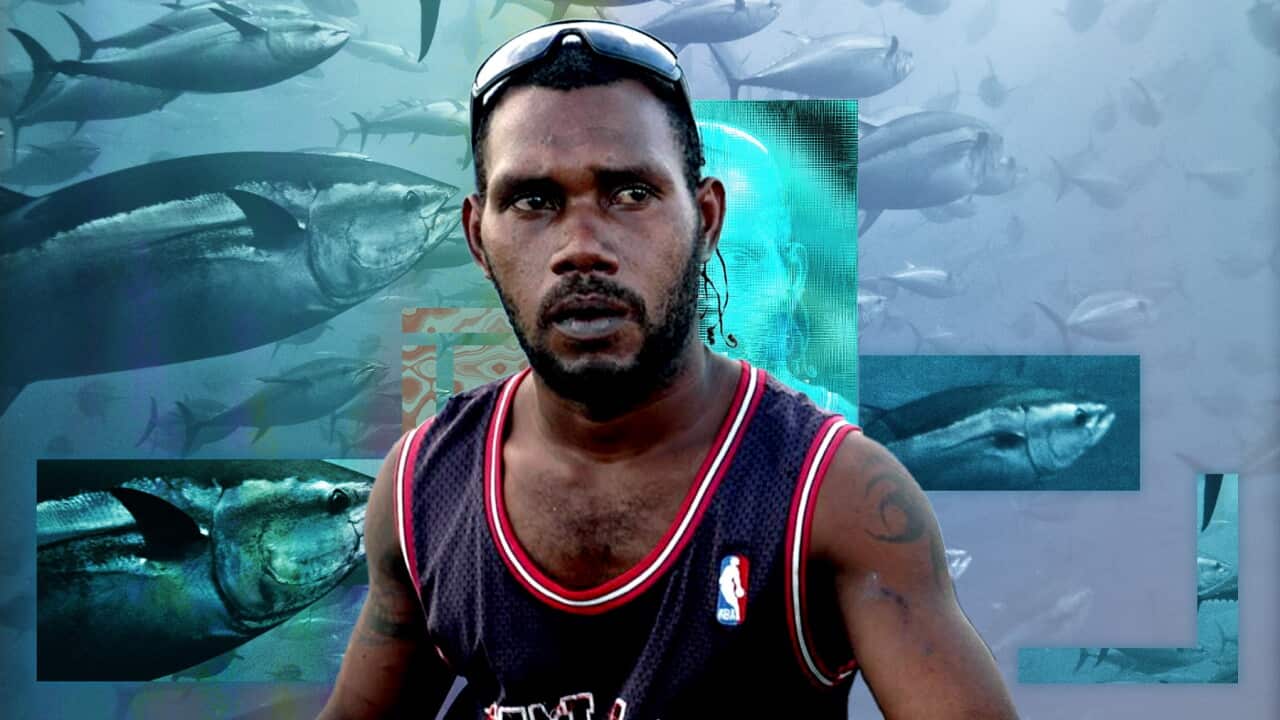

Some Pacific Island Nations are facing a decline in tuna harvest, by 20 per cent on average, by 2050 - with experts warning climate-related fish migration could pose a looming threat to food security and economies across the region. In Solomon Islands, more than 90 per cent of inshore coastal areas fall under customary marine tenure - casting community-led solutions as vital to the sustainability of local fishing grounds. And this feature was produced with support from the Pulitzer Centre.
Listen to Australian and world news and follow trending topics with SBS News Podcasts.
TRANSCRIPT
Dawn breaks over the Langalanga Lagoon - on the west coast of Malaita in Solomon Islands.
It's prime fishing time - and a cluster of canoes dot the calm waters.
The fishermen are using handreels - hoping to hook fish to eat or sell at the market.
This is James Waleronoa, who has been fishing here for years.
“Fishing is important to my life because it helps me to survive as someone that's struggling to make ends meet.”
Locals call themselves saltwater people.
Their connection to the sea passed down through generations.
Lawrence Sale stays out on the water for hours most days.
“I learned to fish from my dad. Now I am able to fish for myself. Now, fishing can help me pay for my daughter's education as well as food for the family. So fishing is like my full time job.”
Tuna species like skipjack and yellowfin are a common catch here -
But a wrestle with a large fish in this lagoon is rare.
On this particular morning, a fortuitous bite from a billfish turns into quite the spectacle, as Sani, a local fisherman strategically tustles to reel in a 2 metre catch.
“It depends on your lucky day. But it's difficult to catch this kind of fish.”
Located in the Coral Triangle, the waters surrounding Solomon Islands form part of what's been dubbed the Amazon of the Seas - and according to locals, these were once abundant fishing grounds.
But a combination of factors like rising ocean temperatures, acidification and sea-level rise, as well as human-driven pressures, including overfishing, are impacting local stocks.
Ben Waleilia is a community leader in the village of Oibola, on the Langa Langa lagoon.
“With the coming of big fishing companies, I have noticed especially tuna, pelagic species have receded and this is affecting our communities, our livelihoods.”
These changes have required Ben Waleilia's village of Oibola and its neighbours to take action.
Through community effort, a fish aggregating device, known as a FAD, was anchored 2 kilometres off shore.
It's proving a successful solution - enticing schools of fish to congregate in one spot.
“The number of fish being caught by fishermen at the FAD is increasing only because of the fishing aggrevating device. The small fish are attracted to the FAD and then the bigger fish follow. Just like on a reef.”
But out on this lagoon, the fishermen tell us a dangerous fishing method is threatening this areas biodiversity - fishing with dynamite.
The dynamite is procured from unexploded World War Two ordnance - thousands of items still scattered across the Solomon Archipelago - making it one of the most contaminated places in the Pacific.
Meshach Sukulu is a research analyst with the international research organisation WorldFish Center, based in Malaita.
“Langlanga is known for dynamite fishing. In a single day, you can hear more than one explosion.”
These underwater explosions are also destroying sea shells - required to craft "shell money" -
A local form of currency central to customary practices, including bride price ceremonies, resolving disputes or paying fines.
Diversifying income sources another concern for the village -
Ben Waleilia says the community has recently implemented a project to begin seaweed farming to take the pressure of its fishing grounds.
“It is harvested, dried here and then sold.”
According to Sukulu, Oibola is part of a cluster of seven communities whose management program involves more than 2,500 people.
SUKULU: "Wherever there is seaweed, you can expect turtles and also the squid population increases"
REPORTER: "And how important is community based resource management to ensuring sustainability?"
SUKULU: "It's about gathering communities to look after their resources, have a management plan in place and enforce those rules to make sure that the stocks are recovering.”
Mangrove restoration is another example of community-based resource management - their root systems shielding the shoreline and essential to the coastal ecosystem.
Waleilia has long championed this project in his village, his father having begun planting after watching the forest disappear and the tide move in.
“Reviving the mangrove means protecting against erosion, and a breeding ground for fish, birds, shells -that we eat - and the mangrove crab.”
Ben has so far planted more than 17,000 shoots -
But it's his concern for the future that keeps him planting.
“When we started the project, I had a third son, he was like five, six. And he came up to me and asked for food. I was watching him and thinking at the same time, here's me feeding you. "What about you feeding your children?" Will you be left with the same environment that I grew up in?”
An uncertain outlook, for a country among the world's most vulnerable to a changing climate.
This feature was produced with support from the Pulitzer Centre.