

The United States has launched new strikes on Iran, after US President Donald Trump threatened a heavy response to an attack on a US military base in Jordan. The strikes comes amid growing concern over an expanding conflict, after a drone attack on a US-owned gas storage tanker in Egypt, and the U-S and Saudi Arabia launched joint-strikes on Iran-backed militias in Iraq.
Listen to Australian and world news and follow trending topics with SBS News Podcasts.
TRANSCRIPT
United States Central Command says it has launched new strikes in Iran, in response to what it describes as 'attempted Iranian attacks on US forces' in the Middle East.
US President Donald Trump earlier vowed to strike Iran with force, after Iran fired missiles at a US military base in Jordan.
Iran's Revolutionary Guard says Wednesday's surprise attack on Jordan’s Muwaffaq Salti Air Base- a key US military hub for the region-was in response to recent US strikes.
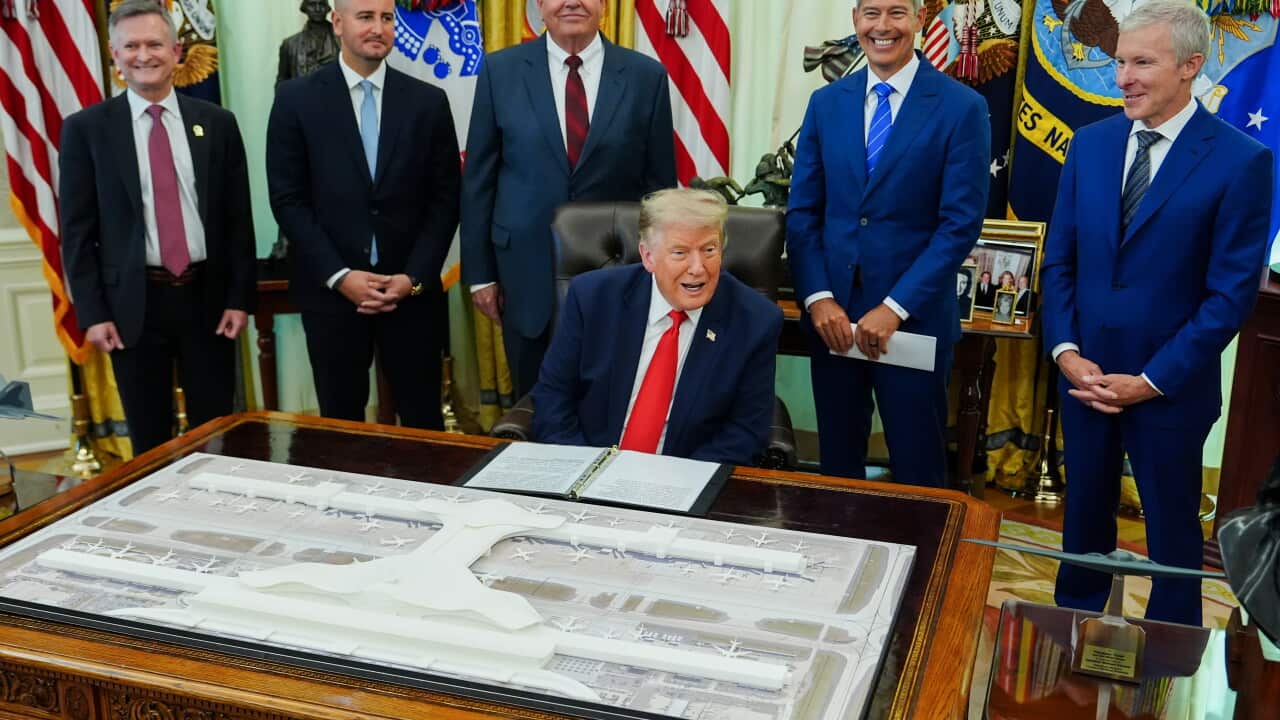
Speaking from the Oval Office, the US President says there is still a chance to reach a negotiated settlement with Iran, but for now, his attention is on ensuring Iran's strikes don't go unpunished.
"It's our turn to hit them. They know it's coming. They're asking us not to do it, but, you know, they tried shooting it last night. So we had five rockets going 8,500 miles an hour. And all five rockets were knocked down to the ground, but they, nevertheless, took a shot. So it's our turn."
The renewed strikes come amid fears of an expanding conflict in the Middle East, after a drone attack struck a US-owned gas storage tanker at Egypt's Damietta port in the Mediterranean.
British maritime security company Ambrey says the drone strike sparked a fire that spread to a second vessel, before crews were evacuated and the blaze was brought under control.
No group has claimed responsibility, and no casualties have been reported.
US President Trump says he's been alerted to the incident and will deliver a response shortly.
"Well I'm going to give you a report, I've been briefed. It's a little more of the same, but it's, can be straightened out. It's going to be straightening out."
Meanwhile, the US and Saudi Arabia have launched air strikes on Iran-backed militias in Iraq.
The Iraqi military says 20 members of the Popular Mobilisation Forces were killed and 32 wounded.
One strike hit a residential area in the city of Karbala, prompting anger from residents and condemnation from the Iraqi government, which says the attacks violated its sovereignty.
Karbala resident Mohammed Shaheed says civilians are the ones paying the price for the escalation in violence.
“Where is the sovereignty? These are citizen lives. Who will take responsibility for this? The commander denies, the president denies, and what is the citizen supposed to say? At 3:30 in the morning, people were sleeping, there were families and children, women, and elderly people who might have heart issues, diabetes. Who will take responsibility for this?”
Saudi Arabia and the US Central Command say the joint strikes were a response to alleged drone attacks on Saudi oil facilities.
Analysts warn Riyadh's decision to publicly join the US in the military action marks another dangerous widening of the conflict.
In response to the recent escalations on multiple fronts, Deputy Spokesman for the UN Secretary-General Farhan Haq has delivered a stark warning against further expansion.
"The one thing we don't want to see, again, is any expansion of the conflict. So having more parties involved in the fighting, having the fighting spread to a larger number of countries, all of these are adverse developments and could get us into a much worse situation even than before."
As the US weighs its next steps in the conflict, Defense Secretary Pete Hegseth has met Israeli Prime Minister Benjamin Netanyahu in Washington.
It follows talks between Mr Netanyahu and President Trump a day earlier, months after the US and Israel launched their joint military campaign against Tehran.
An Israeli official says Mr Netanyahu told Mr Trump Israel would respond if attacked by Iran but would otherwise leave any further action to the U-S president.









