
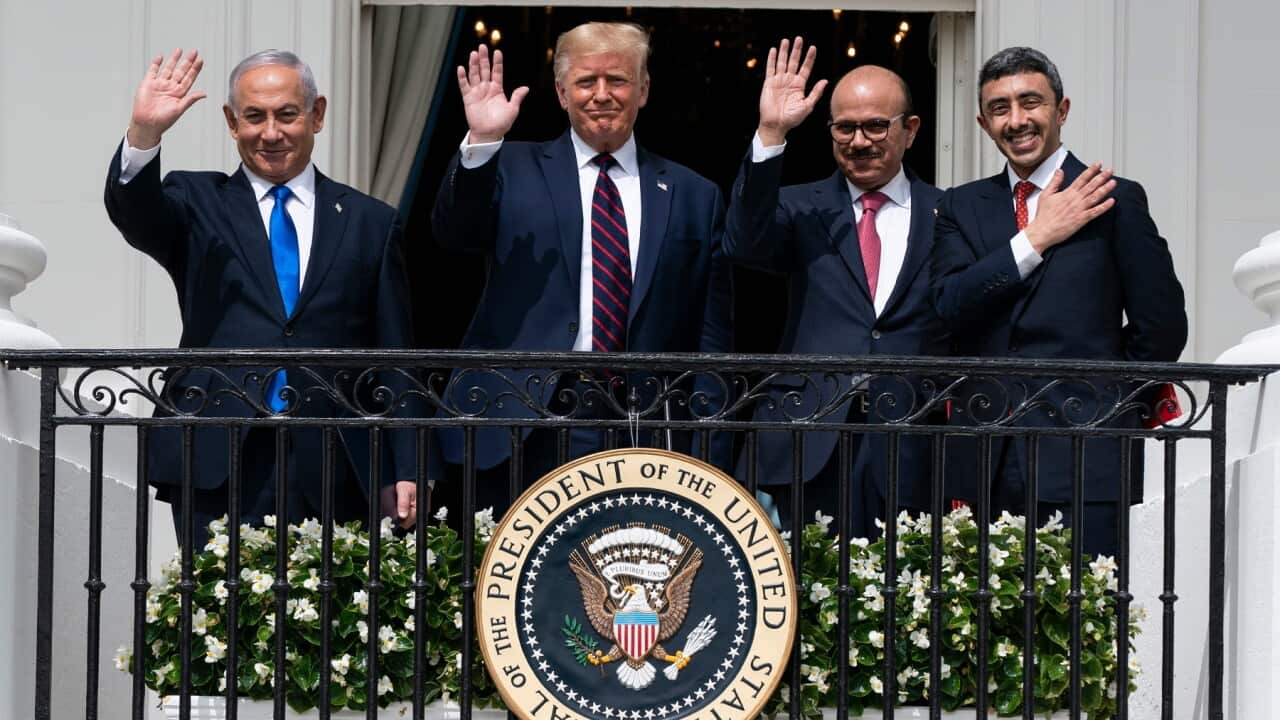

US President Donald Trump has called on a range of Gulf countries to improve their relationship with Israel as negotiations continue with Iran on an agreement to end the war. In a post on Truth Social, Trump has called on more Arab and Muslim states to sign up to the Abraham Accords, which were brokered during his first term in office. Here, we explain what the accords are, and why they're so significant.
Listen to Australian and world news, and follow trending topics with SBS News Podcasts.
TRANSCRIPT
The US Ambassador to Israel, Mike Huckabee, is feeling positive today.
"I'm very optimistic that we're going to see other nations join the Abraham Accords. It may not look like it right now because of the atmosphere that we've just gone through, but one of the things that I hope has resulted is that Gulf states have now understood that they're going to have to make a choice."
Those remarks are in response to a Truth Social post by US President Donald Trump, calling on more Arab and Muslim states to sign up to the Accords that were brokered during his first term in office.
This was his statement at the time:
"These agreements prove that the nations of the region are breaking free from the failed approaches of the past. Today's signing sets history on a new course, and there will be other countries very, very soon that will follow these great leaders."
But just what are the Abraham Accords, and why are they so important?
Bahrain and the United Arab Emirates signed the historic deal in 2020 to normalise ties with Israel, with the US-brokered treaties the first such major agreements between an Arab nation and Israel in 25 years.
The countries committed to exchange embassies and ambassadors, and cooperate on issues such as education, health, security, and trade.
Dr Bob Bowker is an honorary professorial fellow at the centre for Araba and Islamic studies at the Australian National University.
He says the deal is of most importance to Israeli politically, but has provided no security assurance to any of the Gulf states.
"The United Arab Emirates and Bahrain did sign on to those accords, including with some countries further removed such as Sudan and Morocco. But the importance of the accord is really a political one within Israel, rather than seeking to reshape the relationship between the Arab world as a whole."
The accords made no mention of the decades-long conflict between Israel and the Palestinians.
Despite that, the UAE's foreign minister Sheikh Abdullah bin Zayed Al Nahyan has expressed his support for a two state solution, and say the Accords are a way to make progress towards that goal.
ARABIC THEN ENGLISH VO: "This accord will enable us to continue to stand by the Palestinian people and realise their hopes for an independent state within a stable and prosperous region."
The president has called his present day demand on Truth Social for more signatures on the Abraham Accords a mandatory move, directly naming Saudi Arabia and Qatar, as well as Pakistan, Egypt, Jordan and Turkiye.
Pakistan has already rejected the call, while the other countries are yet to respond publicly.
Dr Bowker says that is because it not a realistic proposition by the US President.
"And indeed when Trump first made the suggestion it was greeted with stony silence by those countries he was meeting with. I think we will probably see a great deal of pressure upon the United Arab Emirates and possibly also Bahrain, to walk away from their relationship with Israel as a result of the greater need to find a predictable and stable relationship with Iran going forward."
The Israeli government is currently under fire from the international community for acting without guidance or consultation with regional neighbours in its joint assault on Iran and ongoing fight against Hezbollah fighters in Lebanon.
Prime Minister Benjamin Netanyahu is accused of breaching international law with the ongoing military campaign, which has displaced hundreds of thousands of people in the south.
Lebanese health authorities report more than 3200 people have been killed in strikes between March and Mid-May, as Mr Netanyahu told residents he would escalate the fight against Hezbollah militants there.
(Hebrew to English VO) “We will hit them. It's true that they are shooting drones at us, fibre optic drones. We have a special team working on that and we will solve that too. In the meantime, you are showing resilience, I want to bless the residents of the north's resilience that inspires all of us. But what this requires of us now is to increase the blows, to increase the intensity. We will smite them with overwhelming force."
Iran project director at the International Crisis Group, Ali Vaez, says Mr Trump is trying to sell an Iran deal as an Abraham Accords sequel - while trading one fantasy for another.
“Having survived this war, they believe that they have the credibility to cast a broader umbrella and bring and basically enlarge their own base, which is important for their survival in the medium to long run. But it is not going to win over the majority of the Iranian people unless and until the regime can either deliver on economic prosperity, or provide even more social or political freedoms.”









