
The Hunter region of New South Wales has long been associated with coal mining and energy production. As the transition to renewable energy ramps up, key players are trying to make sure there's enough jobs for workers who will be displaced. And taking advantage of the sites that played a key role in coal-fired energy generation, for a renewable future.
Listen to Australian and world news and follow trending topics with SBS News Podcasts.
TRANSCRIPT
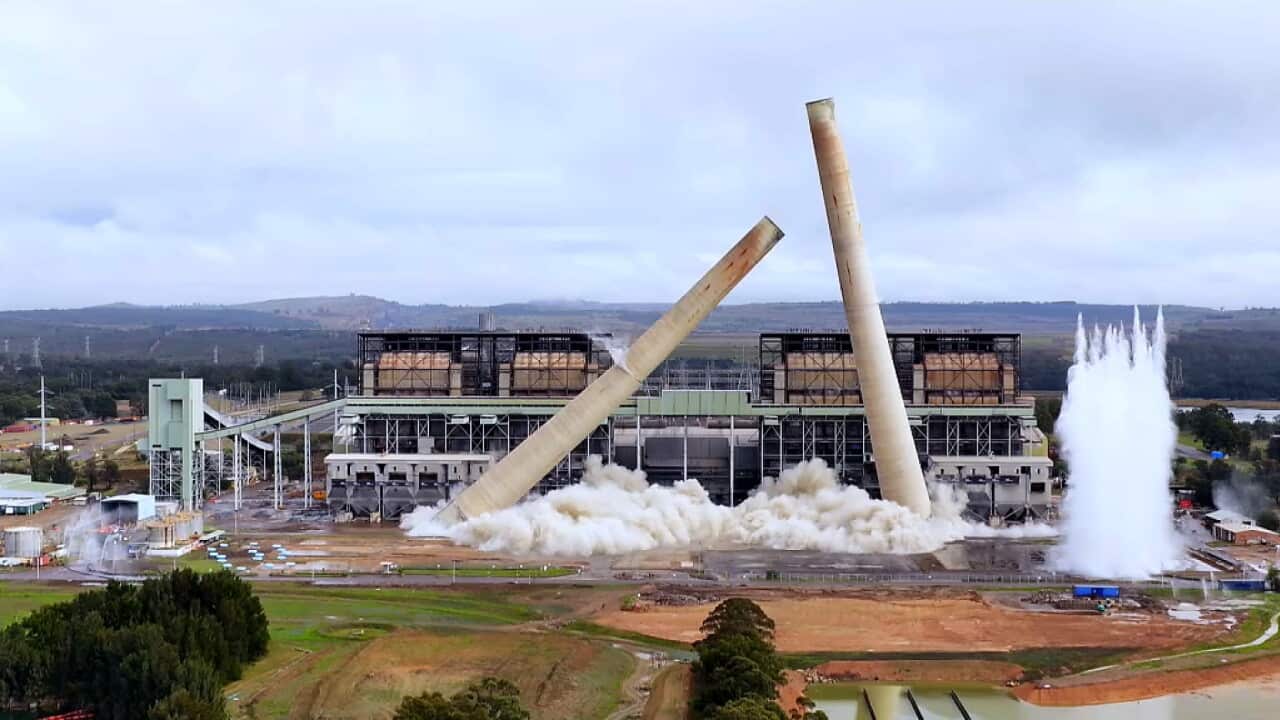
That's the sound of two almost 170-metre tall chimneys coming down in a controlled explosion at the former Liddell Power Station, in the New South Wales Hunter region.
The power station, known affectionately as 'Old Lady Liddell' provided power for around a-million homes, for more than 50 years.
As the power station comes down, a grid-scale battery has been powering up.
Energy company AGL owns the site and General Manager of Energy Hubs, Liz Perrone, says when it's online it will be able to power 200-thousand homes for up to two hours.
“Batteries play an incredibly important role in the energy transition in that they can be charged in the middle of the day when the sun is shining - like it is today - and the wind is blowing. And then the battery can be discharged in the evening when demand is at its peak. So if you think about people arriving home from work or school and they're turning on their lights and heating their homes and cooling their homes.”
Ms Perrone says the site has a key advantage when it comes to building a battery.
“Purely from a battery perspective, there are already existing connections to the energy grid, the power grid. So we can connect to that grid and supply into the market.”
The Energy Corporation of New South Wales, or EnergyCo, is leading the delivery of renewable energy zones across New South Wales, including one covering the Hunter and Central Coast.
Executive project director, Phil Bratby, says old power stations are a prime location for batteries, including the Waratah Super Battery.
“It's right next to the electrical infrastructure. So where we're standing right here now used to be the coal storage area for a coal fired power station and essentially the battery is connecting in to the same point on the high voltage network that the old power station used to connect into. And that can be a costly piece of work to do that connection. So the proximity to those assets makes it a really appealing site.”
Re-using part of the old Munmorah Power Station site on the New South Wales Central Coast, the Waratah Super Battery is designed to act quickly in the event of a failure in the system, such as a lightning strike, to provide energy into the state's biggest population area.
“The way it works is there's two hours of storage at the required capacity and that's plenty of time for the market to respond to any sort of contingency event that happens on the network. So other generators can start dispatching or they can start re-configuring the network, and two hours gives the system plenty of time to then get back to a state where this is no longer to be required to be injecting power.”
Mr Bratby says renewables can fill some gaps left by coal-fired power, but not all of them.
“From an energy supply perspective, renewables can do the lifting. From a jobs perspective, I think it's going to do part of the lifting. And I know we've been working closely with some of the councils, particularly in the upper Hunter region in terms of what the transition looks like for them, and what opportunities might exist for them to get on board as we sort of transition away from the coal fired power into the renewable space.”
With two big coal mines set to close in the coming years, Muswellbrook Mayor Jeff Drayton is well aware of the challenge ahead.
BHP's Mt Arthur and Glencore's Mangoola mines are due to close in 2030 and a number of other mines are awaiting the outcome of the application process.
“12,000 job losses; currently we know that there'll be 12,000 job losses. In a matter of months, that could - from a situation that's fairly dire - could turn into one that's absolutely critical in a few months time if those other two mines don't get approval to continue to operate. You know, 12,000 jobs will soon turn into 20,000 jobs if there's no approval for those mines. So it's a big deal. We're heading towards possibly what could be one of the biggest job losses not only in the state, in New South Wales, but in the country.”
He knows the industry well - having followed his father into the mines, with his own children also spending time in coal mines.
That's three generations among a 100 year history of mining in the area.
“The large majority of us some time in our working life have spent time working in a coal mine or certainly for a coal mine or something to do with a coal mine. So obviously those mines pay really well, and people just like myself raising a young family have chosen to move into the mines to obviously to support our families and make a - have a better life for us.”
On the streets of Muswellbrook, residents are nervous but optimistic.
Female voice 1: “Most of the rural towns around here are resilient. They'll find a way to keep going. It's a worry, but you can't stop it if it happens.”Male voice 1: "You get there and money's good and all that and now it feels like there's a clock, you know what I mean and once it gets to 2030 that's it, what do I do from there."Female voice 2: “Hopefully there will be because once all the mines close, where are all the miners going to go? And they're all getting good money now.”Male voice 1: “I'd be happy to work with renewables, be it in a battery plant or as ... I don't really know. I guess I'd wait and watch the space and see what pops up and then see where it goes.”
Mayor Jeff Drayton says there's been interest from about 20 renewable energy projects in the Muswellbrook Shire, across all types of renewables, from solar and wind, to pumped hydro and batteries.
The area is also enticing to other industries.
“We've attracted now just in the last 12 months, we've had interest from more than 40 businesses and when I say 40 businesses, these are 40 businesses that aren't renewable energy projects. So they're small scale manufacturing right through the largest scale of manufacturing, the manufacturing of renewable energy parts and components, the recycling of a lot of those parts and components, agribusiness, intense agribusiness.”
To fund all this economic development work, council sought and was granted an increase to rates on mining land.
“We know what's ahead of us. I mean, coal mines in our shire provide 56% of all rateable income. So 56% of our rateable income in our shire comes from the coal mines. Now we know we're going to lose more than half of that in only three years time, three and a half years time by 2030. We know we're going to lose that. So no shire can sustain losing more than half its rateable income …a lot of the conditioning around that SRV with those extra rateable income from those mines will go into economic development, making sure we keep our community alive.”
The council's also been re-zoning land, and supporting re-zoning at AGL's Liddell site and neighbouring Bayswater Power Station - which is scheduled to close in 2033.
“Of course the importance of doing this work now and moving the businesses in before we get to 2030 is we can't sustain, nor could any community sustain, 12,000 job losses and then sit around waiting for a couple of years to, for whatever state or federal government or whoever it might be, sit around waiting for them to ride in and save the day, people can't sit around without a job for a couple of years.”
Liz Perrone from AGL says sites like Liddell have served their communities well and will continue to be important.
“This is really a once-in-a-generation opportunity. The potential of this site is immense.”