
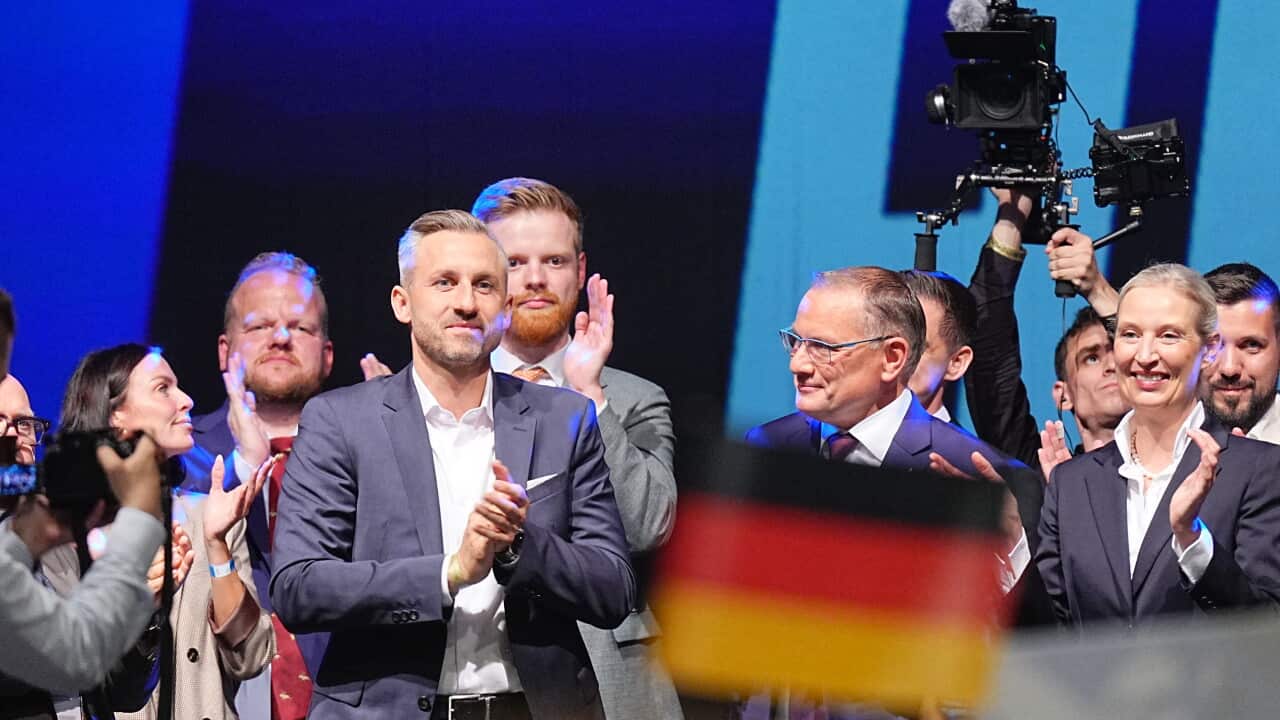

The Alternative for Germany Party, or AfD has celebrated surging into first place in exit polls from the state elections in Saxony-Anhalt putting a far-right party on the cusp of power at state level for the first time since World War Two. It has emerged as the strongest political force in the eastern German state but apparently has fallen short of the absolute majority it had sought to govern alone.
Listen to Australian and world news and follow trending topics with SBS News Podcasts.
TRANSCRIPT
A theatre in the city of Magdeburg in the eastern German state of Saxony-Anhalt.
The right-wing Alternative for Germany Party, better known as the A-f-D, is celebrating surging into first place in state elections, according to exit polls.
Ulrich Siegmund is the AfD's candidate for Governor of the state.
"Dear friends, this evening is historic. We have made history. We are taking our country back. It starts here in Saxony-Anhalt, 45% plus X!"
The exit poll from broadcaster ARD puts the AfD with 44.4 per cent of the vote, with Chancellor Friedrich Merz’s conservatives trailing well behind on 18.3 per cent, and the centre-left Social Democrats and environmental Greens both clearing the minimum threshold to enter parliament.
The AfD went into the vote seeking an absolute majority in the state legislature to govern on its own.
That would have overcome the refusal of mainstream parties to work with AfD.
Germany’s individual 16 states have extensive powers, for example in overseeing security matters and running the education system.
Mr Siegmund has listed among his top priorities “a deportation offensive” and dropping incentives for people to come to Germany and, in his words “exploit the social system.”
He told his followers this is what voters want.
"However, and this is the crucial point which I must emphasise tonight, this election victory represents a leap of faith on the part of the people of this country. And we will live up to that trust. We will not compromise our principles; we will not give up on ourselves. We will never become like those who were rightly punished tonight. We are the Alternative for Germany."
AfD's other policies include withdrawing Saxony Anhalt from the regional public broadcaster, citing 'disinformation'; qutting the European Union, allowing home schooling, which Germany currently doesn't allow; banning schools from raising the rainbow flag; and opposing funding for Ukraine.
Co-leader Tino Chrupulla celebrated the election blow to Chancellor Freidrich Merz's centre-right C-D-U party, which led Saxony-Anhalt for 24 years.
"Two years ago, Friedrich Merz’s slogan was that he wanted and would halve the AfD’s support. That was his statement: 'I want to halve the AfD'. And that motivated all of us to say, 'We’ll halve the CDU', and we started today.”
Political scientist Marcel Lewandowsky from Halle University says the A-f-D, at least in part, is right wing extremist.
"So overall, the AfD has been radicalising since 2015 and within the AfD, Saxony-Anhalt, according to German intelligence in Saxony-Anhalt, is a right-wing extremist party that has also to do with the organisation overall, that has to do with the organisation that are close to the AfD. And I would totally argue that the AfD at least in part, is right wing extremist. With, for example, regard to how it looks at liberal democracy, how it looks at political opponents. It doesn't say that in a platform or in a manifesto, but we know from several studies that that is a way of thinking, if you will, that is present within that party."
He says this shows how it looks at liberal democracy and at political opponents.
And he says the authorities are aware of a core group within the A-f-D that German Intelligence has labelled as extremist.
He says for local people, they either don't care or don't believe those claims.
"They do not believe that this is the truth because they believe that German intelligence, or the intelligence of the state of Saxony-Anhalt, they are part of the political elite that they don't trust in. So that means that the media or the other politicians that point at the fact that the AFD is right-wing extremist does not work for the electorate."
Topping a regional election for first time since World War Two, and in a fracturing political landscape, the AfD is now Germany's most popular party nationally, polling at 28 per cent in a recent poll [[INSA]], comfortably ahead of the conservatives on 20 percent.
Sven Schulze, the defeated Christian Democratic Union Governor of Saxony-Anhalt, was philosophical about the loss and believes it has lessons for his party.
"We would all have liked to see a better result in every respect. And we must not only take note of this result—this initial projection we have—but also recognize that it speaks volumes. And first and foremost, since we live in a democracy, I would like to congratulate the winner of the election. The winner of the election, the AfD, is now the largest party in the state parliament of Saxony-Anhalt."
The wider political significance of the election with a turnout over 80 per cent, is hard to ignore.









