
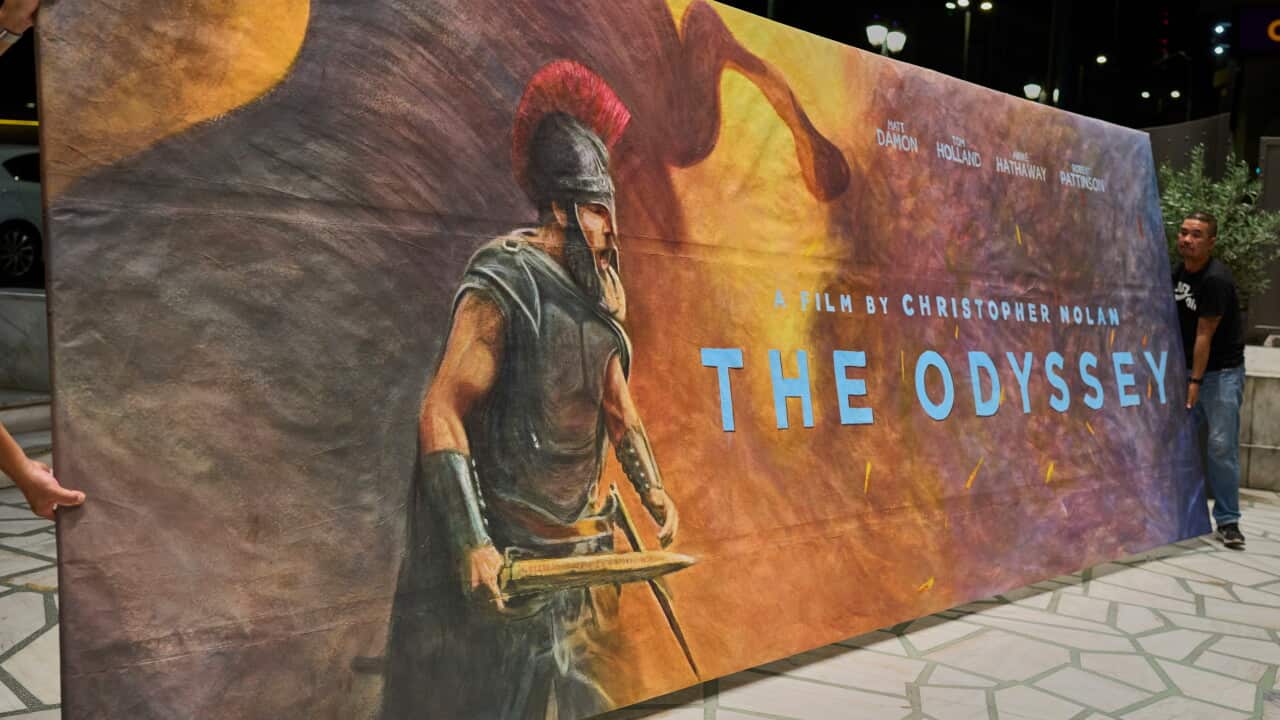

It's one of the most famous of stories - the ancient Greek epic the Odyssey. The latest cinematic adaptation has drawn widespread praise, but also criticism on social media about why there are no Greeks in the lead roles - and if this even matters in the retelling of ancient myths.
Listen to Australian and world news and follow trending topics with SBS News Podcasts.
TRANSCRIPT
Ancient Greece was a place where fantastical stories reigned supreme.
Helen of Troy's mother was a swan for example, while the Greek goddess Athena was born out of the forehead of her father Zeus after he swallowed her pregnant mother.
Add to this giants, winged horses and an array of other fantastical creatures — and you get the idea that story telling in ancient Greece was a wild affair.
Thousands of years later ancient Greek stories and myths continue to be told in oral, theatrical and cinematic form - Christopher Nolan's the Odyssey the latest cinematic epic hitting our big screens.
There are no actors of Greek ancestry in the lead roles in this massive production - and that's got some people on social media all riled up.
"If there was someone from a country that consumes baklava, I'll allow it. But I don't think Anne Hathaway has any idea what filo is."
"I'm gonna go see this movie and I'm gonna try my best to enjoy it. But I know that the whole time there's gonna be my Greek side and my American side watching at the same time and it's gonna be real tough to keep the Greek side quiet."
"I'm not arguing that every character needed to be played by a Greek actor, and I'm not objecting to its diverse casting. I'm saying that in this enormous international cast, it would have been wonderful to see one Greek actor, maybe an unknown actor in a breakout role."
"Name a single other culture where it would be okay to portray their stories on the largest scale possible, on the largest platform possible, without a single actor, cultural advisor, academic or director involved from that culture at all, at any level."
The criticism has come mainly from Greeks and parts of the large Greek diaspora worldwide.
The film itself has attracted huge audiences in Greece with IMAX screenings selling out months in advance.
Vrasidas Karalis is Professor of Modern Greek and Byzantine Studies at the University of Sydney.
He says the themes in the Odyssey remain universal.
"The main idea of this film and the myth behind the whole thing, is the idea of nostos, of homecoming, of going back to your home. This is the most important element, especially if you think of these ancient societies, that they had to go on expeditions, they had to go for food hunting. For all this, they had to leave their home. They had to leave their, ancestral places and move around the world, sometimes in a very hostile environment. Coming back home, therefore, it was a reconciliation with the past. It was a rehabilitation of their humanity."
American actor Matt Damon plays the Greek king Odysseus who makes his long and dangerous journey home after the Trojan War.
Anne Hathaway is his wife Penelope, Zendaya is the goddess Athena and Lupita Nyong’o is Helen of Troy in the in the nearly-three-hour movie.
Tom Holland, Robert Pattinson, and Charlize Theron also have starring roles.
Nyong’o found herself in the spotlight along with fellow actor, Elliot Page — with some on social media questioning the authenticity of the actors playing the mythological roles with their African and trans identities, respectively.
At the film's launch in New York, Nyong'o said one of the central themes of the story is about how important it is that we welcome strangers - those who may be different to us.
"The Odyssey' has everything in it. It's got love, betrayal, longing. It's gotta freakin' cyclopses and monsters and witches. So I think that, and it's got a beautiful, deeply resonant message at the heart of it, which is the power of Zeus' law, which is about treating strangers as you would, treating strangers kindly because they could be gods in disguise, and I think that's a beautiful message for all ages."
On an international press tour in India, Nolan said all stories are open to interpretation.
"Any time you take on a piece of literature that's known and beloved by so many people, and this is a story that's fascinated generation after generation for 3,000 years, a lot of different people have a lot of different ideas of what it's going to be like. But for me, like when, when Emma (Thomas) I were doing the 'Dark Knight' films and we were working on a beloved character, you know, Batman, we sort of realised that you just have to make the best film you can and put a strong interpretation, your interpretation on it, and I think people who love the piece of literature, in this case 'The Odyssey', hopefully they enjoy the respect that we're showing to the original source by making as good a film as we know how to make."
University of Athens Ancient Greek Philology Professor Vassilios Vertoudakis, says such discussions have taken place for decades, and not only in Greece, but anytime historical figures both real and fictional are depicted in modern films or television.
“Greek mythology is open to interpretation. Even Greeks, ancient Greeks I mean, were open to re-interpret their heritage, their past, their myths. The re-interpretation, the re-imagination, keeps vital this heritage over time, otherwise Greek mythology would be a mummy, a museum exhibit.”
Prominent Greek filmmaker Yannis Smaragdis, is known for his films on Greek cultural and historical figures such as “Kazantzakis”.
While he welcomes any film about Greek mythology, and a directors right to make films with their own vision - he's critical of what he believes was "a woke agenda" informing the making of this film.
"Any director or artist that makes a work has the absolute responsibility for that work and no one can tell him to do it this way or that. Whether whatever a director does, in this case Nolan, is liked or not liked, is up to the viewer. If Nolan does these things as a director then it is respected, but he does them as a film producer, as a businessman, and he puts in the elements of a woke agenda and inclusion, for example Black actors etcetera, so he does not have resistance from those that control global film distribution."
Professor Karalis says back when the Odyssey was written, the Mediterranean was a place rich in religious and cultural complexity including in its fictional offerings.
The Odyssey for example features a tribe of Lotus-Eaters who get high consuming the plant, a Cyclops - a one-eyed giant popular in Greek mythology, and another island of cannibalistic giants.
Add to this a woman who changes people into pigs and an island full of seductive sirens - and Professor Karalis says expecting all these characters — human or not — to just be depicted by people of Greek origin thousands of years later is a bit of a stretch.
"The story itself is so complex and involves so many different people. During the wanderings of, Odysseus, he meets all these different people, the Lotus-Eaters, the Cyclops, the cannibals, all of these, different sort of tribes around the Mediterranean back then. I think asking for having Greeks there is a bit of a long shot, I would say. It's very, multinational, multicultural, and I may say in this case, multi-religious, essentially."
Professor Karalis questions the benefits of incorporating modern cultural wars about race and gender, into interpretations of ancient texts.
He believes one of Homer's lasting legacies is that regardless of who we are - in the end we will all meet the same fate.
"The most important thing in Homer, we're all mortal. That is say, we're all going to die. This is the human condition for the ancient Greeks. Black, white, yellow, or green didn't matter. We're going to die. I mean, what happens today by the Greeks who criticise this element is, I think it's parochial, and sometimes you know, it shows a social panic and moral panic. The story itself is extremely appealing to everyone to this day because we see life as a journey full of adventures, full of problems, full of essentially reversals, of going back and losing what we have achieved. And this is I think this is part of the continuous appeal of this story because Odyssey is part of our everyday life."