
After promising "consequences" for Taiwan's presence at the Pacific Islands Forum, China is denying comments by a senior diplomat are a threat - and that it has engaged in foreign interference. Taiwan's expanded role at the forum has enraged Beijing and there are concerns the rivalry will overshadow potential progress on regional issues, particularly climate action.
Listen to Australian and world news and follow trending topics with SBS News Podcasts.
TRANSCRIPT
The opening ceremony of the 55th Pacific Islands forum in Palau - started with colour, movement and tension.
That's because, as a development partner at the Pacific Islands Forum, Taiwan has made its presence felt at the opening ceremony on Monday night [[31 Aug]] - and there was an elephant in the room: China.
Three days of talks are now underway and the rivals are in the same place and vying for the attention of regional neighbours.
And Beijing's special envoy for Pacific Island Countries Affairs Qian Bo is not happy about it.
"There will always be consequences. I mean that, this is objected (to) by all. This should not have happened, we think this is very inappropriate."
Beijing has since denied the comments were a threat - as it defends itself against allegations of foreign interference at the summit.
There have been concerns the forum has been compromised, with a no-show by five Pasifika leaders, including Solomon Islands Prime Minister Matthew Wale, who was issued a no-confidence motion in his leadership back home.
Mr Wale had been leading calls to condemn China for its ballistic missiles test in Pacific waters earlier this year.
New Zealand's foreign minister, Winston Peters alluded to "suspicions" in an interview on Monday.
"As to what is behind it. Well, there is enough detail for one to be highly suspicious, but until we know what this is, we are not going to say."
Mr Peters may not have said directly, but to New Zealand's Chinese ambassador the meaning was clear - and he retaliated via social media.
On X, he wrote; "For someone holding a hammer, everything looks like a nail."
Australia's Prime Minister, meanwhile, wouldn't engage with idea the forum was compromised before it officially began.
"And I don't think it is productive to talk it down, I'm talking it up. I think with regard to China's ballistic missile test we have made it very clear that that is not acceptable, it was not the actions of a friend, it was not appropriate, it was a provocative act. We have made our position very clear, as have a range of Pacific countries."
Palau is one of only three Pacific nations to have diplomatic relations with Taiwan.
Australia's Foreign Minister Penny Wong says while Australia remains committed to a One China policy, it respects others have different positions.
"Well, I think the Pacific should be able to determine its own relationship. Obviously Australia has a One China policy, we have diplomatic relationships with Beijing and we maintain an economic engagement with Taiwan. There are Pacific Island countries who have a different position and we respect their right to make their sovereign decisions."
The Prime Minister emphasised Australia's newly strengthened position in the region, in the wake of new security deals.
"We are a leader here in the Pacific. But it's important as well that we engage respectfully, and that's something that I've always sought to do with the Pacific Islands Forum. And I think that is one of the reasons why we have really improved relations right across the Pacific, whether it be the alliance, uh, with Papua New Guinea that has now come into effect, or whether it be our 4th alliance, which is on the way with Fiji."
There are two subjects battling for attention at the talks this week: security and the climate crisis.
Both are of enormous importance and timeliness in the Pacific - with rising tensions and waters impacting island nations.
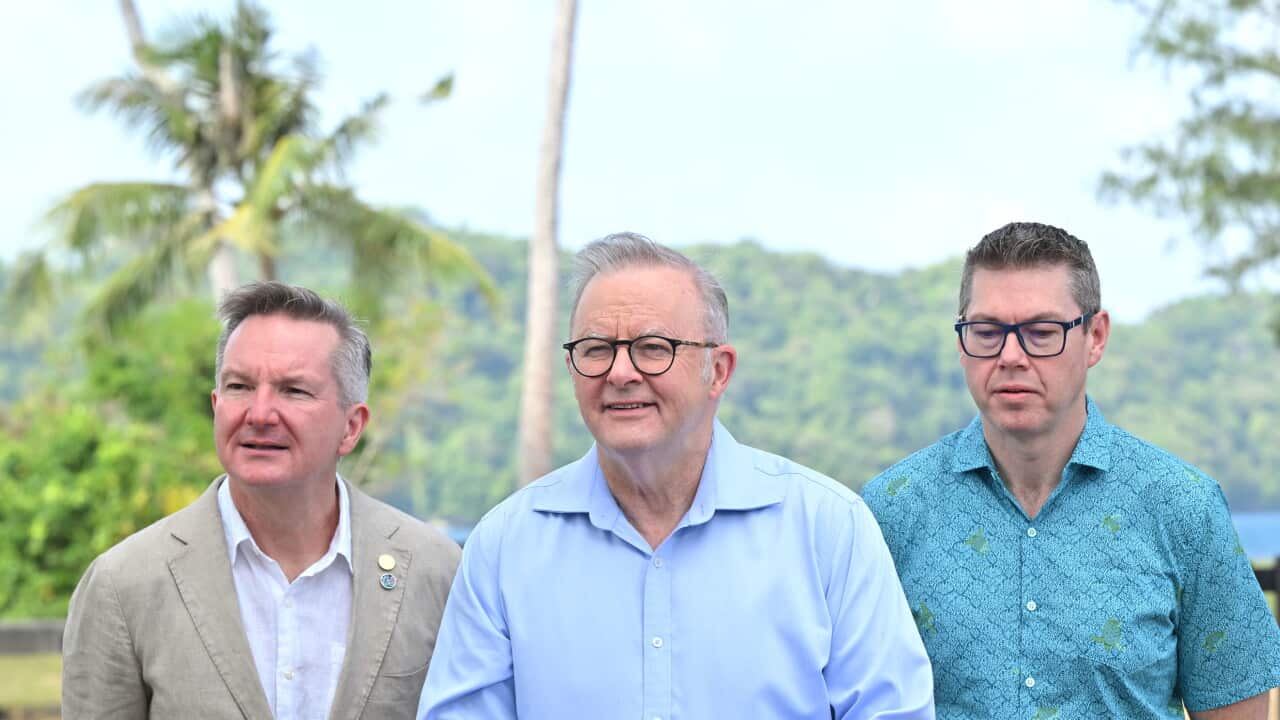
Federal Climate Change and Energy minister Chris Bowen is in Palau, which falls in the lead-up to global climate action summit, COP-31 in Turkiye later this year.
He outlined Australia's agenda ahead.
"Access to finance for small island developing states. Those small island developing states are on the frontline, but have trouble getting access to the support for climate adaptation which is a key signature approach of our cop31 role. The role of oceans in cops, which has been under played and under emphasised in recent years. Oceans, which cover the vast majority of the Earth's surface and are so key to the ongoing prosperity of our region."
Greenpeace political coordinator Shiva Gounden says he hopes geopolitical arguments doesn't take too much oxygen from crucial climate discussions.
"So, I am not concerned that climate change will be neglected by the leaders, however if the noise from the outside is so much on geopolitical interests, There will be, I have a little bit of concern that some time will be wasted in terms of discussions."
And it is time that the Pacific says its people cannot afford to waste, on the frontlines of the climate crisis.