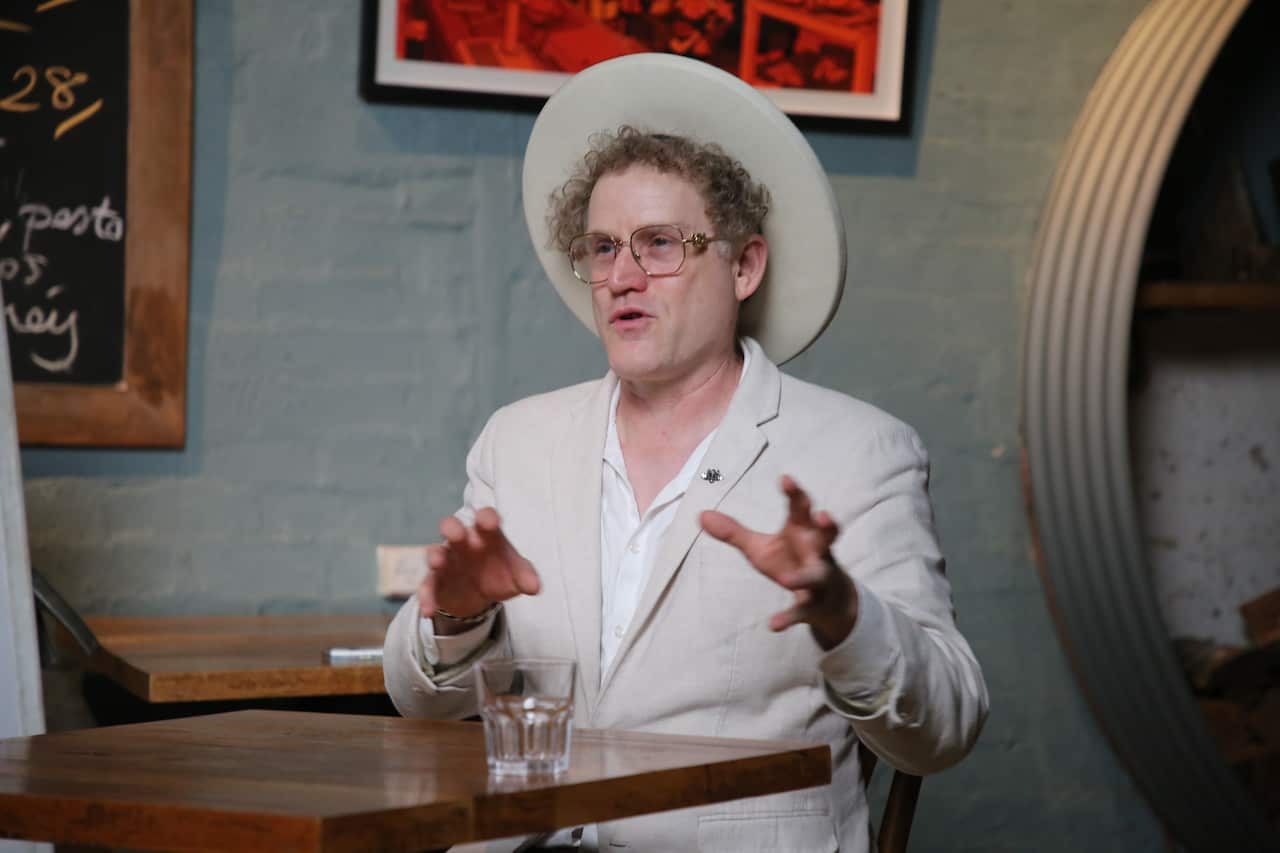
Shut Your Big Fat Mouth John Safran opens at a free speech summit at an undisclosed location: "It is not a crime to offend someone, okay? It is NOT A CRIME."
The documentary film is Safran's exploration, his artistic sensibility leading him to ask what's over there, why is it there, what does it mean? Offence is subjective where harm is legible, and when I spoke to Safran earlier this month, that distinction was the one I most wanted to talk to him about.
He'd thought about it, but wasn't in the market for a tidy formula. As he put it, we've become fluent in talking about talking, and worse at actually talking.
The free speech summit attendees share a collective belief in the persecution of their views. They are not entirely wrong about this, but the conversation inevitably pinballs between extremes. Safran asks one woman what topics she wants to speak about and she answers immediately: "Full-term abortion" Then: "Forced vaccinations in Australia." In voiceover, Safran deadpans: "Unable to get a word in at the free speech summit."
Another summit attendee, an alternative medicine practitioner named Dawn, says, "We are being silenced by politicians making laws that impede your rights, my rights, all of our rights."
Safran indulges his curiosity of Dawn's alternative practices, allowing himself to be hooked up to her ABMMA (Academy of Bioelectric Meridian Massage Australia) Pro device, and this sincere exchange is jarred by a thundering voice off-screen; the summit's organiser Jamie McIntyre (who bills himself as an entrepreneur, author and political commentator) is delivering an address via video call, arguing (passionately) that the Holocaust was fake.
McIntyre's also pitching real estate: "Marina Bay City: where luxury meets opportunity". Safran, exercising his freedom of expression, inquires about the connection between the project and the summit. Him and his menacing inquiries are asked to leave.
The irony galvanises him into securing an interview with McIntyre afterward, where he cleanly extracts the answer.
It's Safran's observation after the summit that stays with me: why are people like Dawn hanging out with Holocaust deniers? Is there no middle ground for people with "challenging" views? Is it all so extreme? The film doesn't answer the question so much as serve tapas: different subjects, different kinds of offence, different stakes, frolicking across the board rather than spelunking into the void.
In the film, Safran speaks to Kayla Jade, a sex worker and content creator with millions of followers, and Melinda from Collective Shout, who campaigns against the pornification of culture. Both push the question past offence and into harm, though they disagree about where the harm occurs. Safran and I discussed this from generationally different vantages. He described the taboo around pornography as intensely shameful in his youth, and told me that the change didn't seem dramatic at all, but looking back, the chasm is shocking.
I brought up Christina Aguilera's "Dirty" video clip (2002), salacious enough when I was in high school that its release was itself proof of a taboo being reconfigured, even as its reception still dragged the waters of offence. We both agreed it all looks a lot tamer in the rearview.
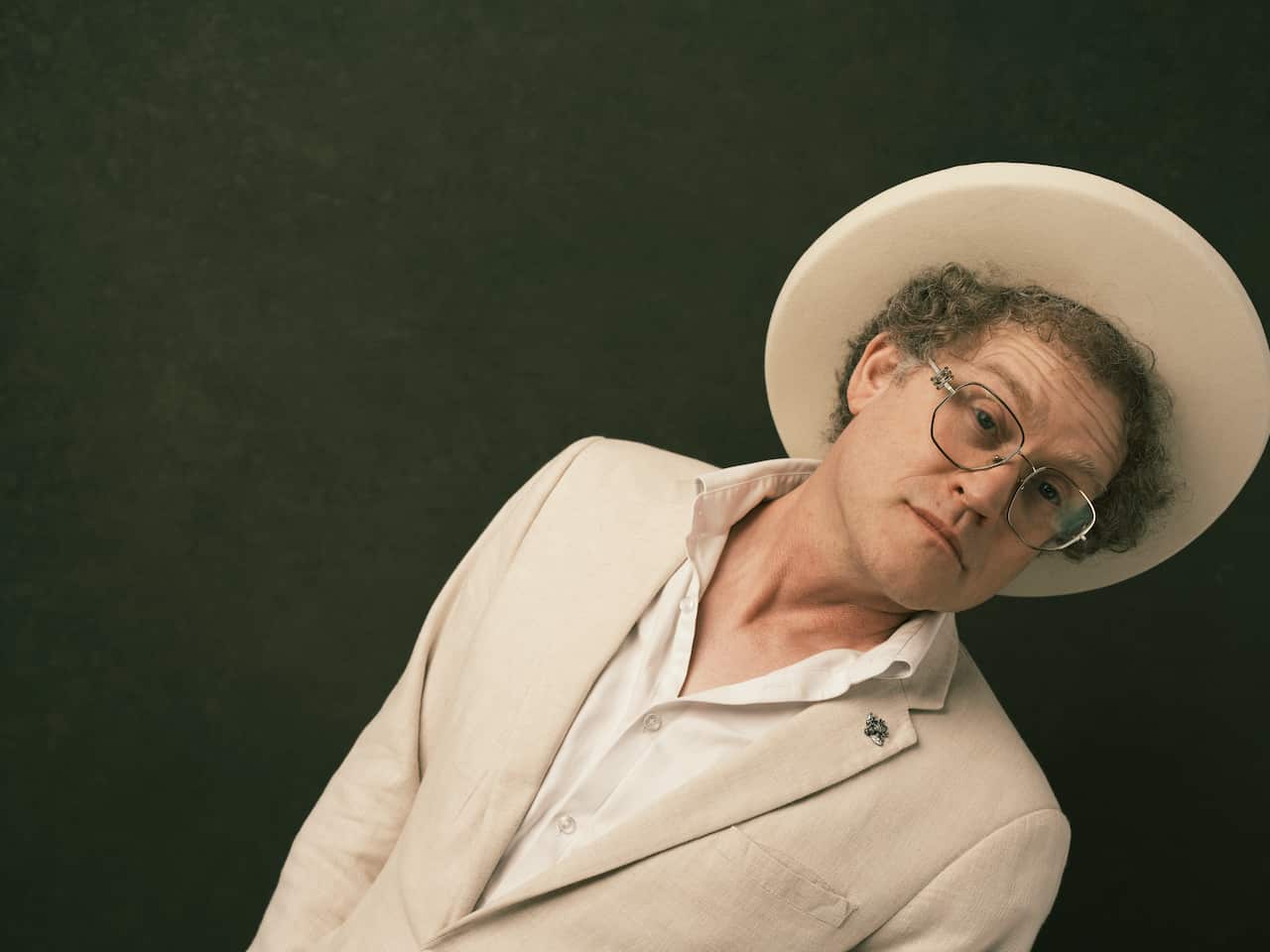
I asked John what he thought of the idea that these changes can be reduced to economics, that anything generating income for interested parties gets lifted from the gutters of judgment into the cool sanction of industry. Our metabolisms for the question differed. I was cynical; Safran was more open and thoughtful. What interested him, he told me, was the strangeness of change, how we come to accept things once considered beyond the pale.
Melinda and Kayla are on the same side in more ways than not. Melinda describes the threats her team has received for the work they do: "They say they are the defenders of free speech. But they'd shut us down in a second."
Kayla's position bypasses offence and goes straight to harm minimisation: pornography is made for adult entertainment, not as a sexual curriculum for teenagers. Education is that lynchpin.
The ambitious, politically activated, enthusiastically unemployed Nazi whom Safran asks to tutor him in the proper execution of the salute, is the film's deepest probe into the paradox of tolerance, a concept I'd posited to Safran in our conversation. In the film, as the camera holds on a closed door, we hear Safran's energetic "Sieg Heil!"

His abstraction from this gently brushes a wire so taut one can hear its hum: "As an artist my instinct is to allow more free speech, not less, but of course, free speech would unleash more tirades against Jews, of which I am one."
The Nazi's basic, catch-all defence is, "It's a form of political expression and if we want a system that purports to be a liberal democracy then you have to allow people to express themselves even if you're opposed to it."
Ah, the paradox of tolerance laid bare. What do we do, I asked Safran, with this contention? He didn't pretend to have an answer; instead he acknowledged that "the line is definitely not a static one, we often have conversations about the conversations we're having… which is not the same as having a conversation." I told him that's exactly it — he’d distilled the phenomenon into perfect ugliness: petty bickering.
What delighted me, watching the film and talking to Safran afterward, was his absence of contempt (Gina Rinehart being a notable, spirited exception). He's as even-handed with those who hold contemptible views about him as a category of person as he is with anyone else. His questions aren't designed to humiliate, they attempt to get people to reveal their thinking, and they do.
The film is both an artefact and activity, of tolerance and freedom of expression. The tolerance is what reins this expression in from doing harm, though it will certainly, hopefully, offend somebody.
Shut Your Big Fat Mouth John Safran is now streaming at SBS On Demand.