
Rune Pedersen just wants to talk about something he’s not supposed to talk about. Taboos! Idioms are a great way to approach taboos. They allow us to talk about something without saying it directly, but what and who gets cut out of the conversation when we beat around the bush?
Idioms get really interesting when you look at the things people don’t want to talk about. What someone won't say aloud tells you a lot about their culture.
When is a spade not a spade?
A lot of culture wars start when people disagree on what we should be saying out loud, and what should be left unsaid.
Did you know the idea of taboos came from Tonga? The Tongan concept of tapu is about defining sacred spaces and rituals.
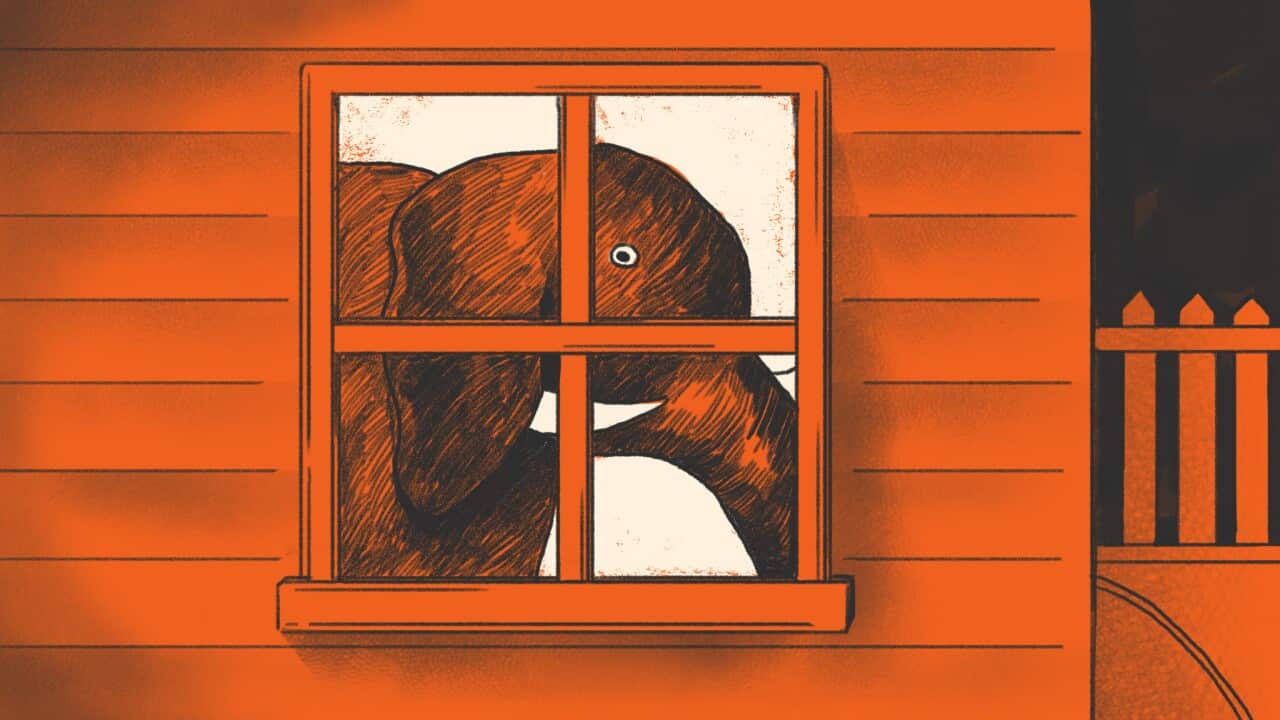
On episode two of The Idiom, we get the skeletons out of the closet and your elephant out of the room to tackle taboos.
Rune talks to Howard Manns, Linguist at Monash University and Tonya Toi, proud Tongan Woman and President of the Pasifika Community of Australia.
What’s really interesting about taboos is that they give us a visceral reaction… They’re revolting.Dr Howard Manns
The Idiom is a podcast about how language shapes the way we see the world and relate to each other. Hit follow in your podcast app to hear all episodes in the eight-part series.
Get in touch at theidiom@sbs.com.au
The Idiom is an SBS Audio podcast produced by Think HQ CultureVerse and SBS.
Host: Rune Pedersen
Producers: Bridget Bourke, Jacob Agius, Beaurey Chan, Mie Sorensen, Michael Lincoln & Stefan Delatovic
Writers: Rune Pedersen and Stefan Delatovic
Art and design: Wendy Tang
Design direction: Melissa Hill
SBS Audio team: Caroline Gates, Joel Supple, Max Gosford
Guests: Howard Manns, Tonya Toi
Other voices: Stefan Delatovic and Bridget Bourke
Other contributions: Think HQ Managing Director Jen Sharpe and the Think HQ team, Chloe Favre and Nicolas Ojeda Amador.
Transcript
Rune Pedersen 00:01
We acknowledge the traditional owners of the land on which we work, the Yaluk-ut Weelam Clan of the Boon Wurrung, Naarm. We pay our respects to the elders past, present and emerging as we try to live up to their example, as storytellers and we recognise that some stories are best told when the context is right.
I just want to talk about something that I'm not supposed to talk about. Taboos! Taboos are those things that are not allowed due to a social custom. You know what I mean? Right? The skeletons in the closet, the forbidden fruit. So we know loose lips sink ships. So we bite our tongue, and we don't rock the boat. Look just one second.
Sorry, there was an elephant in the room. Idioms are very good for discussing Taboos, because they allow us to talk about things without saying them out loud. See, I like Taboos because just like idioms, they'll tell you a lot about culture. Taboos tell you where the pressure points are. The sensitive spots. A lot of cultural fights will get into are around who gets to decide what taboo is. When most people decide that say, we're no longer going to treat interracial marriage, or suicide, or pineapple on a pizza as a taboo. There's always a group who aren't ready to talk about it. And it's understandable when people have grown up with entire parts of the language built to help them not talk about it. Language shapes who we are. So if you grew up somewhere where let's say gay people are called “confirmed bachelors”, or we beat around the bush about a pet's death by saying, well, they've gone to live on a farm, we come to see that these things are sort of cosmically off limits. too terrible to entertain.
Hey, Bridget, we work close together on this podcast. Can I be straight with you for a moment?
Bridget 02:25
Okay, sure.
Rune Pedersen 02:27
Great! I know this might be a little bit of a taboo in Australia, but…
Bridget 02:33
Cool. Yeah. Cool. Cool. Hum…Yeah, Hum Yeah…
Rune Pedersen 02:40
Hey, Stefan, Stefan, you're here too. Stefen, why can I say…?
Stefan 02:45
I mean, it's not like offensive or anything, man. It's just, you know, a taboo. It's a taboo here in Australia, is what I'm saying.
Rune Pedersen 02:52
Okay, so I can't just say... So what about…
Stefan 02:57
Don't… Don’t.
Rune Pedersen 03:00
To talk more about taboos, I've invited Howard Manns, a linguist from Monash University, back on the Idiom to help us understand what taboos are and how they work.
Howard 03:11
So a taboo is a prescription of behaviour, or a person or a thing for a particular community in a particular context, and I think these latter two points sometimes get lost on people. Taboo - the word originally comes from Tongan Polynesian, and in its original context, it referred to sacred things. It was very much about just just the sacred and being careful around God because, you know, whenever we humans deal with the unknown, it's a very slippery slope.
So what taboos ultimately do is they help us regulate behaviour in a particular society, especially where that behaviour might be perceived to be negative might perceive to be a flashpoint or lead to problems in society.
What's really interesting about taboos more generally is that they give us a visceral reaction, you know, we have this bodily reaction to them. They're revolting, untouchable, filthy, you know, unmentionable dangerous. And because of that, for us, they're very powerful. But to go back to this contextual point and community point, what is very visceral and powerful for the person standing next to you might not be the same thing that's really visceral and powerful for you. You might not feel the same thing.
One word or one concept, across time and space might not be the same thing that impacts another person.
Rune Pedersen 04:45
All right, that makes me think, what words function as Taboos?
Howard 04:50
Well, these will vary across different cultures and also various times but in general across languages across human languages in human context.
You come across four key taboo areas. One of those taboo areas is religion and sacred topics. And this is where, you know, you get euphemisms like Gadzooks for God's hooks, which refer to Jesus's nails from the cross.
So religion and sacred topics is the first one. The second one is body organs, activities and fluids. This is where once again, you get a lot of these euphemisms good ways of saying things where penis used to mean tail, and it was used euphemistically before it kind of evolved into this word for what it is. Sleeping together, you know, for referring a sex. And you know, the call for going to the toilet, all of these things kind of illustrate bodily fluids and body parts.
The third thing that ultimately functions as taboo or is taboo across different contexts is actually food gathering and preparation. And a great example of this is that we raise pigs but we eat pork, we raise cows, but we eat beef. So what we do is we dress up our words a little bit by choosing the French words, for actually the thing that we eat.
Rune Pedersen 06:19
Yeah, we're not eating Mary from, from the field.
Howard 06:23
Exactly. We're we're eating a fancy French word instead, which puts some distance between us and that.
This is actually an add on to some of this food stuff and food preparation, though is, you often see whenever there there's like this fervour of nationalism, that people will rename their food stuffs to distance themselves from, from, you know, other people during world war one here in Australia, there was a shift from the German sausage to the Windsor sausage. The fourth set of words that typically function is taboo and the fourth area of taboo is typically diseases, death and killing. So you know, we don't typically talk about death, right? We talk about risk low, rest, loss, passed away, kick the bucket pushing daisies, you know, that's what we do with language. That's how we cope in difficult times or with difficult topics.
Rune Pedersen 07:18
So would you say that taboos are often idiomatic expressions
Howard 07:22
Yeah, totally. I mean, there's this really natural overlap between taboos and idioms, because of course, at their core idioms don't mean exactly what you would expect them to mean on their surface. And with taboo, what we're often trying to do in our choice of words, is actually distance ourselves from the the bad thing, you know, the thing that is prescribed.
Because of it, you see all these wonderful idioms emerge in relation to taboos. So you know, one that I like, here in Australia is ducks on the pond. And what's really interesting about this idiom ducks on the pond, is that it's generally viewed and historically, you've wanted to be very careful about the kind of language used, if you're a man, you want to be very careful about the kind of language that you use in front of a lady or children. And ducks on the pond used to be a code that got used and still gets used actually, here in Australia, whenever a, whenever a woman or the owner of a house that you're working on comes onto the site, people will scream ducks on the pond. And that's the way to tell you that you should begin regulating your language.
Rune Pedersen 08:40
So looking back in history, or maybe in literature, have we previously used idioms to discuss taboos?
Howard 08:50
Yeah, I mean, we find it across different cultural contexts to actually that people use these idioms to be able to discuss taboo things, and in fact, in fact, there's this great way of viewing it, I think, by this linguist Jack Dubois, who actually studies a lot of Mesoamerican context, so like Central American and Mexican context. He calls it speaking the culture. And the idea of speaking the culture is that if I'm actually using this idiomatic expression to describe you, you know, as intoxicated, or as being unattractive, if I'm using the idiom, it's not actually coming from me. You know, it's this idiomatic expression that's actually circulating in a in the culture and I'm invoking this to be able to negatively evaluate you and it's a way of like just literally voicing another person and that's why he calls it speaking the culture; so speaking the culture would be using Australian slang any of those great to Australian slang ways to actually say intoxicated. You know, well, you know, look at you, you’re as full as upon me complaint box. That's not me say meaning that you know?
Language doesn't just mean language, especially from the way that I would look at it as a linguist. Language does stuff. And that stuff is sometimes very emotional and sometimes visceral. So it can be useful to actually ask yourself, not necessarily what something means, but actually, what is it doing in this circumstances, and to what degree is that something emotional or problematic for one person or the other?
The same thing with pronouns that, that people sometimes get very upset about being asked to use a particular pronoun. And ultimately, what ends up happening is if you talk to somebody about why if you sit down and actually probe the reasons of why they've come to this particular instance, and are interested in having their correct pronoun used, or let's, let's kind of flip this a bit, a pronoun that makes them feel safe in a conversation. The reasons that they're asking you to do these things are actually quite compelling, so I think that's why it's really good to walk backwards from the context that you're in. I think we don't have those kinds of conversations. And I think that actually, those kinds of conversations are some of the most critical conversations that we can be having this day and age.
Rune Pedersen 11:19
Okay, Howard, how do taboos change over time? And how do taboos influence the way we talk?
Howard 11:26
Well, the societies of course, change over time and what typically happens is taboos are wrapped up in society. And because they are, you know, whatever a society feels is important at any one time is going to influence their taboos. There's something called euphemism treadmill. What ultimately happens with euphemism treadmill, is that whenever you think of a nice way to say something, if it's associated with a taboo or a difficult topic, it will gradually over time develop a bad meaning, and sometimes an insulting meaning. And thinking about this, the word moron, right, the more moron, if you go back into the 19th century, is actually just a medical diagnosis. And if you look in the 1920s, there's actually a very vivacious kind of debate in the newspapers about the extension of this term as an insult like the people who work in psychology are actually getting really, really panicked. Why is this word being used as an insult? And this is something that ultimately happens in language is oftentimes a word that starts out quite neutral will develop negative meanings. And I think people need to understand that these sorts of processes happen in their discussions when they're talking to other people about these things. And this is something that just happens with language, you know, that whenever there's a bad word, it pushes out a good one you mentioned earlier….
Rune Pedersen 12:55
So the meaning of words often change over time and across cultures. This brought me back to what Howard was talking about in the beginning about taboos being originally from Tongan .
Joining us is Tonya Toi, president of the Pacifica community of Australia. She's a proud Tongan woman who migrated to Australia and was kind enough to share her insights on Tongan taboos.
Rune Pedersen 13:20
(speaking Tongan)
Tonya 13:23
(Speaking Tongan)
Rune Pedersen 13:27
(Speaking Tongan)
And that's all the Tongan I know.
Tonya 13:32
That's good.
Rune Pedersen 13:23
Could you comment on the Tongan Tapus?
Tonya 13:38
Tapus means sacred, but there's a limit to places, areas that you can enter or perform. For me personally, I take it to heart. It might sound like it's restricting you from doing things. But I guess it's important to have this taboo means end, stop, do not enter us sacred places. Tapus, the word Tapu, simply because our country is all about respect. We have sacred places, especially in faith and in culture, there's places that you can enter and these are places that we have. We use the word Tapu especially in family settings, and also because we have a huge respect to our King, and the noble lines, and then we bring it back to our family unity. It's played a critical role the word Tapu.
Rune Pedersen 15:00
So what would be examples of sort of the most sacred Tapus in Tongan society?
Tonya 15:08
Well, I can only comment especially like in family settings. I know that I cannot eat my maternal father's leftover food, I cannot enter their bedrooms. Brothers and sisters, maternal brothers and sisters, we cannot expose ourselves any part of your body that's very sacred to us. And also, when we enter faith space, there's a space that it's only for individual congregations, we can't go beyond that, because it's only for ministers. And then when we enter into the king's palace, there is a protocol and certain places that draw the line for us as the communists to enter those spaces. But we love it. Because it's something that we adore. It's not restricting us to anything. We embrace it very much. And we respect the learnings that we receive from our ancestors. And it would stay with me, no matter for how long no one can ever take that away from me. That is my part of my culture, and it's staying with me for the rest of my life.
Rune Pedersen 16:39
Tongans preserve something sacred through their Tapus, which helps to maintain the way of life. And discussing taboos and multicultural society like Australia is kind of a tricky business.
Not everything that's a taboo for me is a taboo for you and vice versa. As Howard said, it's about community and about context. Power and privilege play a role in shaping taboos. In some instances, taboos are used to enforce power dynamics and maintain the status quo.
This is where the real challenge lies.
Some taboos are meant to be challenged as time catches up with them, while others should remain intact. Sometimes breaking them makes your a hero, sometimes a villain. As I continue to navigate the complexities of cultural traditions and social dynamics in this multicultural society, I have to approach the subject with an open mind. I can't travel with all of my taboos and expect them to be adhered to. I need to respect the culture of the place where I am. So I can't just say… [Beep]
Rune Pedersen 17:48
The idiom is a production of Think HQ CultureVerse and SBS. It is hosted by me, Rune Pedersen, produced by Bridget Bourke, Jacob Agius and Stefan Delatovic. And written by me and Stefan Delatovic. If you haven't seen our amazing artwork, it's done by Wendy Tang and you can find it online. Follow and review us wherever you found this podcast. And tell us your favourite idiom at the idiom@sbs.com.au