
We know that language shapes how we see the world, and storytelling has the power to preserve cultural knowledge from one generation to the next. Storytelling and yarning is at the heart of First Nations cultures and communities in Australia. Stories have been passed down for thousands of years, connecting Indigenous peoples with their culture and land. So how does language - including stories, slang and idioms - preserve First Nations cultures? And what is the impact of colonisation on this tradition of handing down culture through language? This episode of The Idiom is all about deep listening, with guests Taryn Marks and Dr John Davis.
In this week's episode, Rune has a yarn with Wotjobaluk woman Taryn Marks, and Murri Ambae man Dr. John Davis from the Indigenous Knowledges System Lab at Deakin University, about communication in Aboriginal and Torres Strait Islander cultures.
As an outsider to Australia, Rune tries to understand the tradition of yarning, the cultural knowledge that is carried through languages, what is needed to rekindle what was stolen, and how all Australians can take steps towards better understanding and reconciliation.
Understanding and knowing our words, who we are, our places... it helps you heal, and reconcile, and be a part of that land, that landscape.Dr John Davis
The Idiom is an SBS Audio podcast produced by Think HQ CultureVerse.
- Host: Rune Pedersen
- Producers: Jake Im, Rune Pedersen, Beaurey Chan, Stefan Delatovic
- Writers: Rune Pedersen and Stefan Delatovic
- Art and design: Mandi Barton
- SBS team: Max Gosford, Joel Supple, Caroline Gates
- Guests: Taryn Marks, Dr John Davis, Xiaohan (Jenny) Xu, Dung (Darren) Le
- Other voices: Nadia Ladson
- Special thanks to Jen Sharpe
A note on the episode artwork
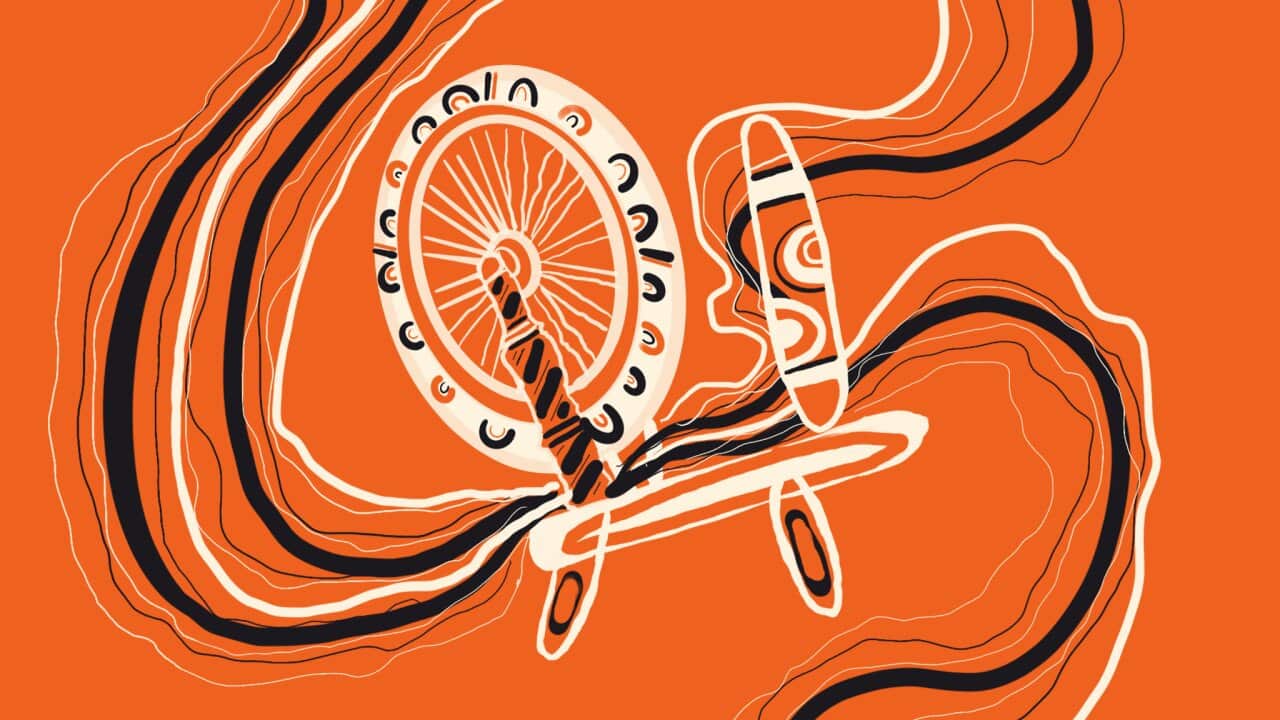
Melbourne-based Yorta Yorta artist Mandi Barton created the artwork for this episode, it's her interpretation of the idiom ‘Spinning a Yarn’. Mandi says, "The main feature is the Yarning Circle, which also has a traditional yarning wheel called The Charkha. The artwork also incorporates the Message Stick, which represents who shares and receives the stories, and how they are communicated."
Transcript
This transcription may contain some misspelt words across different languages. Some words are captured phonetically while others are represented by a [note].
RUNE 00:00
We acknowledge the Traditional Owners of the land on which we work - the Yaluk-ut Weelam Clan of the Boon Wurrung, Naarm.
We pay our respects to their Elders past, present and emerging as we try to live up to their example as storytellers.
RUNE
(singing) It’s early morning and I’m walking to wooooork…
OH MY, it’s cold outside today! This is not the kind of weather I believe I was sold on. But it is beautiful!
I'm travelling between two countries when I go to work.
But I don't need a passport to enter either. I don’t even speak their language.
I live and sleep on Wurundjeri country, and I work in Boonwurrung country.
It's estimated that there were more than 250-300 Aboriginal languages spoken when Europeans colonised Australia, and today all but 13 Aboriginal languages are endangered.
I can't help but think of all that has been lost.
When a language dies, something else dies - it is inevitable!
50-60 thousand years of living on, caring for country - vanished in just a couple of hundreds of years because speaking your mother tongue was made punishable by law, and by social pressure.
I got this text from a friend the other day, I can’t stop thinking about:
WOMAN READING
“Imagine your mother language being the second most spoken language in Germany and the one you can no longer speak in public as your mother country is currently invading Ukraine. I feel so torn. Part of my identity is just being smashed. When I hear a song in Russian that I used to hear as a child, I cry…. I also feel like I’m losing my sense of humour as I am more humorous in Russian than in any other language.”
RUNE
When big politics happens, when war happens, it’s the civilisations who suffer. The civilians. And sometimes their language suffers too.
Time passes, people adapt and language changes.
Braunschweig, a city in Germany becomes Brunswick in English.
Last names changes, and people assimilate, but sometimes people never even get the option. That’s when language and culture gets stolen.
The thing is, we don’t all get a fair suck of the sav, which my Aussie friends tell me means that we don’t all get a fair go, and my other friends tell me means that inequality is real.
We’re all in this together. We’re all in the same boat.
WOMAN
As we say in Mandarin, 一条绳上的蚂蚱, we are all grasshoppers on the same cord.
MAN
In Vietnamese, you’d say, Một con ngựa đau, cả tàu bỏ cỏ. When one horse is hurt, the whole stable starves.
RUNE
This is true even for those of us who feel like a black sheep, or, as you’ll hear in the Ukraine, a white crow.
I feel like the tension between these two ideas - that we are all one people, and that we are all splendid in our multicultural difference - frustrates a lot of societal progress.
So far on The Idiom, I’ve been looking at the ways our different languages shape the way we see the world. But what if your language is taken from you - like it was with Australia's First Nations? Can reclaiming language - including slang, idioms and stories - help you reclaim and revitalise culture?
And what else can we learn from the oldest living society of storytellers on the planet?
To learn more, I’ve invited a friend on the podcast to have a yarn.
Taryn Marks 3.14
I'm Taryn Marks, and I work on various things that relate to Aboriginal and Torres Strait Islander advice and consultation. But mostly, I'm a proud Wotjobaluk woman. I'm a mum of three beautiful daughters, and live and work on Wurundjeri country. I'm privileged to do that and be able to just do the little things that help organisations work in a better way to appreciate Aboriginal and Torres Strait Islander people but also increase their workforces, to think about where Aboriginal people are not at the table.
RUNE
I have an understanding that storytelling plays a big role in Indigenous communities in Australia. Can you help me understand this?
Taryn Marks
I think story, oral histories is the way in which Aboriginal and Torres Strait Islander people have communicated for tens of thousands of years. And there are definitely communities that have continued those traditions more strongly than others. It's not for a want from Aboriginal people themselves, but we've kind of been taken away from being proud of our language, culture, dance, our customs, and the songlines that have been passed down from generation to generation. In many communities, that's pretty fractured, which is really sad. Aboriginal and Torres Strait Islander people love a cuppa and a yarn. It's the way that we build trust and get to know one another. When we meet, you'll see Aboriginal people introduce their mob and where they're from. But it's also a way in which we kind of connect to one another and know, you know, what part of Australia, what part of a story a particular person may have come from.
RUNE
What can we learn from this kind of storytelling?
Taryn Marks
I think it's a beautiful thing to think about how one generation to the next can pass down important art, stories, songlines, and also knowledges from their community. There's a lot to learn in that for people that don't have that in their generations or families. Dance and expression that is not necessarily about the verbal expression of things. I think that, to me, is what's really beautiful about what a visual piece of art will tell you, or the way in which a songline of a particular country and area and how that connects people. And there's 300 plus languages that were spoken, that are trying to be revived here in Australia. So they're all connectors. And it's where people feel warmth and generosity when we share stories. And we feel like we know more about one another, I guess.
RUNE
When I hear you talk now, it sounds so fundamental and healing, that I feel like, what are we losing?
Taryn Marks
I couldn't agree with you more.
Taking time with an elder or somebody in a family who does carry the stories, and even if those stories don't seem profound, when I think about it, you're right. We're missing so much; it's like a puzzle, isn't it? Like missing a piece of the puzzle.
And sometimes it's really just about sitting and listening or seeking it out. And that makes you feel more whole.
RUNE
What role does storytelling play in the transmission of cultural knowledge and values within Indigenous communities?
Taryn Marks
Particularly, I guess of cultural stories, there's only certain people that have the permission to kind of tell their stories. So it's ideally that Aboriginal people are able to continue their oral stories and their own community and cultural stories, and some of those are permitted to be shared and others are not. There's family, many families often involved in, in story. And so it has quite a process I guess, of making sure that it's transmitted appropriately. But it's, I guess, in the public domain, important to be able to actually give everybody a sense of knowledge, not just, you know, the oral handing down a story from generation to generation, but also, we educate and we're able to communicate with non Indigenous people, the meaning and, you know, knowledges that should be respected and also celebrated, shared, and so on.
RUNE
I've noticed in Australia that there is a lot of hesitation and sort of, I don't know what to say, like white glove handling, when it comes to engaging or talking about Aboriginal and Torres Strait Islander people. Have you seen that as well? Or, and why is that?
Taryn Marks
I would describe it as people feel like they need to walk on eggshells if they're a non-Indigenous person. That would be, maybe associated with shame and guilt and not knowing. And many people want to know, but they have been grown up in a generation where they weren't told.
For Aboriginal and Torres Strait Islander people, I'm a fair-skinned Aboriginal person, so, I sometimes fly under the radar, and people will say things around me that are, you know, quite racist or insensitive. And then for people of colour, you know, that's really explicit at times.
So, it is that we need to be able to move together in understanding our shared history and remove the eggshells, I guess, is what I've heard different people describe. Not be handling things with the white gloves. You know, that takes work of healing. It takes work of re-educating people, and it's why there's a movement now to have truth-telling in our country.
RUNE
Can you expand on truth telling?
Taryn Marks
We've grown up in an education system that didn't tell us the truth about where Aboriginal and Torres Strait Islander people existed long before colonisation, and, you know, colonisation is, has been a dirty word. So now the movement of truth telling is about making sure we redress and re-educate the people that have missed that conversation as part of their education and upbringing, but also for the next generation of young people and children that are currently being educated from Kinder right through to their university years that they actually have the content and the knowledge and information that will hopefully help us to feel more equal in this country.
I think that when people are curious with the right level of questions, and actually, it's heartfelt, and it's honest, it goes a long way, doesn't it, wanting to share and and also where you may be a little bit forgiving if the questions can come across as very naive or sometimes even harsh, but I would hope that it's the approach of people to just at least be curious.
And then it is about tempering, I guess the way in which you would want to be treated yourself if people were questioning you about your history or your cultural background. Think it happens for multicultural people, you know, all of the time. It's something that we all just should come together as humans and respect that we've got stories and backgrounds that then sometimes that is being outside of your comfort zone. Sometimes it feels uncomfortable having these conversations, or I may feel silly because I will pronounce what a Danish person would pronounce completely differently. But it's got to be that we have a go.
RUNE
I know I should be listening more, what role does listening play?
Taryn Marks
In our communities, we talk about deep listening. And that is really connecting with a message and sitting with a message and, you know, letting that be absorbed.
It is a beautiful thing, I guess, to be able to be so absorbed and properly listening to all of the words and all of the messages, but also the body language that is conveyed in, you know, in communicating, that we miss when we're not properly observing and present. It's a respectful thing to just to sit and also to know that it might not be your place to talk. And that's okay. I think people see that as being excluded or not being part of the conversation. But then in other cultures, that's actually just about being respectful to who's speaking at the time, and that they have the authority, particularly over whatever is being spoken about at the time.
RUNE
For someone who's curious about Aboriginal and Torres Strait Islander culture, but doesn't know much about it, but wants to engage with it, what are good questions to ask?
Taryn Marks
I think it's just really starting with knowing that some people also don't know their story. So they may have been from the Stolen Generations, and they may not know much of their own story themselves. That's a good starting point. I have gaps in my own story, having not grown up around my Aboriginal father, and his family, and then also in the times that I was raising my own children being on another country, I was welcomed by people. And I asked who were the local people and wanting to learn about, you know, who, who were the families. And so I would expect similar for non Indigenous people to just kind of want to know what land they're on what you know, what education is happening in their kids schooling, who they could be in contact with to find local Aboriginal people to share stories, but where that's not available there's a National Indigenous Television service, there's many things that we can do in reading books and engaging in, you know the rich culture and storytelling. We all learn differently. Read a book, go online, watch a movie, watch a show, watch a documentary are all of these things are available to us to just better educate, but also to create that lifelong curiosity.
RUNE
What is our shared story?
Taryn Marks
Well, I think it's just knowing that there's 60,000 plus years of history here in Australia, and that is really difficult to grasp in a very short time for people. But having some curiosity about that shared story and understanding how Aboriginal and Torres Strait Islander people came through, you know, the ice age, came through caring for country, and now probably the are best knowledge holders for answering some of the biggest questions of our time in sustainability and climate action.
So, there's so many things that we do share, but we do differently. It's really then acknowledging that we were a colonised country, amongst many others across the world, and that there's still some sort of awkwardness and tension that exists because that occurred. But if we can move forward knowing that 60,000-plus years has definitely got some sort of intel and knowledge system that's worth sharing, that might have some different answers to problems of our time that we haven't been able to solve, but also just day-to-day things that, you know, we've often thought of the only way is the Western way.
So, I think that's the kind of secret sauce of finding how do we get to the shared space and then also respect different knowledge systems.
RUNE
That's really interesting. Can you give some examples of some of those knowledge systems or some particular examples of those pieces of knowledge?
Taryn
I can't necessarily unravel specific systems of knowledge but I can suggest some really good guests that we might talk to. I think particularly health, Bush medicine, and the ways in which it's important to care for country, it's important to care for family and to care for community, there's a whole holistic way of thinking about social and emotional wellbeing for Aboriginal and Torres Strait Islander people. So that would be, I guess, the very brief description - we think about health a little bit differently, but caring for country, and particularly looking after the mob, eating the resources available to you on country, understanding different weather patterns and weather systems. Protecting the country by having planned burning and understanding how that works. There's so many, so many ways in which this knowledge has not necessarily been respected or, or given privilege to, you know, big, big discussions that we have around in Australia particularly flood and bushfire and weather events.
I would suggest an awesome guest to speak to on some of these systems would be John Davis. Dr. John Davis is a great colleague and friend of mine, but an incredible thinker on Indigenous Knowledges and a great language man as well. But I think that's that's kind of where you'll have a great yarn.
RUNE 16.27
Taryn put me in touch with Dr John Davis to get deeper into First Nations language and knowledge. John had just come back from a trip out on country, so we jumped online and spoke over Zoom.
John Davis
[speaking in-language] name JD. So I’m JD, John Davis, Dr. John Davis, I’m with the Indigenous Knowledge System Lab at Deakin University, as well as working for Traditional owners company called Riteways, which is all about strength based and empowering education for our people.
RUNE
JD, where are you tuning in from today?
John Davis
I'm sitting on Yugambeh Country at the moment. But you and I were speaking earlier, my country's actually west of Bunya Mountains. And because of Australia's history, our families were taken away from a range of our different spaces. So it's quite a trek now for my family to get back or we do it regularly to get back to Country because nothing beats getting back to the closest parts of fire. And that's an important part of continuing the thread of our language reclamation and also our spiritual place within Australia. Just wanted to sing that out too. Before we start, we get into our yarn.
RUNE
JD, can you share some idioms, sayings or similar in your language?
John Davis 34:50
I just thought I'd share some of those on country context-yarns first [...]
Yeah, so definitely gunnin gunnin, I’m gonna sing it, gunnin gunnin, a lovely sing out of ‘oh you poor little thing” there's a chant, there's a lovely healing caring saying about how are you, Like, are they okay?
Because yeah, one of the aunties when my mother was sick she she got on the phone to my eldest sister was was singing out this gunna gunna gunna gunna gunna, it was all about singing out that gunna gunna, that chant, wanted to make sure nanna Davis was alright. I love that!
There are sayings for us about how are you, are you okay? And if you're not, if you haven't been alright that there's a turn of phrase to where mob will use gunna gunna as a way of: Aww, you poor little, gunnin gunnin... it the way the use it in sentence, in feeling, it's a it's a lovely incantation, and there's like I said, there's a chant for it as well.
And then the antithesis of the saying gunna gunna, oh you poor little fellow, is a fighting one, goolie... I love the way the G's kind of roll with each other. But if you ever hear any Kooris or Murris sing out goolie–up, goolie–up, goolie–up, means a good big energy up, and they're gonna want to fight. It's gonna get goolie–up, they're gonna fight, they want to fight.
And you'll often hear many people now Aboriginal communities, especially in Queensland, talking about the goolie–up, the goolie–up. Yeah.
And growing up and getting into education such as definitely the notion of sitting down and have a listen to the yarn. So Binung means earns and Gunba means to not listen. So you don't ever want to be called Binung gunba You don't want to be called someone who doesn't listen.
So over the years, I've got big binung but I've over the years have worked hard at doing that more deep listening, and it's been lovely then being growled at, being told or you know, you should listen more and binung gunba is our lovely way of saying that.
Back on country, as country reveals, there's a lovely saying on country about deep time listening called Bianga: Bianga, Bianga, Bianga, and that's a call in again to the binung. But the Bianga is about sitting down, just being with it, and understanding. But growl is a good thing, can be a bad thing or a good thing. There's a lovely turn of Aboriginal phrase too as well, when you hear anyone saying that giving a growl, that they may be upset. And then in language translates like you're not listening. But like I said, a beautiful turn of phrase that now I've picked up on country as well, this notion of Bianga that if you do take that time you do listen, you do start to understand some more. Yeah, there's some of the kickoff on yarns.
RUNE
Tell me what the role two stories and languages play in the oldest continuing living culture in the entire world?
John Davis
They are the coming together around the boul, the circle. it gives you that centre base and understanding and knowing and to hear, like I said I've been blessed to tune into those intergenerational yarns and then tune the ears in more and not speak so much really tune in. And it's it's all encompassing.
Language not lost language stolen, especially in Australia where it's been legislated against people being physically jailed, and there's a whole range of terrible things that happened earlier on. I would say still happen in some of our school structures.
John Davis
There's a reason why, like you're in Melbourne now, while you're not hearing the full strength and language down through the halls of of the big towers and such in Melbourne. And as compared to you go to somewhere like South Australia, Adelaide, you'll hear countrymen and women yarning in the streets that a beautiful old time language in a constant cycle and loop. And the reasons are in those really heavily colonised places like Melbourne, Brisbane, Queensland, Sydney, is because of those legislations and heavy colonisation footprint and moving our people off country to take over country.
So that's why, one thing to do is just tune our people into understanding that as the most researched people in the world, there's also a shift that linguists, anthropologists, good meanings people, even like yourself when we were first yarning, like, get into a situation where you say language lost. It's a trick in our thinking where we were made to think we've lost - No I know, in our story, Pa Jerry Jerome, who's married to my Great Aunt Alice, he was literally, something we're proud of, he was locked up in Cherbourg (Aboriginal mission) because he kept speaking lingo, he kept speaking your native tongue and repeating that, so then the grandkids would maintain it, they're able to keep that thread and then our uncles and aunties could maintain other yarns outside. But that were literally elders of the past, were actually locked up. And those stories then become, the reason why the yarns are so, the stories then start becoming our stories of strength.
But the great myths of Australia, you know talking up to authority, the fair go, it comes from those major stories of strength like my pa Jerry Jerome who I just mentioned there. He's very celebrated by our family groups. Cobble Cobble and Jarowair mob represent thousands of Indigenous countrymen and women of the southeast and yet that story is not footprinted all the way through the education system. But they are our stories, they are our yarns, it gives us strength and energy.
Australia's got amazing stories of strength, we just don't sing out and celebrate them enough.
And like I said a trick that mainstream linguists, educations and such do is to make language loss sound like... as an Indigenous person it makes you feel like you've lost something. And that's an attack on identity again too, you know what I mean, I know that’s not your flow. It's a simple roll of the tongue that can happen in English, and it just makes you it really makes you question your identity and makes you think, and that's a terrible thing, it's not creating a safe space. It's not creating reconciliation.
There was actually attacks on identity. It was forcibly removed. So that is a part of the truth, the true telling part of reconciliation, just to be real about that. And also understand your, not so much yours, but other non-Indigenous whiteness. Unpack your racial privilege backpack, and understand when you're coming to yarn that, you know, that these are these are the impacts of those previous colonisation pieces. And I'd rather be yarning to you and full Barunggam and full Wakka Wakka but we can't at the moment because there's not that structural power in place that support that being a regular way of of doing it within our countries. And there's a whole colonisation history, which is a part of that. Yo.
RUNE
What is the consequence of a stolen language?
John Davis
When it's systemically maintained by systems and once the knowing like, we know that's what's happened in the past. If it's being legislated, educated like that, we're talking breaks of our human rights, it's massive violations on an Indigenous polity to not provide the time, the energy, the resources to do our languages, our language revitalizations.
If we're not being more open to revitalisation of languages then you're increasing the gap between Indigenous and non-Indigenous advantage. So it's a really important piece because it's the oldest living surviving culture, the language is needed.
RUNE
So for all listeners, what's the potential when we revitalise these languages, what can we find? What are we hoping to find? What are we hoping to find and regain,
John Davis
You're retuning into the oldest pattern of human relationship and connection in the world. So when we do tune in, and when we hear and see and be, you're grounding yourself in our country and you are creating that pattern of vibration, good energy, you created that good energy flow again, there's been a disconnect because our people have been taken off country, the painful parts of country. I mean, you see it in the ecology of the area, the fact that there's over-farming since our people were taken off, the hard hoof animals ruining the vegetation, in creating salinisation where it never was.
If we're not all working together as a collective community on that language revitalisation... we lose, because that's not the way to be as a democracy in the 21st century, to not support, to not look at, to not celebrate. And that's the piece we're at now is how do we get back to that embassy, that connection? Because I’ll finish by saying that point. We get it unfortunately in the data all over Australia, and especially as me and yourself as males online, in Australia there's a big disconnect in the mental health and wellbeing space when so many, and I'll focus on males, can feel out of contact, not connected. So a deeper IK, a deeper Indigenous knowledge, a deeper weave on country, knowing your place... It helps rebuild those connections and connectivities that, obviously over the years, 200 years of colonisation, that hasn't worked. A big part of that healing is that we're getting our mob back on country, looking after country. So understanding and knowing our words and who we are, our places, it helps you heal and reconcile and be a part of that land and that landscape.
RUNE
I don't have a connection to land that much. I do have a hometown. This is deeply personal but when I was growing up, I grew up by forest and water. And you know, as a young child, I would go into the forest and I would listen to the babbling brook. And I would say hello to the trees. And I would feel I would feel in tune with nature. I know the feeling of that forest. But you're what you're talking about here mental health. And you know what had been stolen, probably from many of us is a connection to land and to vibrations. And I think it's not just only in Australia, I think it's many places. And I don't know what I don't know, but I can now point our conversation with you, and Taryn cannot point to like, what if we find our way back? And we do revitalise that, what does that mean for our health and our spirits, and it's a beautiful, beautiful thought. But we somehow managed to build our way out of it for some reason, and we've lost something while doing that, while seeking while seeking more we lost something which is now hard to refind because we don't know what to look for.
John Davis
Thank you, Rune. That's the power of country, of Jagun. And you just mentioned there in your, in your flows in the forest.
RUNE
I'm curious to hear you unpack what is knowledge systems?
John Davis
I'll start off with that, and then branch out - the notion that the system is bigger than me. So you're always going to have your centre of place. And that's we talk about us only. And then in the circle, you always need to have a relational Weave. A Connect. That's us two, we are here now yarning.
And then that bigger than me, I mentioned before about us three, you're looking at expanding your knowledges out you're looking at connecting further.
And ultimately you're aiming toward the broader collectives, where the best energy and the best learnings, the best biangas happen, Rune, and that's us all.
And for us all, I mentioned before about my pattern on the Bunya Bunya, the place of Booburrgan Ngmmunge, the place of mother's milk. That collective is where you do get to learn that empathetic way, the diplomacy, the how to yarn, how to be, the different roles you take on. So systems wise, what we are working on... the way you maintain centeredness, the way you tune into country where you are, and how you go about doing that. So applying Indigenous knowledge systems is a really important piece.
And in all those different spaces around Australia, what we're aiming at is the notion of creating a mapping tool, which speaks country back through not only not with a westerners ecologists’ lens, not a anthropologists lens, but speaks country back through our lens, our ways of seeing the pattern of country.
We can't bring our stories of connection, because they dislocate against Western ideology and thinking so we're creating a piece which is a way of mapping and understanding country. It's about the regeneration, the fact that we have to look at better systems of mapping and understanding and yarning and translating about our country. Because in Australia, what's happened then is massive fires, massive floods, because this knowledge hasn't been listened to, and woven in a way that is respectful to the local land. That's an important piece, an important part of the puzzle. So I guess the signal there is we're bringing our different embassies, the way we come from different countries, together to work out well what are ways that we can share our knowledges to create a more regenerative way of looking at ecology and understanding country.
RUNE
How can we integrate these knowledge systems into western education in a meaningful way, in a respectful way?
John Davis
Really good, really good question.
When it comes to curriculum infusion, there's parts that are open, which we say in language is bullen, open place, and there are places that are Dua or that are closed - where you should stop your curriculum, you should get an Indigenous expert to come in and do those yarns. Whereas before, in the good nature of educators, with intellectual property and knowing stories, a lot of education is just like a black wash, where there's a whole range of different stories that are taken from all different countries and taught in education where it really should be place-based. Country jargon is where you are, so in that in that scenario when you're talking about fire country, get them in when you're talking about ecology and looking after the land that they're important because they're operating and working the land now to the oldest living storyline around the around the rainbow snake.
RUNE
What are some key challenges or barriers that Indigenous communities in Australia face when it comes to preserving and promoting their language and cultures?
John Davis
It's that structural racism, structural racism. Straight up straight out.
That's what happens. So if we go from these yarns, we keep going in ways which don't embrace new opportunities, like the Voice vote to happen at the end of the year. If we don't, as an Australian nation, embrace that. And we are going to continue to widen the gaps, because that is, that's informed choice. And I know Australia is better than that. And I you know, I'm very proud of my non Indigenous history too, and my countrymen and women, and I know that we can do, I know a lot of Australians want to do better too, which is that's why something like the Voice is needed because structurally the racism is very entrenched.
And that's why we're needing an injection of another way so that more voices like myself and ourselves can get to the table to speak our truths on country and I appreciate you and the space and time, like said it's been a lovely weave the fact that coming from country coming back to home camp off country, and then yarning with you, nationally, it's it's been lovely... thank you for that. It's been a lovely yarn. You've reenergised me mate for the end of the week, I gotta say, I was feeling feeling flat, but definitely feel more energy, that knowing that there's good people like yourself, who have been a part of that and will be a part of that, and calling it out. Because we need the other 97% Rune, we need to we need the non Indigenous brothers and sisters to call out that structural racism too that's a really important piece of the puzzle too, because it becomes very taxing and attacking on identity when it always has to be you raising your voice as a 3%. A much caring, supportive way is when others take on the challenge. So I'm very hopeful that the mob that I've worked with over years, non-Indigenous especially that there is that energy to support, and so it will be that notion of seeing how we go. The Voice is going to be a great example of where Australia is at yeah. That's definitely a notion of knowing where we are when it comes to this language revitalization challenge.
RUNE
As always, it comes back to how we talk to each other.
In this, like in so many things, First Nations communities can teach us a lot.
About the power of languages and what’s at risk if we lose them.
About the stories we use those languages to tell.
About how we bring our wisdom together.
RUNE
The Idiom is a production of Think HQ CultureVerse and SBS.
It is hosted by me, Rune Pedersen. Produced by Jacob Agius, Jake Im and Stefan Delatovic and written by me and Stefan Delatovic. The SBS team is Caroline Gates, Joel Supple & Max Gosford. For this episode, the Artwork has been created by Mandi Barton.
Follow and review us wherever you found this podcast, and tell us your favourite idiom at theidiom@sbs.com.au