As a renowned journalist, food writer, and author of seven cookbooks, Emiko Davies has more than a little experience with food and creating recipes. But beyond these accomplishments, she is equally passionate about something less tangible: preserving the written word and advocating the value of human thought and experience in a world increasingly shaped by technology.
Why We Need Cookbooks More Than Ever is a piece Emiko published on her Substack, Notes From Emiko's Kitchen, in early 2026, in which she explores the decline in our reading habits alongside a steady rise in free recipes, e-books and cooking videos.
What startles Emiko is the growing shift away from owning tangible things, and with it, the loss of the experiences behind them. So much of modern life exists in the cloud: streaming services, e-books, digital photographs, with AI quietly facilitating it all, leaving little that can be held or truly committed to.
"It really struck me when I was working at Fratelli Alinari in Florence, the largest photography archive in Europe. We had photographs printed on paper that were hundreds of years old, and negatives that would simply always be there. And I kept thinking: what happens to digital photographs? This was around 2008, and even then, it felt precarious. Where are they going? What will conservators be preserving in fifty years if nothing is physical?"
The tension between physical and digital became far more personal in 2023, when six of Emiko's cookbooks were stolen to train AI platforms. The feeling was gut-wrenching. Years of research, testing and lived experience reduced to a simple prompt. It brought her to a question that sits at the heart of her argument: how can AI create anything in the kitchen if it has never tasted food?
"It doesn't know what the texture should feel like, how the flavours interact, whether the proportions actually work. I remember reading early pieces where New York Times writers tested AI-generated recipes by actually cooking them. They were genuinely bad, things that didn't make sense either in flavour or in method. Not because the AI was being careless, but because it simply has no sensory experience to draw from. Cooking requires all five senses, and nothing about AI can replicate that."
She extends the analogy to travel and culture: someone who has actually lived somewhere can convey not just what a place looks like but what it feels like to be there. Just as a physical book carries the marks of everyone who has used it, an authentic dish carries the history of everyone who has made it. Both are records of accumulated human experience, which is precisely what gets erased when you outsource to an algorithm.
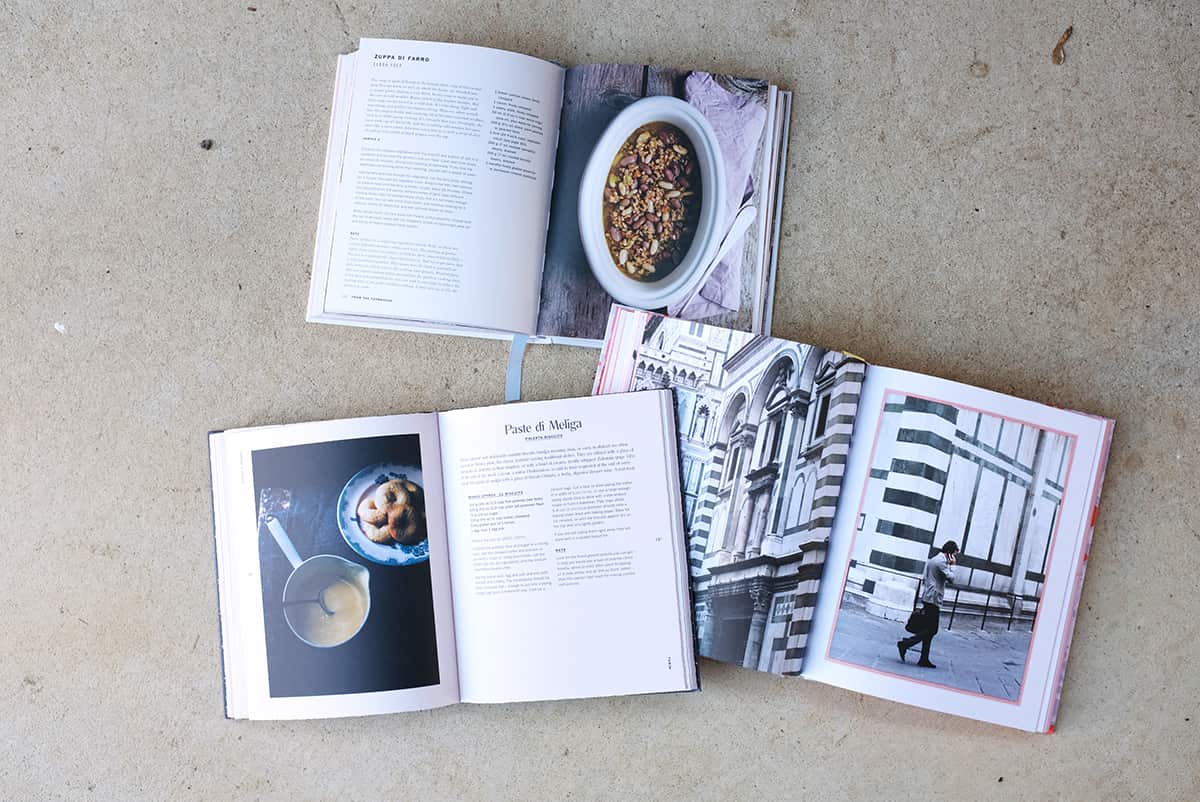
Despite all of the above, there is a spark of reassurance in the fact that cookbook sales remain surprisingly steady. "There's something very natural about a physical cookbook if you love cooking, because people who love cooking love working with their hands. There's a tactile pleasure in peeling back the pages, returning to a favourite recipe, the book falling open where you've used it most."
The same sentiment rings true for Emiko; she inherited Science in the Kitchen and the Art of Eating Well, by Pellegrino Artusi, a staple in every Italian household originally published in 1891. "When I first met my mother-in-law, it was the only cookbook in her house. She's someone who has an extraordinary number of books; she was an Italian literature teacher, so her house is floor-to-ceiling, double-stacked books, but just the one cookbook," Davies shares. "That immediately made me curious. It turned out it wasn't even hers; it was her mother's. When you open it, the spine splits and it falls open to the same page every time, and there's a small pencil mark next to one recipe, a pastry recipe. So of course that was the one I had to try. I still use it whenever I'm making any kind of pie or cookies; it's completely foolproof."
As the threads connecting us loosen in the real world, Emiko returns to food as one of the most enduring ways to weave them back together. Eating the food of another culture is its own kind of time travel, one that requires no framework or prior knowledge, only a willingness to experience something extraordinary.
She recalls the first time she had tortellini in brodo, and how immediately it transported her somewhere else entirely. "It took me straight back to making dumplings as a teenager in Beijing with our housekeeper. The concept is identical: the folding technique, the broth, the occasion. The only real difference between wonton soup and tortellini in brodo is what goes inside. That moment of recognition, these are the same foods, these people are doing the same thing, that's what food can do."
For Emiko, almost every recipe she puts into the world is connected to a memory, a place or a person. She hopes that anyone who cooks from her work is transported somewhere they have never been. That kind of discovery, the kind that requires human feeling on both ends, is precisely what no algorithm can replicate.

SBS Food is a 24/7 foodie channel for all Australians, with a focus on simple, authentic and everyday food inspiration from cultures everywhere. NSW stream only. Read more about SBS Food

Have a story or comment? Contact Us