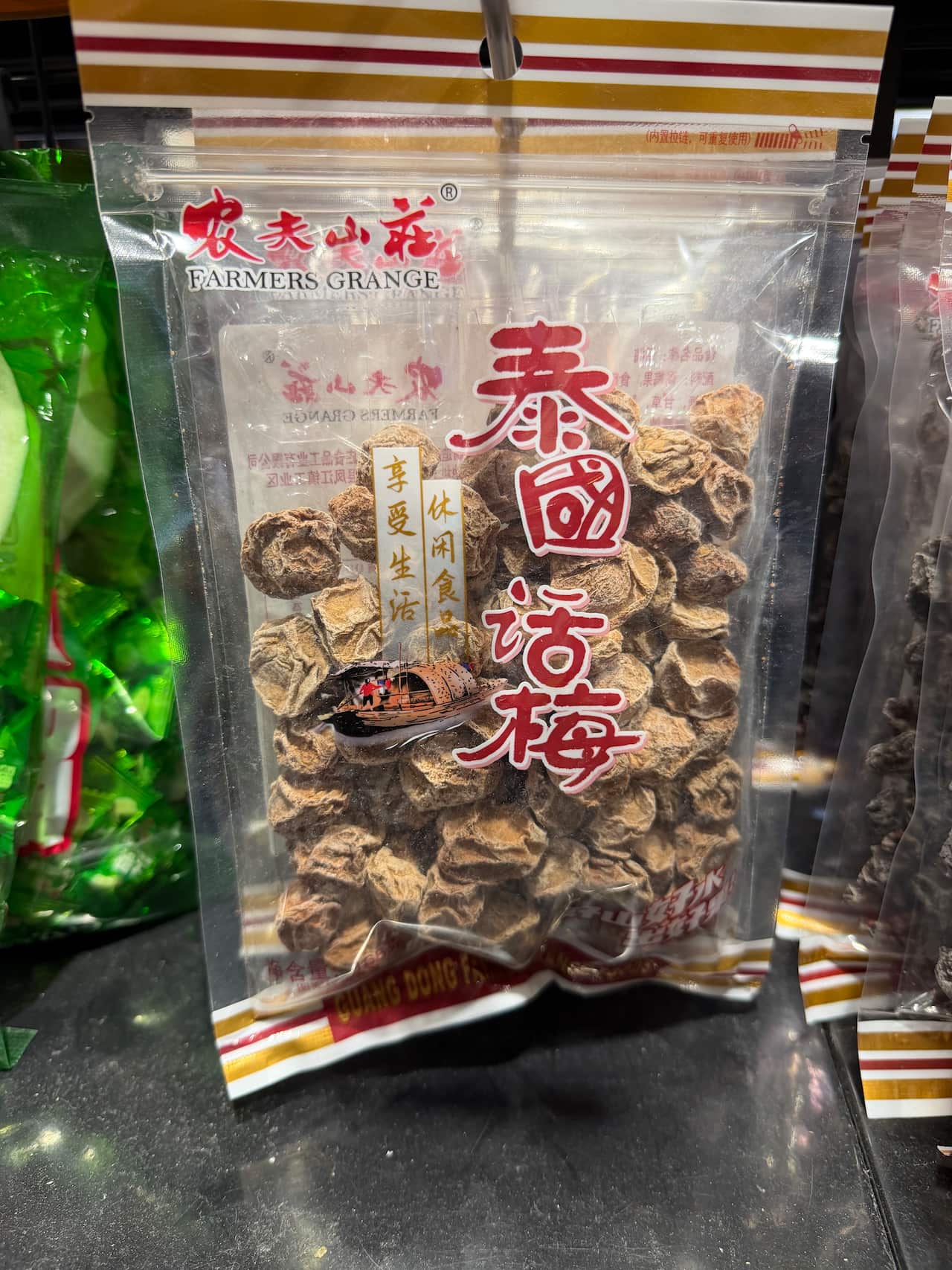
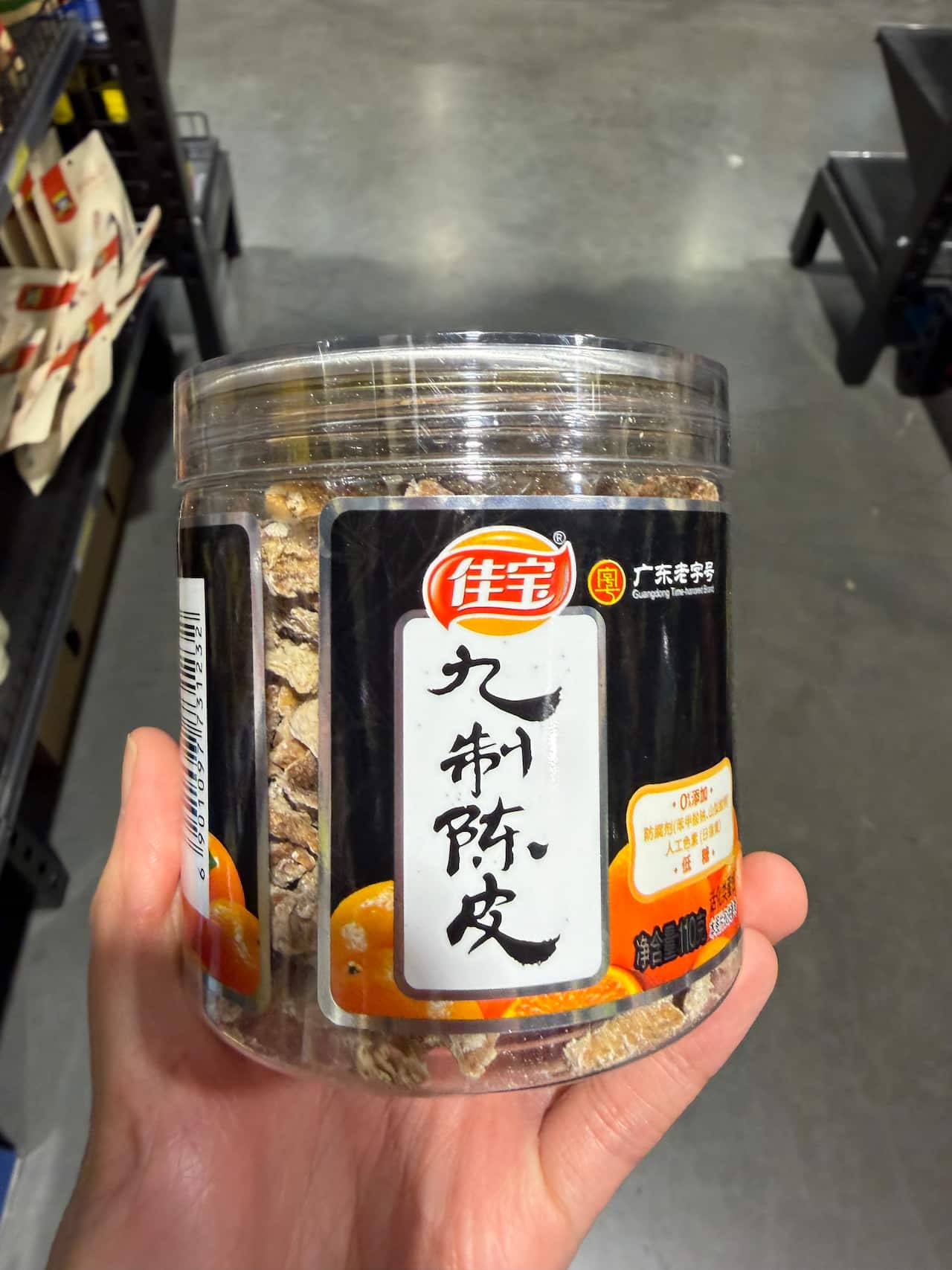
If you go to an Asian grocery store, you will inevitably come across a shelf stocked with dried preserved fruit. Some are used in cooking, added to soups and stews, but certain sugar-sweetened types are eaten as snacks. Whenever I see these preserved fruit snacks, like hua mei (known either as sour or salty plum) and jiu zhi chen pi (sweet tangerine peels flavoured with a touch of liquorice), I am taken back to my primary school days in Singapore.
My mother, in her late thirties at the time, always carried these in her handbag. She would never have very many pieces, despite each being the size of a twenty cent coin. For Mum, this was surprising, given that she loves snacking, especially on sweet treats. But Mum was always satisfied with just one or two hua mei or chen pi.
This is how I learnt to eat it. Whenever we rode the MRT subway home after a day of exploring Orchard Road, she would pop one in her mouth and I would get one too, if I pressed. It would occupy us for part of the lengthy journey back to our stop near Changi.
If these preserved fruits are snack foods, why did Mum ration it so carefully like a cough drop? Mum tells me that she reached for these particular snacks to combat one of the following: indigestion, bloating or nausea after a particularly large meal, sleepiness (on the subway or at a long church meeting), boredom when waiting, or bad breath.
Penang-based Peranakan food expert Pearly Kee and doctoral Southeast Asian Studies student at Cornell University, Joshua Kam, share similar ideas. Kee, who is from Penang, Malaysia, says it is common for Penang women to tote these preserved fruits around in their bags. “For me, I don’t like gossip,” says Kee. “I’d rather have something in my mouth when I hear people gossiping around me, so I concentrate instead on the sour plum I’m eating.” For Kam, his mother had sour plums to keep her awake on long drives around Malaysia. As a child, “she would put me in the shotgun seat and stick out her hand toward me for more sour plums,” he says.
Being dry, light in weight, and tasty, these preserved fruits make the perfect portable remedy. Sydney-based Chinese medicine practitioner Dr. Linh Quach explains that sour plums help ease nausea during pregnancy, and preserved tangerine peels help with moving your digestion along.
In China, this method of multiple rounds of salting, drying and soaking plums in liquorice-infused liquid originated in the Guangdong province. The resulting fruit is dry on the outside, with a white dusting of fine salt powder. It tastes sour, sweet and salty, with a chewy texture. Preserved tangerine peels have a bright citrus aroma and slight bitterness to accompany its sweetness. The peels undergo an additional steaming step on top of the aforementioned process, to soften them.
Another of Mum’s favourite handbag snacks was preserved sweet nutmeg. Fresh nutmeg halves are pickled in a sugar syrup, creating a snack that is refreshing, aromatic and sweet. To prevent the syrup from leaking in her handbag, Mum would make sure she drained the nutmeg well before transferring it into a mini Tupperware wrapped in a plastic bag. Seems excessive, but ultimately worth the effort for the moment she gets to have one or two halves when she really needs it on a hot Singapore day.
Nutmeg originated in the Banda Islands of Indonesia, and it is likely that preserved sweet nutmeg was first made there too. It spread throughout Indonesia, all the way to the city of Jakarta, where Mum got her first taste as a ten-year-old. “In the pool where I had swimming lessons, there was a Chinese-Indonesian seller who sold these out of a little fridge,” she recalls. “It was juicy, sweet, crunchy and cold, and it was very nice to eat in the hot weather after you’re tired from swimming. He sold ice-cream also, but I loved the nutmeg.”
The Banda Islands are the original cultivators of nutmeg, but Penang is also known as another prominent producer, says Kee. The reason behind why Penang grew to be abundant in nutmeg trees is steeped in a dark and terrible historical event. In the 1600s, Dutch colonisers slaughtered rulers of the Banda Islands to take control of nutmeg plantations. To avoid the Dutch monopoly of the nutmeg spice trade, the British smuggled nutmeg seeds and planted some in Penang, explains Kam. It is uncomfortable to remember the history of how nutmeg made its way to Penang, but it is important.
Today, Penang’s existing nutmeg farms are run by local Malaysian families, says Kee. Many Penang locals have relatives or friends with nutmeg farms, says Kee, and when they get fresh nutmeg from them, they pickle some in sugar to create this refreshing snack.
Like with hua mei and chen pi, Kee never eats more than three preserved nutmeg halves at a time, since it is something she reaches for to quench her thirst or fight boredom. “Sometimes when you’re queuing in the bank and waiting too long, you feel moody. Preserved sweet nutmeg quenches your thirst, it helps your mouth stay sweet, so you’re no longer as moody,” she shares.
I can attest to this. Those MRT subway rides home with Mum never did feel long at all.

SBS Food is a 24/7 foodie channel for all Australians, with a focus on simple, authentic and everyday food inspiration from cultures everywhere. NSW stream only. Read more about SBS Food

Have a story or comment? Contact Us