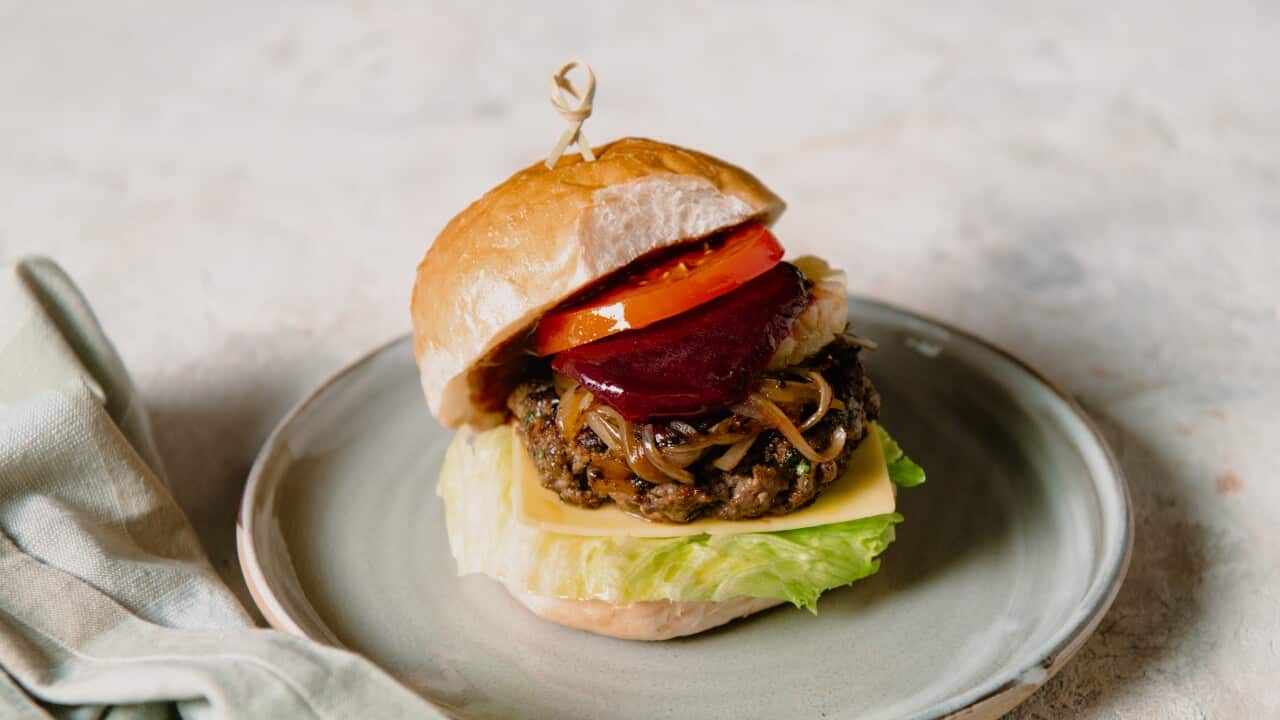
Where would our beloved Aussie burger with ‘the lot’ be without a slice of pickled beetroot intentionally tucked between a warm beef patty and oozy, melted cheese? It certainly wouldn’t taste as sweet or as culturally iconic, that's for sure.
Despite the fact that an Aussie burger must always feature beetroot, its inclusion is rarely questioned. That was, until celebrity chef Rick Stein paused to eat a burger with the lot during his food travels across the country in Rick Stein’s Australia.
I’ve ordered a classic hamburger with a lot, which always includes slices of canned beetroot.
In episode five, Stein visits the Niagara Cafe, Australia’s oldest milk bar (located in Gundagai) and orders an iconic burger with beetroot - a historic inclusion that has been on the establishment's menu for decades.
“I’ve ordered a classic hamburger with a lot, which always includes slices of canned beetroot,” says Stein.
As the chef’s burger arrives, Stein appears impressed. “I think it’s quite a lot bigger than I remember having [when I first tried a burger with the lot in Australia] in the sixties … [On the burger], we have got cheese, egg, bacon, fried onion, patty. We’ve got the tomato, lettuce. And, we’ve got the beetroot!”
Greek milk bars and the making of the Aussie burger
Although the exact origins of canned beetroot on a burger in Australia are not precisely documented, it's understood that the growth of Australia’s food manufacturing industry in the early twentieth century played a major role in standardising preserved vegetables across the country.
Companies such as Edgell, established in 1926, helped to make canned vegetables like sliced pickled beetroot widely available. “It’s a mystery as to why beetroot began appearing on burgers here but it’s believed the opening of canneries in Australia led to a huge enthusiasm for canned food across the country,” says Stein.
By the 1940s and 1950s, sliced beetroot in brine had become a supermarket staple.
At the same time, waves of Greek migration was shaping Australia’s early café and milk bar culture. Many Greek-Australian entrepreneurs adapted American-style diners into local 'milk bars', which became widespread from the 1930s onwards.
Hamburgers were a natural inclusion in these venues, as the ingredients were available and affordable. Canned beetroot was shelf-stable, inexpensive and ready to serve. As a result, it became a regular addition to early burgers sold in milk bars, fish-and-chip shops and cafés like the Niagra Cafe in Gundagai.
Over time, the beetroot inclusion on a burger became standardised. “While milk bars like [the Niagra Cafe] imitated the American fast food experience, their burgers were uniquely Australian,” says Stein.
By the 1950s and 1960s, the 'burger with the lot' (typically beef, egg, bacon, lettuce, tomato, onion, cheese, and beetroot) had become a recognisable Australian takeaway format.
Reflecting on his early eating experiences while travelling in Australia in the 1960s, Stein recalls: “A milk bar sold burgers but they were burgers beyond my wildest dreams. Once I tasted a burger and then when I also tasted a chocolate malted milkshake I thought, ‘I like this country’.”
Today, beetroot still appears on the burgers sold at many traditional fish-and-chip shops, pubs and regional cafés across Australia.
Despite beetroot’s unruly behaviour, slipping out of buns and leaking into the burger's wrapping paper, the inclusion of the canned vegetable on the iconic food remains a national expectation.
And, in a food culture shaped by migration, the Greek-influenced Australian burger with beetroot continues to endure as a national symbol of our diverse food culture.
As Rick Stein, a huge fan of burgers with the lot, puts it: “beetroot is what made it Aussie”.

SBS Food is a 24/7 foodie channel for all Australians, with a focus on simple, authentic and everyday food inspiration from cultures everywhere. NSW stream only. Read more about SBS Food

Have a story or comment? Contact Us