- makes 5 serves
- preparation 25 minutes
- cooking 20 minutes
- difficulty Mid level
Ingredients
- 300 g (10½ oz) plain (all-purpose) flour
- 3 tsp sugar
- 1 tsp salt
- 1 medium egg white
- 1½ tbsp (30 ml) sunflower oil or groundnut oil
- 100 ml (3½ fl oz) lukewarm whole milk
For the yeast mixture
- 11 g (½ oz) dried yeast
- 75 ml (2½ fl oz) lukewarm water
- 3 tsp sugar
For shaping and brushing
- 45 g (1½ oz) unsalted butter
- 1 medium egg yolk, beaten
- ⅓ tsp nigella seeds (optional)
Resting time: 1 hr 45 minutes in total.
Instructions
- Combine the yeast, lukewarm water and sugar in a small bowl, mixing well to dissolve. Cover with cling film (plastic wrap) and rest for 10 minutes, to get frothy.
- Take the butter out of the refrigerator and cut into five pieces, each weighing 9 g (⅓ oz). Place on a plate and set aside in a warm place to bring to room temperature and soften.
- Combine the flour, sugar and salt in a large bowl and make a well in the centre. Add the egg white to the flour, then pour in the yeast mixture, oil and milk. Draw the flour into the liquid then, using your hands, mix into a sticky dough. Turn out onto a lightly floured surface and knead for 5 minutes until you have a soft, elastic, smooth dough. Grease a baking tray (pan) with a little oil, divide the dough into five equal pieces and roll them into balls. Place the dough balls 4 cm (1¾ in) apart on the tray, cover with cling film (plastic wrap) and rest for 1 hour in a warm place, or until they have doubled in size.
- Once the dough balls have risen, take one of them and place it on a clean, dry surface (no need to sprinkle flour on the surface first, as the dough will be quite buttery in the following stage and shouldn’t stick to the surface). The other dough balls should be kept covered under the cling film. Using your fingers, stretch the dough into a rectangle measuring roughly 15 cm x 18 cm (6 in x 7 in). Dot 9 g (⅓ oz) of softened butter all over the dough, then gently spread it evenly across the entire surface, at the same time stretching the dough into a rectangle measuring 25 cm x 21 cm (10 in x 8¼ in). Starting from one of the longer edges, roll the dough into a log. Using both buttery hands, twist each end of the log in opposite directions, then join the two ends to form a circle with a diameter of about 11 cm (4 ½ in), twisting and pressing the ends to seal. Place the açma on a large baking tray lined with baking parchment.
- Repeat the process with the remaining dough balls, placing them 5 cm (2 in) apart on the tray, then loosely cover with cling film and rest in a warm place for a further 45 minutes for the second rise.
- Preheat the oven to 180˚C fan-forced (200˚C standard / 400˚F).
- Once risen, gently brush top and sides of each açma with the beaten egg yolk (try not to press hard as it will deflate the dough) and sprinkle over the nigella seeds, if using. Bake for 16–17 minutes, until dark golden with light brown patches, but still soft inside. Transfer to a wire rack to cool for 10 minutes before serving warm or at room temperature.
Note
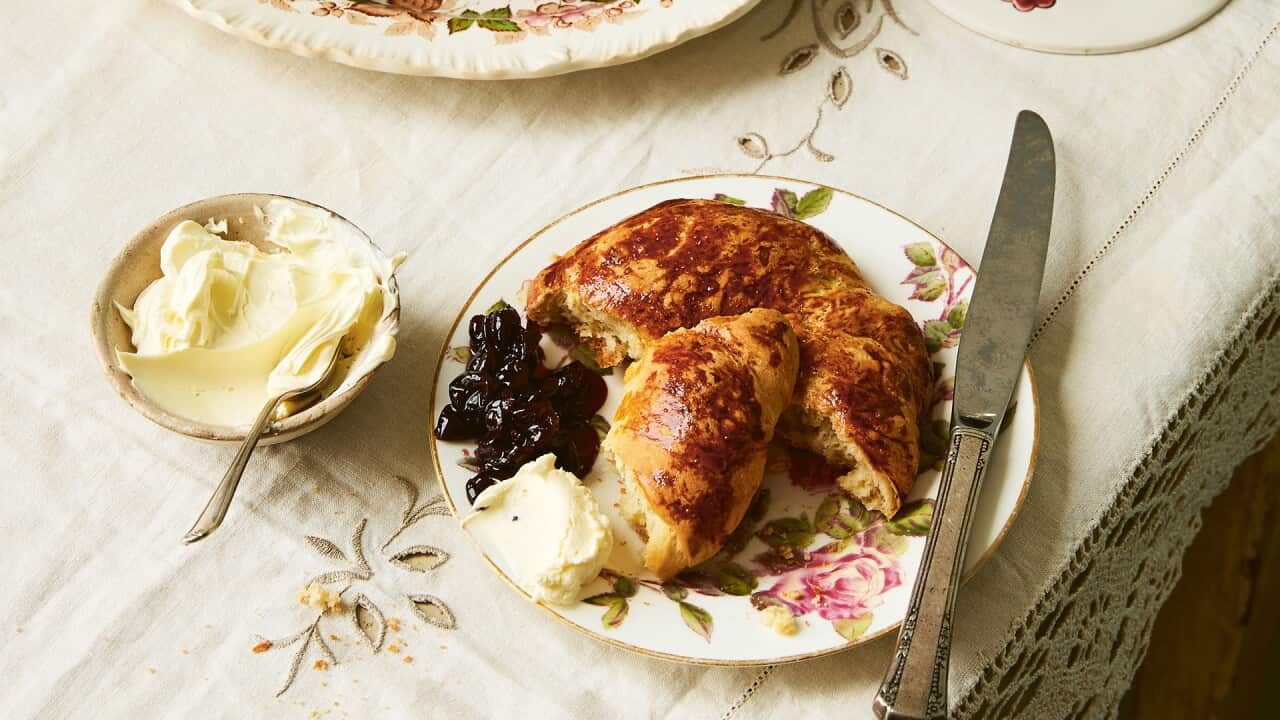
Açma is wonderful with vişne reçeli (sour cherry jam), butter or kaymak (clotted cream), as well as with cheese and olives.
This is an edited extract from Istanbul by Özlem Warren (Quadrille, AU$55). Photography: Sam A. Harris.
Cook’s Notes
Oven temperatures are for conventional; if using fan-forced (convection), reduce the temperature by 20˚C. | We use Australian tablespoons and cups: 1 teaspoon equals 5 ml; 1 tablespoon equals 20 ml; 1 cup equals 250 ml. | All herbs are fresh (unless specified) and cups are lightly packed. | All vegetables are medium size and peeled, unless specified. | All eggs are 55-60 g, unless specified.

SBS Food is a 24/7 foodie channel for all Australians, with a focus on simple, authentic and everyday food inspiration from cultures everywhere. NSW stream only. Read more about SBS Food

Have a story or comment? Contact Us