- makes 30 serves
- preparation 1 hour
- cooking 45 minutes
- difficulty Mid level
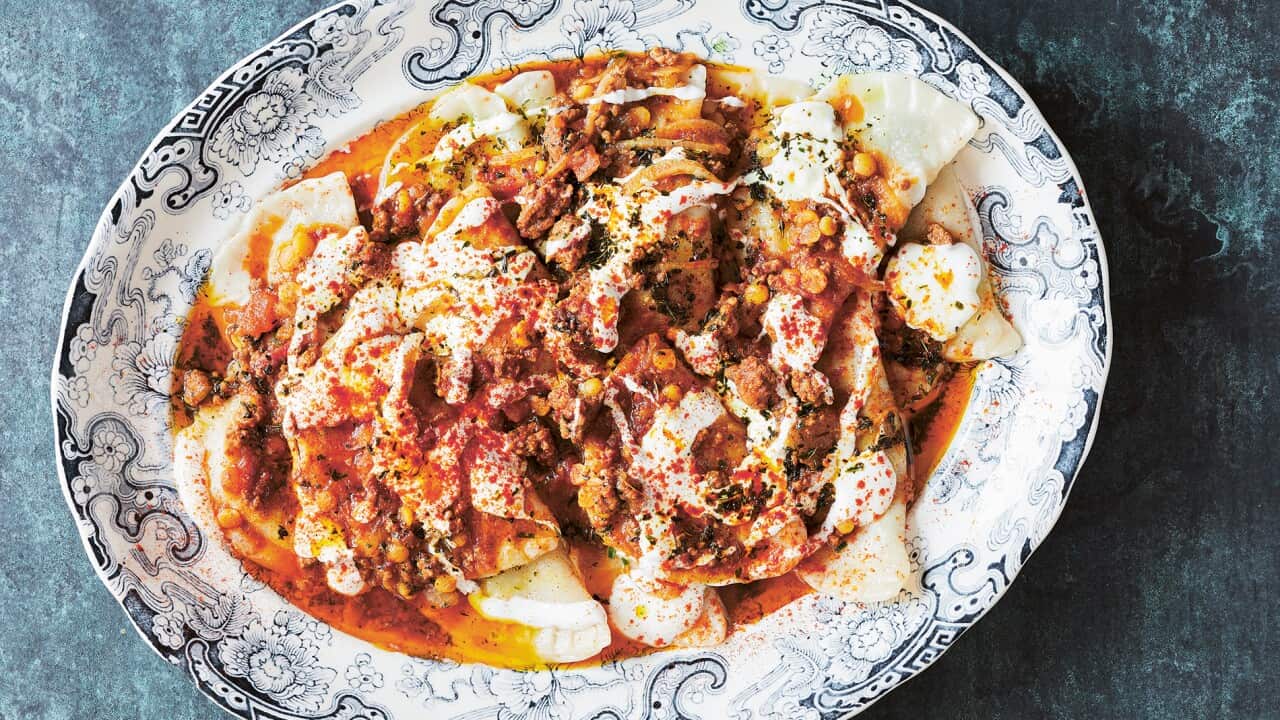
Ashak is made using the same dough for the wrapper as the very popular mantu, but these are less intricate to fold. Typically, they are typically filled with gandana, a traditional Afghan leek that can be substituted with garlic chives or leeks. Ashak are boiled, then served with lamb kofta sauce or vegetarian tomato sauce and a garlic-yoghurt dressing. It’s a good idea to have these ready before making ashak, so that when the dumplings are ready, there will be no delay in serving. Like mantu, ashak is considered a special-occasion dish. Because the dumplings are somewhat time-consuming to make, family and friends often gather together to make them.
Ingredients
Filling
- 500 g (4 cups) garlic chives, finely chopped, or 540 g (4 cups) finely chopped leek
- Small handful finely chopped fresh coriander (cilantro) leaves and stalks
Dough
- 450 g (3 cups) plain (all-purpose) flour
- 1 tbsp sunflower oil
- 250 ml (1 cup) warm water
Garlic-yoghurt dressing
- 130 g (½ cup) plain yoghurt
- ½ tsp garlic powder
To serve
- 1½ tbsp sunflower oil
- Lamb kofta sauce or vegetarian tomato sauce
- 1 tsp ground turmeric
- 1 tsp dried mint
Lamb kofta sauce
- 2 large, ripe tomatoes, quartered
- 2 tbsp sunflower oil
- 1 large brown onion, finely chopped
- 1 garlic clove, crushed
- 500 g (1 lb) minced (ground) lamb
- 1 tsp ground turmeric
- 1 tsp curry powder
- 1 tsp coriander seeds, crushed in a spice grinder or mortar and pestle
- 2 tbsp tomato paste (concentrated purée)
- 1 tsp white vinegar
- 60 g (¼ cup) chana dal (or yellow split peas)
Vegetarian Tomato Sauce
- 125 ml (½ cup) sunflower oil
- 1 large brown onion, finely chopped
- 1 fresh long red chilli, finely chopped
- 4 garlic cloves, crushed
- 1 tsp curry powder
- 1 tsp chilli powder
- 2 large tomatoes, finely diced
- 1 tbsp white vinegar
- 1 tsp white sugar
- 60 g (¼ cup) chana dal (or yellow split peas)
Resting time: 15 Minutes
Instructions
- If making the lamb kofta sauce: Process the tomatoes until puréed in a blender or food processor and set aside.
- Add the oil to a medium saucepan over medium heat. Fry the onion and garlic for 3–4 minutes, or until golden brown, then add the meat and fry for 10 minutes or so, stirring frequently with a wooden spoon and breaking it up so there are no large clumps, until the meat is browned.
- Stir in the turmeric, curry powder, coriander and 1 tsp salt and fry for another 5 minutes, or until the meat starts to release water. Boil the mixture for a further 5 minutes, so that some of the water reduces and the oil rises to the top.
- Stir in the tomato, tomato paste, vinegar and 250 ml (1 cup) water. Continue to break down any remaining large clumps of meat with a wooden spoon, so it’s relatively evenly minced, and bring to the boil.
- Cover the saucepan with a lid and simmer gently over low heat for 10 minutes, or until the sauce has reduced and thickened.
- Meanwhile, put the chana dal into a small saucepan with enough water to cover. Bring to the boil and cook for 10 minutes, or until the dal is soft, but not mushy. Drain, then add to the sauce and stir through to combine.
- If making the tomato sauce: Add the oil to a medium saucepan over medium heat. Fry the onion, chopped chilli and garlic for 2–3 minutes, or until golden brown.
- Next, add the curry powder, chilli powder and 1 tsp salt, and fry for a further 2 minutes, or until fragrant. Stir in the tomato and cook for 10 minutes, or until the tomato softens. Add 375 ml (1½ cups) water and bring to the boil over high heat, then add the vinegar and sugar. Reduce the heat to medium and simmer for another 15 minutes, or until the sauce has reduced and thickened, and is bright red in colour.
- Meanwhile, add the chana dal to a small saucepan with enough water to cover the dal. Bring to the boil and cook for about 10 minutes, or until the dal is soft, but not mushy. Drain, then add to the sauce and stir through to combine.
- For the dumplings, first make the filling: In a colander, wash the chopped garlic chives thoroughly and allow the excess water to drain. Add 1 tbsp salt to the chives and mix well with your hands. Take handfuls of the salted chives and squeeze to remove as much liquid as possible, then place in a bowl. Add the coriander and 1 tsp freshly ground black pepper, mix well and set aside.
- For the dough, stir the flour and 2 tsp salt in a large bowl, then add the oil and mix well to combine. Slowly add the water, kneading to incorporate between additions. You may not need it all, but use enough water to form a firm dough. Turn out the dough onto a workbench and knead for 5 minutes, or until it is smooth and elastic. Place in a clean bowl, cover with plastic wrap and set aside to rest for 15 minutes.
- When the dough is rested, turn out onto a workbench lightly dusted with flour and roll into a paper-thin rectangle about 60 cm (24 in) long and 40 cm (16 in) wide. Using a 7 cm (2¾ in) cookie cutter, or as close to this size as possible, cut as many circles as you can. Leave them flat on the workbench, ready to be filled with the chive filling.
- Line a tray or large plate with paper towel and have a small bowl of water to hand. Working with one wrapper at a time, wet the circumference with your finger, being careful not to make the dough soggy, then place a tsp of the chive filling in the centre. Fold the wrapper in half over the filling to create a semi-circle, then pick it up and press the edges firmly together to seal, so it won’t open while boiling. Place on the lined tray and repeat with the remaining wrappers and filling. You can place ashak in layers on the same tray, but make sure you place a sheet of paper towel between each layer to prevent sticking.
- Three-quarters fill a medium saucepan with water and bring to the boil. Add ½ tbsp oil and 1 tsp salt. Carefully add the ashak to the boiling water and stir occasionally for 6–7 minutes, or until the dough is translucent. Using a slotted spoon, gently remove the ashak, allowing the water to drain well, and place on a plate.
- To make the garlic-yoghurt dressing, whisk the yoghurt, garlic powder and ½ tsp salt in a small bowl until smooth. Spread half the dressing over a large platter and arrange the ashak on top. Pour over the lamb kofta sauce or vegetarian tomato sauce, then drizzle with the remaining garlic-yoghurt dressing.
- Place a small frying pan over high heat. Add the remaining 1 tbsp oil, together with the turmeric and dried mint. Heat for 1–2 minutes, or until the oil is hot and infused with the turmeric and mint. Carefully pour the hot infused oil over the ashak and serve immediately.
Images and text from Parwana by Durkhanai Ayubi (Murdoch Books). Recipes by Farida Ayubi with assistance from Fatema Ayubi. Photography by Alicia Taylor.
Cook’s Notes
Oven temperatures are for conventional; if using fan-forced (convection), reduce the temperature by 20˚C. | We use Australian tablespoons and cups: 1 teaspoon equals 5 ml; 1 tablespoon equals 20 ml; 1 cup equals 250 ml. | All herbs are fresh (unless specified) and cups are lightly packed. | All vegetables are medium size and peeled, unless specified. | All eggs are 55-60 g, unless specified.

SBS Food is a 24/7 foodie channel for all Australians, with a focus on simple, authentic and everyday food inspiration from cultures everywhere. NSW stream only. Read more about SBS Food

Have a story or comment? Contact Us