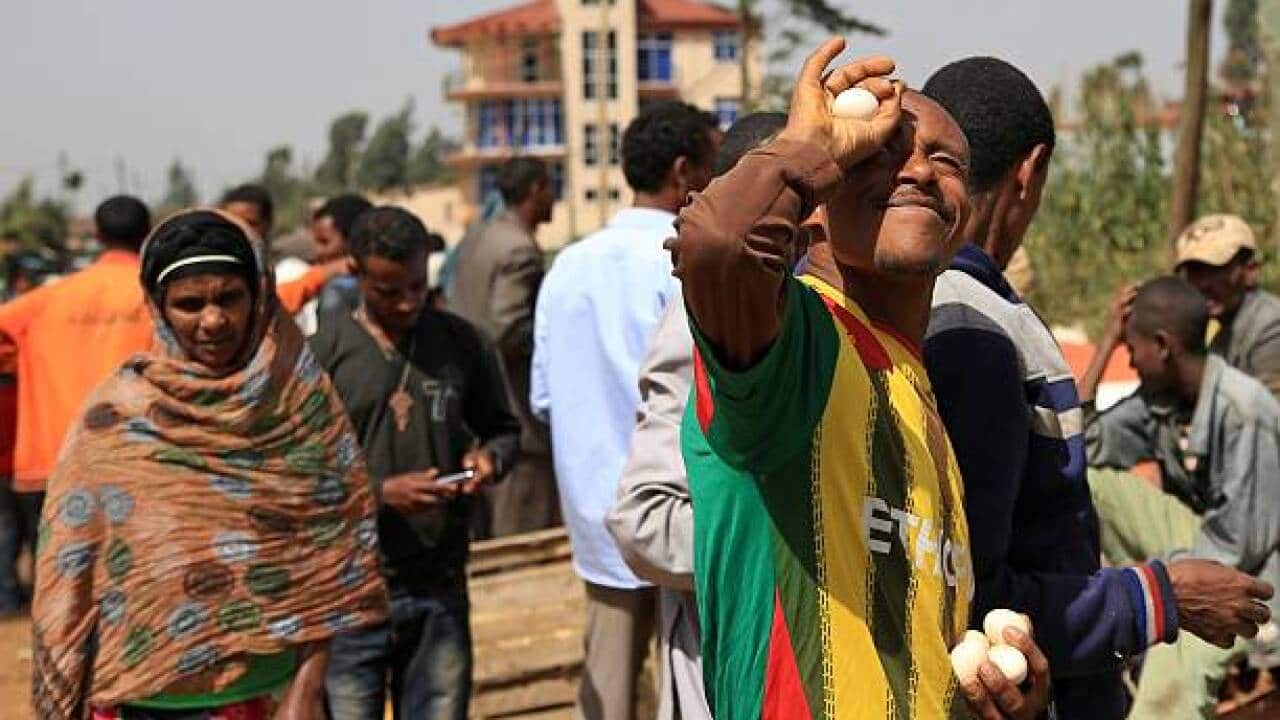
Across Ethiopia's diverse landscapes—from dense urban centres to remote rural hinterlands—the price of an egg now varies not only over time, but across space, revealing a distinctly geographic pattern of economic strain.
The Protein Barometer
In contemporary Ethiopia, the humble egg has quietly graduated from a simple breakfast staple to something far more revealing.
It now serves as a socio-economic barometer—not of atmospheric pressure, but of the growing pressure on the average citizen's wallet.
This pressure is unevenly distributed, shaped by distance from markets, access to transport networks, and the geography of production zones.
Once known as the affordable "queen of the table," the egg was a reliable source of protein that most households could count on without much thought.
Today, however, that modest oval has taken on a new life. Shielded by its fragile shell yet propelled by powerful market forces, the egg seems to have sprouted wings—soaring steadily into the upper atmosphere of inflation.
What was once a routine item in the kitchen has become a quiet indicator of modern living costs.
When the price of eggs rises sharply, it often signals deeper trends in the economy, household purchasing power, and the delicate balance between food supply and everyday survival. In that sense, the egg has become more than food—it has become a story about life in contemporary Ethiopia.
It is also a story about spatial inequality—how location increasingly determines access to even the most basic sources of nutrition.
Nature's Mini Powerhouse
Science has long celebrated the egg as a "complete food"—a compact nutritional powerhouse containing all nine essential amino acids required for human growth.
Nature, in its quiet efficiency, wrapped this remarkable package in a biodegradable shell long before the word "superfood" entered the modern vocabulary.
Yet the egg's reputation has not always been sunny-side up. For decades, it endured a prolonged smear campaign in the medical world, branded a dietary villain because of its cholesterol content.
In kitchens and clinics alike, the egg became a symbol of health anxiety.
This era of cholesterol panic even inspired a local joke:
A health-conscious diner orders a fried egg. "Remove the yolk—it's full of cholesterol," he insists. "So just the white, sir?" asks the waiter. "Actually, the white causes allergies—leave that out too," the diner replies. Losing patience, the waiter snaps, "Fine! Shall I bring the pan to lick?"
Fortunately, science has since reconsidered its verdict. Eggs are now recognised as vital nutrients for heart health, brain development, and overall well-being.
Even the shell tells a remarkable story: over 7,000 microscopic pores breathe in oxygen and release carbon dioxide to sustain life within—an elegant natural design that mirrors the egg's enduring role in human nutrition.
Across Ethiopia's varied ecological zones, from highland farms to peri-urban poultry systems, this small biological unit connects landscapes to livelihoods.
The "Mortar" of Our Past
In Ethiopia, the egg has never been just food. It has also been, quite literally, part of the architecture of our history.
Local lore tells of 16th-century builders near Debre Libanos Monastery who mixed egg whites with lime and sand to produce a remarkably resilient mortar used in constructing the famous Portuguese Bridge (Debre Libanos).
The technique gave the structure strength and water resistance—qualities that help explain why the bridge has endured centuries of weather, history, and legend.
Here, geography and material culture intersect, where local environmental knowledge shaped construction practices adapted to specific landscapes.
Further north, in Fasil Gibbi, the royal compound houses Enkulal Gemb (Egg Castle), with its distinctive egg-shaped dome—a symbolic nod to the egg's enduring place in Ethiopia's cultural imagination.
Eggs also left their mark on Ethiopia's social and economic history. An old folk verse humorously laments a time when taxes were paid in eggs:
"Had Menelik not raised his shield, the Ethiopian tax would still be eggs." (ምንሊክ ተነስቶ ባያነሳ ጋሻ፣ ግብሩ እንቁላል ነበር ይህን ጊዜ አበሻ።)
Even today, the neighbourhood Enkulal Fabrika ("Egg Factory") preserves the memory of massive storehouses where these "tax eggs" were once collected.
These spatial imprints remind us that eggs once moved not only through kitchens but also through tax networks and regional economies.
In Ethiopian history, the egg is more than sustenance—it is a tangible connection to architecture, economy, and everyday life.
The Political Shell
Eggs have long served as unlikely props in politics. Small, ordinary, and universally familiar, they provide a simple yet powerful metaphor for economic and social realities.
From global political discourse to local market stalls, the egg operates across scales—linking household experience to national and even international economic narratives.
Globally, eggs have been invoked in debates as early as the Kennedy–Nixon era, when egg prices were cited as an indicator of economic health.
They have also been flung in protest—a messy but peaceful way to voice dissent.
During the Cold War, the metaphor became darker. When a French author asked a Soviet cadre about the disappearance of dissidents, the official reportedly said, "My friend, if you want to make a delicious omelette, you must first break a few eggs."
A chilling reminder that political power can treat human life as fragile and disposable.
In Ethiopia, the late Prime Minister Meles Zenawi once compared political actors to chickens: "Some cluck without laying an egg; others lay an egg and stay silent. We [the EPRDF] lay the egg and cluck as well."
Today, regardless of who is clucking in the political barnyard, one fact remains: no one seems able to coax the price of an egg back below 25 birr.
The Stratospheric Rise
There is an old saying: "Slowly, the egg will learn to walk on its own legs." (ቀስ በቀስ እንቁላል በእግሯ ትሄዳለች) Today, however, the egg is no longer walking—it has boarded a rocket.
This rise is not occurring in isolation, but along supply chains that stretch across regions—linking feed production areas, transport corridors, and urban consumption centres.
- 1960s–70s: 1 birr could buy 40 eggs
- The Derg era: 1 egg = 5–10 cents
- 15 years ago: 2 eggs = 1 birr
- Today (2026): 1 egg = 18–25 birr
The egg has migrated from the poor man's table to something approaching a luxury item.
In the 1990s, the late comedian Tesfaye Kassa joked that when eggs reached 1.50 birr, one might wonder if they were laid by gas stations like Mobil or the National Oil Company of Ethiopia (NOC) ('ይቺን እንቁላል የጣላት...የኖክ ወይንስ የቶታል ነዳጅ ማደያ? ').
Looking back today, those prices feel almost nostalgic—a reminder of an era when inflation still had limits.
Visitors have noticed the phenomenon, too. Don Koppes, a retired American teacher, observes that in southern Ethiopia, "egg prices and fuel prices" are the two main indicators of quality of life. Fuel moves the machines, but eggs fuel the human engine. When both soar, daily life grinds to a halt.
In geographic terms, these two commodities map the lifelines of the economy: fuel enables movement across space, while eggs reflect the cost of sustaining life within it.
The "Egg-Geonomics" Map
Facebook pages such as ACCU Breed, which focus on agribusiness content, demonstrate how social media can serve as a surprisingly effective source of real-world data.
In early March 2026, the page invited Ethiopians to report egg prices in their respective towns. In response, more than 65 price observations were crowdsourced and compiled into a list of towns and their corresponding prices.
Building on this grassroots dataset, this analysis extends the ACCU Breed initiative to generate additional value-added insights.
After cleaning and verifying the reported data, a dataset representing 60 towns was prepared for analysis.
Using geospatial techniques, these observations were transformed into an "Egg-Geonomics" map—a term coined to represent the spatial economics of egg prices—providing a visual snapshot of price variations across a substantial portion of Ethiopia.
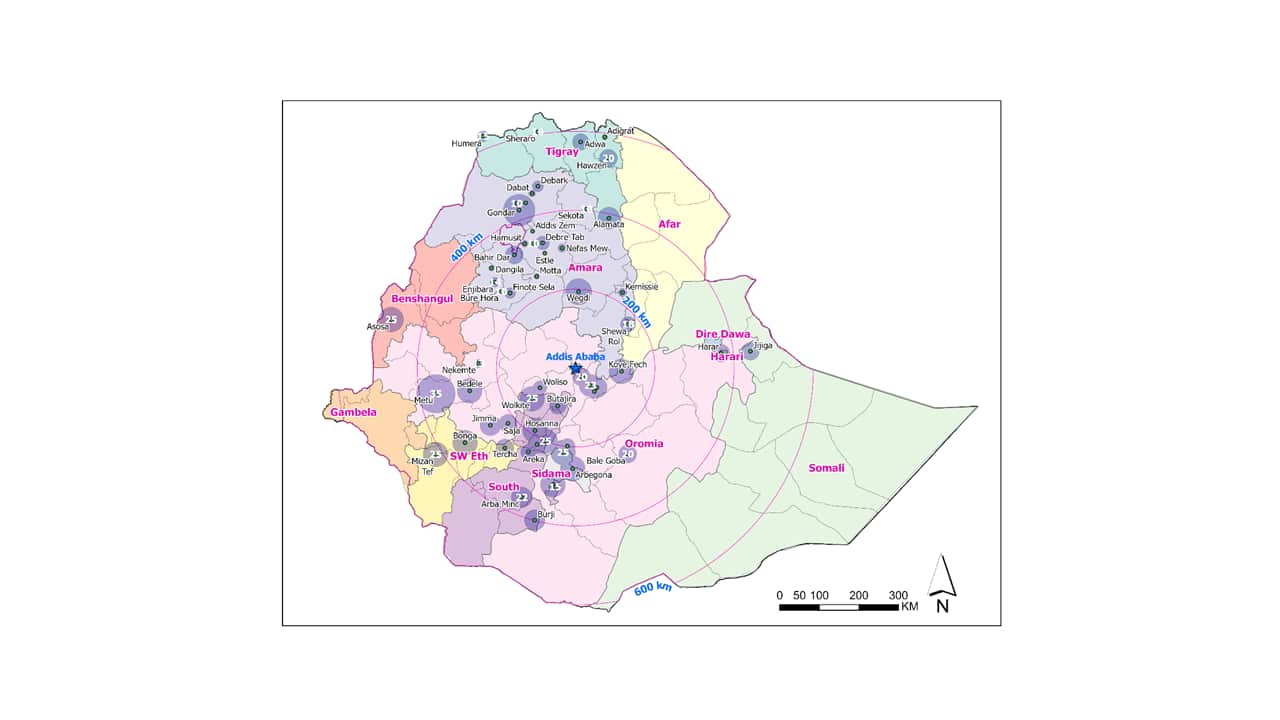
Here are the key insights of the resulting map:
- Spatial Distribution: Most reports come from central, southern, and northwestern Ethiopia.
- Distance from Addis Ababa: 14 towns within 200 km; 32 towns between 200–400 km; 14 towns between 400–600 km.
- Price Variation: Overall average = 18.50 ETB; within 200 km of Addis = 20.80 ETB; 200–400 km = 18.31 ETB; 400–600 km = 17.60 ETB.
The expected spatial gradient—where prices decline in more rural or production-rich areas—appears surprisingly weak.
Even in distant towns with ample land for poultry production, prices are not significantly lower. This pattern challenges conventional geographic expectations.
The principle of distance decay, whereby prices typically decrease with increasing distance from major urban centres, is only faintly evident. Instead, the data points to a broader systemic issue: widespread erosion of purchasing power across the economy.
The real value of the currency has, in effect, leaked away—much like the contents of a cracked eggshell.
Conclusion: Repairing the Shell
The story of Ethiopian "Egg-Geonomics" delivers a bitter truth: the soaring price of eggs is not a failure of the chickens, but a symptom of deeper cracks in the national economy.
These cracks are not evenly distributed; they ripple unevenly across regions, reflecting disparities in access, infrastructure, and economic opportunity.
Addressing this challenge requires stabilising the cost of poultry feed, improving supply chains, and protecting household purchasing power.
The price of an egg is no longer just an economic figure—it is a geographic signal, mapping the uneven terrain of affordability across Ethiopia.Daniel Kassahun (PhD)
Breaking an egg may be easy, but restoring a struggling economy requires the careful touch of a master chef.
In this sense, the geography of eggs mirrors the geography of inequality—mapping where the burden of economic hardship is most intensely felt.
Without decisive action, the humble egg will remain out of reach for many families, leaving the nutrition, health, and brain development of the next generation as fragile as its own shell.
For Ethiopians today, the age-old question—"Which came first, the chicken or the egg?"—has been replaced by a far more pressing one: "When was the last time we actually ate an egg?"
====================================
Daniel Kassahun, PhD, is an Associate Professor based in Austin, Texas. His work focuses on examining environmental, social, and economic challenges through a geospatial lens, with particular attention to how spatial patterns reveal hidden dimensions of everyday life, and sharing these insights with both academic and general audiences.