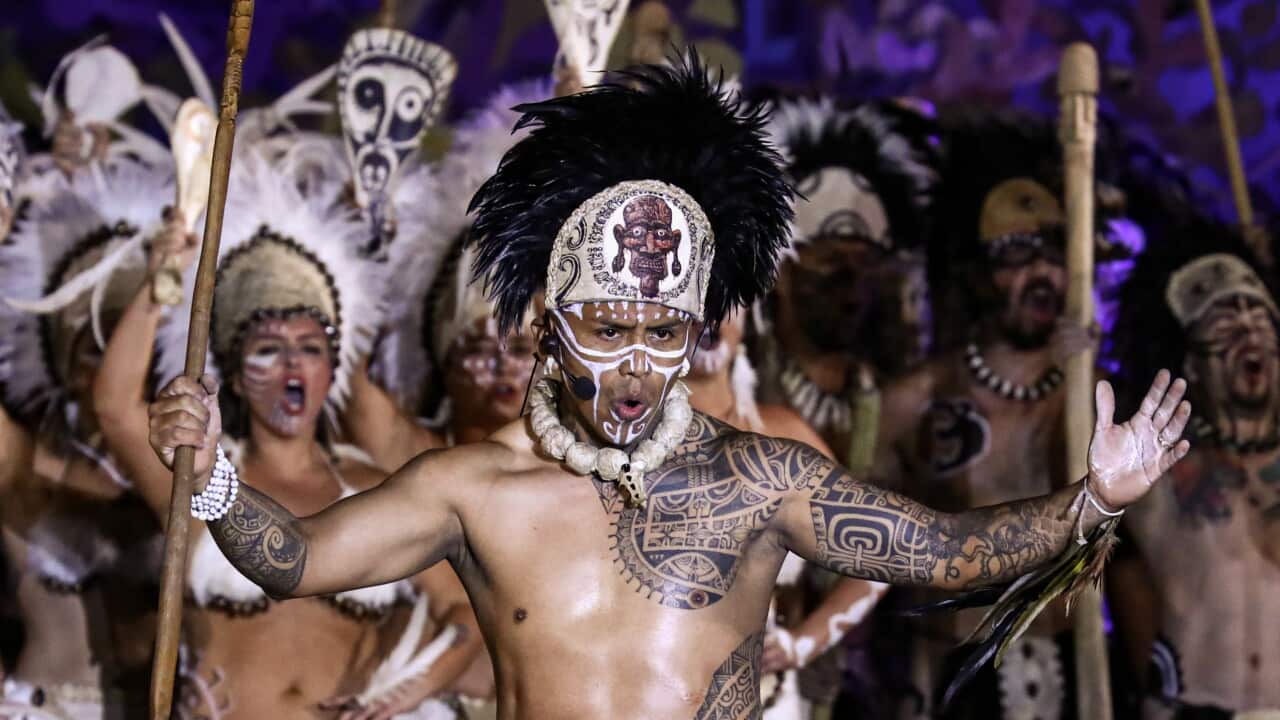

The Australian Museum has repatriated the ancestral remains of 17 Rapa Nui islanders to their eastern Pacific place of origin. This homecoming has renewed calls for the return of giant statues, or Moai, from the British Museum. But a UK based archaeologist has warned against overturning historic arrangements made between consenting parties.
It has been a long journey for the ancestral remains of 17 Rapa Nui islanders.
Removed from sacred burial sites, without Indigenous consent, by a German naval expedition in 1882. They were then acquired by the Australian Museum.
For Indigenous Rapa Nui like Victor Pakomio, their repatriation, nearly a century and a half later - is part of an ongoing post-colonial healing.
"I cry because I see the carving of my people in the past," he says.
I cry because I see the carving of my people in the past.Victor Pakomio
Rapa Nui is a Polynesian territory of Chile. It lies about a five-and-a-half-hour-flight from the capital Santiago. Also known as Easter Island, it is most famous for its giant statues, known as Moai.
The repatriation was funded by the Australian Museum Foundation. Melissa Malu is head of Pasifika Collections and Engagements at the Australian Museum. She says the return of these Rapa Nui ancestral remains is about righting the wrongs of the past.
"Where the relationship has been built where we have consulted and there is a pathway for return, it is important for the Australian Museum to carry out this work," says Malu.
However, other museums around the world continue to retain artefacts and remains from Rapa Nui. Despite appeals for repatriation - the British Museum maintains possession of two stone statues or Moai - including the giant Hoa Hakananai'a.
In a statement to SBS Our Pacific, a British Museum spokesperson said, "The museum recognises the significance of Hoa Hakananai'a and Moai Hava for the Rapa Nui community today, and acknowledges the impact of their removal from the island."
There is no wrong to be righted, therefore no return.Mario Trabucco della Torretta
UK based classical archaeologist Mario Trabucco della Torretta supports the British Museum's position of retaining Hoa Hakananai'a.
"On this, particular case, I say there was no wrong to be righted, therefore no return. There is a report from 1869 that basically says that the Rapa Nui people were actually helping out the British sailors in digging out the Moai. First of all, pointing their attention to it, then digging it out with them, and then helping them out in bringing it over on the ship on HMS Topaze. So, in this situation, we have an acquisition that has been done legitimately, has been done without any wrongdoing. So, if you come after that, after 150 years, 200 years and say, 'No, I want it back. It was all wrong.' For me, this is the wrong. This is basically wanting to rewind the clock of history and trying to build an alternate past."
Let us have our ancestral spiritual power back.Francisco Nahoe
But Rapa Nui clergyman Friar Francisco Nahoe believes the rightful place for the Moai, is at home, situated in a cultural context.
He says, "Let us have our ancestral spiritual power back."