
Investigations are still underway after Australian biosecurity officers intercepted an illegal importation of citrus budwood infected with Huanglongbing (HLB) disease at the Brisbane airport on 28th May.
According to Department of Agriculture and Water Resources Biosecurity, officers investigating luggage discovered the single budwood stick hidden in a tire inner tube.
“When searching the passenger’s baggage, officers located a tire with an inner tube that was secured with tape. The cutting was in a green plastic bag with moist tissues,” a department representative said.
Commonly known as the citrus greening disease, HLB is currently not present in Australia. The disease, which has no known cure, is listed as the country’s 5th priority plant pest.
The department confirmed that the budwood recovered is of a cumquat citrus variety and came from the Asian region.
Announcing the arrest in June, Australian Chief Plant Protection Officer, Dr Kim Ritman said: “This particular passenger tried to smuggle citrus budwood through Brisbane Airport in the inner tubing of a tyre, and we have now confirmed that plant material was carrying Huanglongbing.
It is also highly disappointing that the passenger is employed in a horticulture sector that was significantly impacted by the 2005 outbreak of citrus canker.Our biosecurity officers intercepted the risky material and the passenger is now the subject of enforcement action by the department.”
Citrus Australia CEO, Nathan Hancock, had earlier released a statement about the successful interception and commended the department for its work in preventing a major biosecurity threat that could have potentially put the AUD $460 million industry at risk. According to Mr Hancock, Australia produces 750,000 tonnes of citrus a year.
Biosecurity Australia has declined to give any additional information on the exact country where the budwood was sourced. However, evidence seen for this report suggests the material may have been sourced from the Philippines.
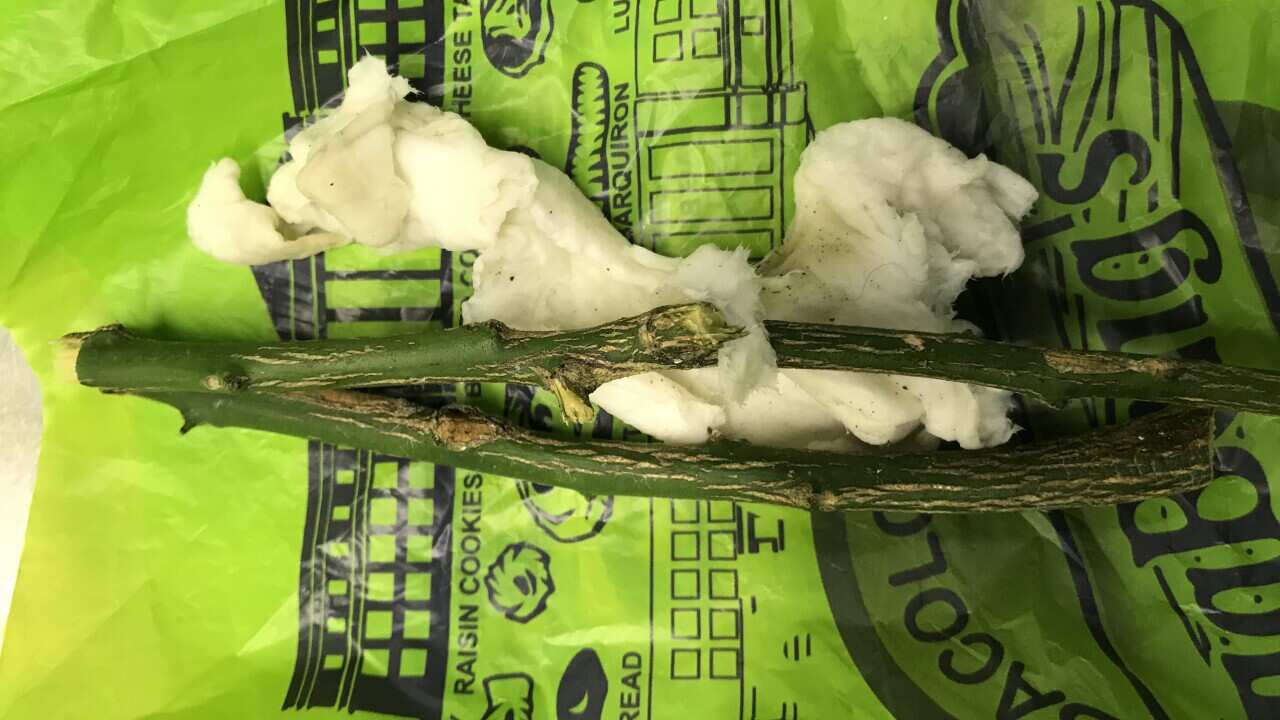
In a photo provided by the department, the budwood is on a green plastic bag that resembles packaging being used by a Philippine food business. However, there is no clear indication that the budwood indeed come from the Philippines.
In an article published in 2016 by the Department of Agriculture of the Philippines, the devastating citrus disease “affects all main types of citrus”. It is believed to have reached the Philippines in the 1950’s “when it imported citrus seedlings from China, Taiwan and India.”
It was reported that between the 1960’s to 1970’s, the disease wiped out over a million citrus trees in the Philippines – more than half of the country’s entire citrus production during the time.
Many citrus varieties are grown in the Philippines including mandarins such as szinkom and ponkan, and the native calamansi. According to Dr Rene Espino, a citrus crop expert in the Philippines, while calamansi is not known to be highly susceptible to HLB, szinkom and ponkan are far more prone to the disease and decline within three years. In an interview, he said cumquat is a temperate citrus variety and is not widely grown in the Philippines.
Dr Juliet Ochasan, a citrus crop scientist who has done research in HLB, confirms that cumquat is only grown on a small scale in cold climate areas in the Philippines. “We have not received any reports of HLB cases on cumquat since it’s a very small production. Although, cumquat is not immune to HLB if planted next to other varieties that may be infected with it,” Dr Ochasan explains.
Dr Ritman does not believe that people who travel into Australia who are caught carrying plant materials have any intentions to illegally smuggle these items or cause damage. He said that most people are simply not aware of the conditions in Australia. Likewise, he does not believe that travelers and importers intentionally bring in infected materials. He said that it would be difficult for someone with an untrained eye to recognize a disease like HLB.
“We have very few pests and diseases compared to other countries. It gives us a significant advantage in our cost of production and helps us protect our unique environment that is highly susceptible to diseases coming from overseas. I think this needs to be a concerted effort that everybody works together – not only for financial but also environmental benefits of the country,“ Dr Ritman added.
Depending on the circumstances, a person who imports plants into Australia without lawful authority may be liable to penalties of up to $420,000 and/or up to 10 years imprisonment.