
India’s historic second lunar mission, Chandrayaan-2, is on course to land on the lunar south polar region on 7th September, India’s Space Research Organisation (ISRO) said on Sunday.
Chandrayaan-2 (“moon craft” in Sanskrit) was launched in India on July 22, a week after it was previously called off due to a technical snag on July 15.
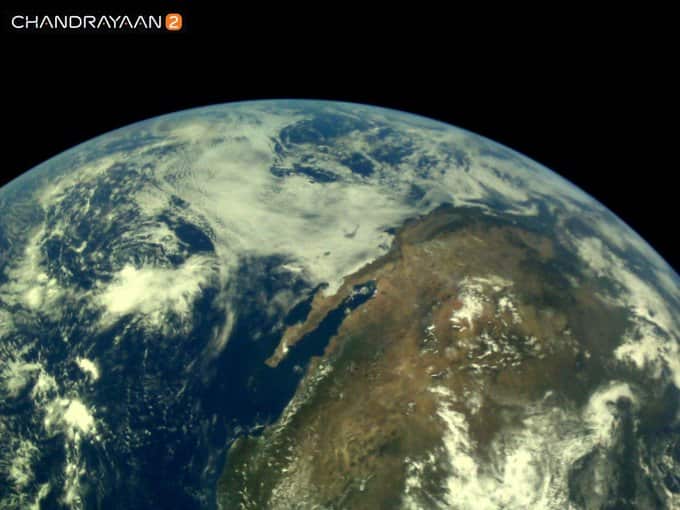
Almost a month later, the space mission is on track and doing well.
‘The health of the spacecraft is being continuously monitored from the Mission Operations Complex (MOX) at ISRO Telemetry, Tracking and Command Network (ISTRAC) in Bengaluru with support from Indian Deep Space Network (IDSN) antennas at Byalalu, near Bengaluru,’ ISRO said.
‘Since its launch on July 22, 2019, by GSLV MkIII-M1 vehicle, all systems onboard Chandrayaan-2 spacecraft are performing normal.’
On Tuesday, August 20th, Chandrayaan-2 will approach Moon and the spacecraft's liquid engine will be fired again to insert the spacecraft into a lunar orbit.
‘On entering Moon's sphere of influence, on-board thrusters will slow down the spacecraft for Lunar Capture.
‘The Orbit of Chandrayaan-2 around the moon will be circularized to 100x100 km orbit through a series of orbital manoeuvres.
‘On the day of landing, the lander will separate from the Orbiter and then perform a series of complex manoeuvres comprising of rough braking and fine braking,’ ISRO said.
The mission’s 1,471-kilogram Vikram lander, accompanied by the 27-kilogram Pragyan rover, will subsequently separate on September 2 in preparation for a landing which, if successful, would make India the fourth country to soft-land on the moon, following the U.S. China, and the former Soviet Union, and also the closest touchdown to the south pole so far.
Why is India going to the moon?
The Moon is the closest cosmic body at which space discovery can be attempted and documented.
‘It is also a promising testbed to demonstrate technologies required for deep-space missions,’ ISRO says.
‘Chandrayaan 2 attempts to foster a new age of discovery, increase our understanding of space, stimulate the advancement of technology, promote global alliances, and inspire a future generation of explorers and scientists.’
What is the objective of Chandrayaan 2?
ISRO wants to conduct further studies on the extent of water molecule distribution on Moon’s surface after Chandrayaan-1 discovered the presence of water on the moon.
‘Extensive mapping of the lunar surface to study variations in lunar surface composition is essential to trace back the origin and evolution of the Moon.
‘Evidence for water molecules discovered by Chandrayaan-1, requires further studies on the extent of water molecule distribution on the surface, below the surface and in the tenuous lunar exosphere to address the origin of water on Moon.
The lunar South Pole is especially interesting because of the lunar surface area here that remains in shadow is much larger than that at the North Pole. There is a possibility of the presence of water in permanently shadowed areas around it. In addition, South Pole region has craters that are cold traps and contain a fossil record of the early Solar System,’ ISRO says.
Tune into SBS Hindi at 5 pm every day and follow us on Facebook and Twitter




