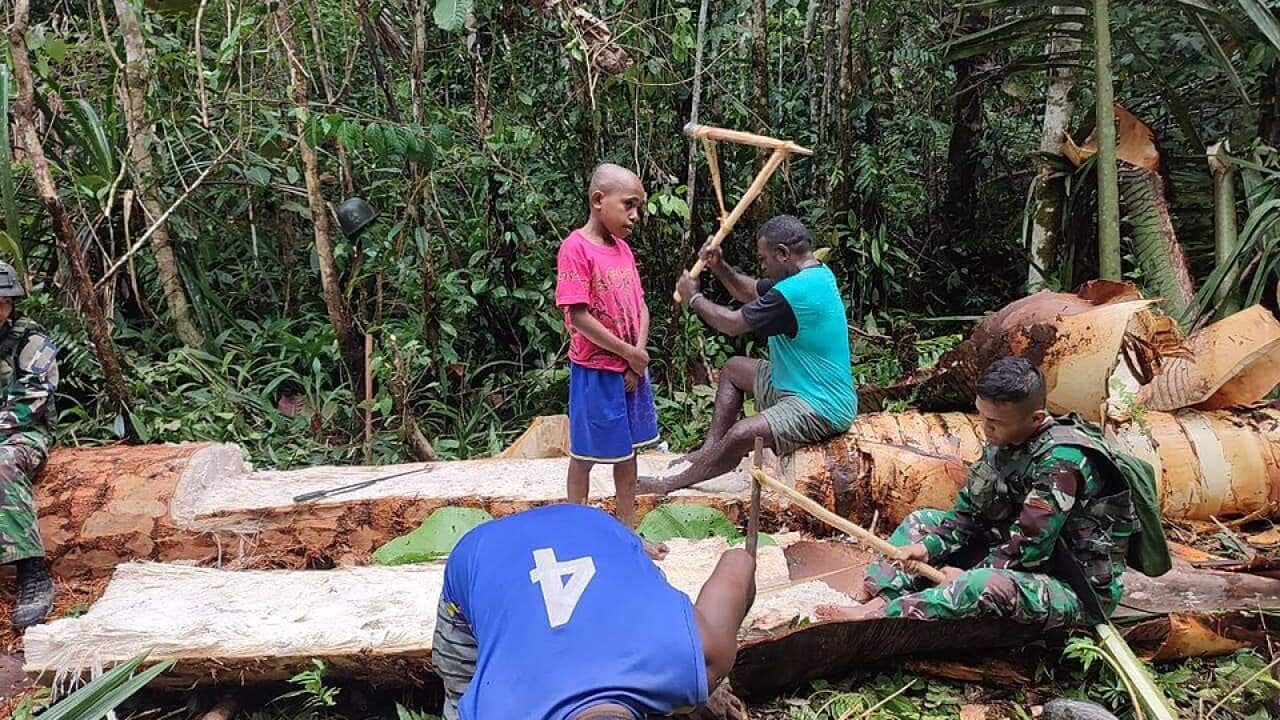

For Papuans, sago is not just a stomach filler. It is the foundation of fair culture that blends with the history and identity of man on his land. However, the shadow of lifestyle changes is now fuelling concern: will sago be excluded from Papuan people's lives?
SBS Indonesian spoke with Dr. Aser Rouw, SP, M. Si, as Head of the Papua New Agricultural Modernization Implementation Hall (BRMP). He revealed a significant shrinkage in the natural sago population.
Based on indicative analysis data, the sago potential in Papua, which in the 1990s reached about 5.2 million tree trunks, has now decreased dramatically to only about 1.2 million trunks.
This phenomenon is also evident in Jayapura, where in the space of two years since 2018, the number of sago trees has decreased from five thousand to four thousand trunks more.
Although rice consumption among Papuans is increasing as a form of food diversification, this does not necessarily indicate a total shift in consumption, according to Aser.
The government has also carried out various strategic steps through conservation programs, structuring, and downstream processing. The Aser-led institute has registered 11 Papuan sago germplasm accessions for protection and proposed two of them to become national varieties.

One peculiarity of sago is its banana tree-like mulching properties, so the regeneration process occurs naturally when a single tree is cut down.
In the future, sago preservation becomes crucial for several key reasons. First, amid the challenges of climate change, sago should be viewed as a major food source because of its adaptability in marginal lands and its resistance to drought.
Secondly, sago has great potential as an energy source.
Thirdly, the sago ecosystem holds a rich ecological value for Papuans, as it contains a variety of forest products, from game animals to swamp fish that support their lives.