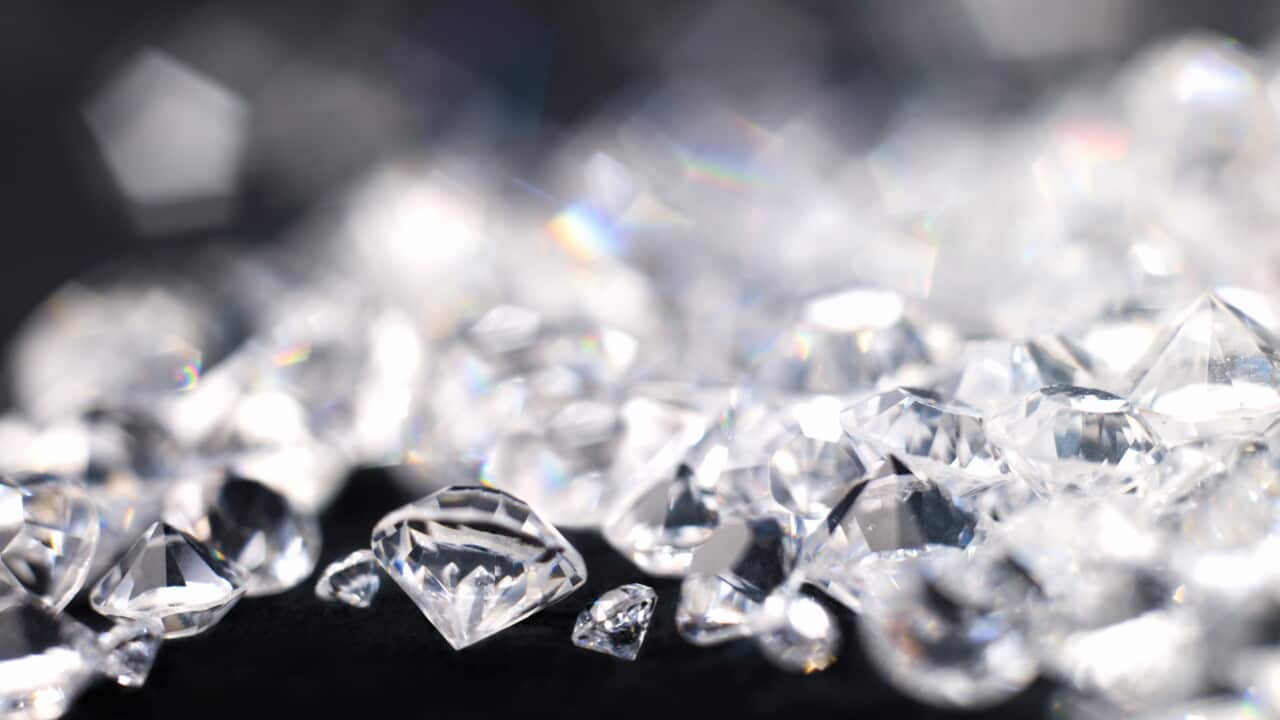

Natural diamond prices have tumbled as lab-grown diamonds surge in popularity. Physically and optically identical, they can cost around a tenth as much and can now be produced at mass scale.
DOWNLOAD the script in Italian and English side by side.
English
Once upon a time, a diamond engagement ring was a powerful symbol of social status: the bigger the rock, the greater its cachet.
Today, ring owners posting on social media will often voice a different sentiment: "Does this look too big?"
The diamond industry has undergone unprecedented disruption in recent years as lab-grown diamonds have become cheaper, more popular and effectively limitless in supply.
Since the start of 2022, the price of a one-carat natural diamond has more than halved, according to US market data.
At the heart of the upheaval is a physically and chemically identical product: diamonds that were created by scientists, rather than forming beneath the Earth's surface over billions of years.
"What happened is the technology to make those diamonds has rapidly improved, and the price to make them has come down substantially. And as the price has come down, that's when I've really seen consumer demand pick up for the man-made diamonds, and that I would say happened within the last five years in a big way."
That's Paul Zimnisky, a leading diamond industry analyst based in New York.
According to his data, back in 2016, a one-carat natural diamond would retail in the US for around $9,400, while a similar lab-grown stone would cost about $1,600 less.
Today, the natural diamond retails for $4,900 while the equivalent lab stone can be bought for less than $850.
Just a decade ago, lab-grown diamonds only accounted for a tiny share of the global market.
But as manufacturing rapidly expanded in China and India, prices plunged and what was once a niche product went mainstream.
“I would say, in a major market like the US, and the US is the largest consumer of diamond jewellery globally at about 60 per cent of the world share. I would say that the man-made diamond represents probably approximately half of diamond sales here."
As for the global diamond jewellery market, Zimnisky estimates lab-grown diamonds account for roughly a third now.
But if lab-grown diamonds have existed for more than 70 years, why did it take so long for them to take off?
Michael Cohen is managing director of the Diamond Certification Laboratory of Australia.
He says it took decades to develop the technology needed to make gem-quality stones, and even longer for it to become commercially viable.
"The original idea with laboratory-grown diamonds was more for an industrial purpose. That was done right in the early to mid-50s ... No one actually entertained the fact of polishing those stones into gem quality stones until the late 80s ... But to get to where we really become an economic power when it comes to the size of the stones, you really need to exceed a carat, and those were only generally coming into existence in the early 2000s."
Now, diamond factories can create large and virtually flawless gems in a matter of weeks — and even experts can't distinguish them from their natural counterparts.
"The only way to tell the difference is either through the laser inscription, which is usually engraved on the girdle of the diamond, or through a certificate which is associated with the diamond. Other than that, you need to put it to a laboratory to actually know the difference. It's not possible to actually see it visually through a microscope, through basic testing, even your countertop retail test. They can't discern the difference."
Last month, De Beers — the company that helped define the diamond industry and monopolised it for decades — suspended production at South Africa's biggest diamond mine.
It cited a need to cut costs amid challenging market conditions.
It was the latest sign that the once-booming industry is at a crossroads, as collapsing diamond prices force mining giants to shut down sites and projects.
The rise of lab-grown diamonds has coincided with several other headwinds.
Changing consumer spending, soaring operating costs and declining diamond yields have also made mining less profitable.
In order to survive, Zimnisky says the industry needs to figure out how to persuade consumers to spend 10 times as much on the natural product.
"I think the natural diamond industry has to kind of collect itself and kind of come up with a strategy to further differentiate its product from lab-grown diamonds. I think there's still a lot of consumer confusion where people don't even know if you could tell the difference."
De Beers, which famously suggested that a diamond engagement ring should cost two months' salary, has been working on that.
The multinational has developed a suite of advanced screening machines.
Costing from around $7,900 to more than $35,000, they allow diamond sellers to distinguish between natural and lab-grown diamonds by analysing microscopic signatures left behind by their different growth processes.
The technology forms part of the company's broader effort to convince consumers that a diamond's origin, rather than its composition, is an important part of its story.
But for some consumers, understanding the difference doesn't change the calculation.
"So, in terms of the age of it, I still find [with] natural ones, when I look at it, I'm like, 'Oh, this just existed millions of years before me, and it probably would millions of years after me.' So that point, labs can't compete with it."
That was Ms. Elangovan, a 33-year-old living in Canberra. Over the past decade or so, she's collected more than ten diamond rings with both natural and lab-grown stones.
Despite her fascination with the ancient history of natural diamonds, nowadays, she chooses lab-grown gems.
"As I aged, I got into labs both for price and I mean I'll be honest, like the biggest factor is price. But the more I knew about like the ethics behind the diamonds, the natural ones, I started leaning more towards lab ... Another reason is with the natural ones, there will be inclusions, and the average stone you get, they're not very visually appealing if you can't have like, thousands of dollars. But the lab ones [are] just fantastic. For not even a quarter, like maybe one tenth of the price of my natural ones, I could just get a beautiful lab, virtually like no flaws inside, no inclusions, and the sparkle was just crazy."
As larger diamonds have become more affordable and visible on social media, demand for smaller stones has slowed.
Designs that were once reserved for celebrities and the ultra-wealthy are now well within reach for many middle-income earners
It reflects a generational change in consumer sentiment — one that is fast becoming an identity crisis for the natural diamond industry.
Jana Bowden is a professor of marketing and consumer behaviour at Macquarie University.
She says brands like De Beers built lasting perceptions in consumers' minds about what a diamond should cost and what it should mean.
"So much of this has been driven by the perceived rarity and exclusivity of the diamonds, and of course the controlled supply of diamonds through the market, and particularly De Beers as being the pinnacle brand with the most control of the market and supply as well."
At its peak in the 1980s, De Beers controlled nearly 90 per cent of the global diamond market.
Its tight control of the world's diamond supply allowed it to stockpile excess diamonds and manage how many entered the market at any time, helping to keep prices elevated.
Through its marketing, the company famously built the idea that a diamond is rare, "forever", and the ultimate expression of love, turning diamond engagement rings into a social norm.
"Really, we've been taught, and we have learnt how to incorporate diamonds into our lives. This is not something that existed prior to the clever marketing campaigns."
Bowden says the lab-grown diamond market is increasingly appealing to younger consumers, who are often more financially constrained and ethically motivated.
But she says decades of marketing have left a lasting impression, even as diamonds become increasingly accessible and affordable.
"I do think that diamonds do remain a status symbol despite the price point, despite the origin of the diamond. Because interestingly, the legacy branding that's come from the original traditional mining of diamonds is also now naturally transferred to lab diamonds as well. So, consumers still have that association of exclusivity or a milestone thing that I should have in my life for these particular important events that I'm going through in life."
Facing existential challenges, the future of the diamond mining industry is unclear.
De Beers, which is considered a bellwether for the broader industry, is currently up for sale from its parent company.
Cohen has worked in the industry for more than 40 years and says there will now be a never-ending supply of lab diamonds.
But he expects prices may eventually increase as the significant amount of energy required to produce them becomes more expensive.
That could potentially create new ethical concerns for consumers.
"I personally see a problem going forward because there's going to be a shortage of energy worldwide, and people are not going to appreciate that they can't turn on the air conditioners because there's a power outage, but trinkets are being made with that energy ... Although they're clean and they are ethical, and there's no blood diamond issue, slave labour issue, anything like that going on with them, they are going to be using energy which could be better served somewhere else."
Ultimately, he believes diamond mining will come to an end.
“ I think that in the next 10 years we'll probably see a few more mines closed down. We'll probably see some companies joining forces to try and survive what's coming. I think inevitably there will come an end to the natural diamond markets. That's not an end to the market because the biggest supply of diamonds will no longer come from the mine, but it'll come from the second-hand markets."
For people like Elangovan, it's a great time to be a diamond-lover.
"It's fascinating industry. I'm just happy I'm alive now, so I can have really pretty jewellery at a very affordable price and ethically sourced ones."
Italian
Un tempo, un anello di fidanzamento con diamante era un potente status symbol: più grande era la pietra, maggiore era il suo prestigio.
Oggi, chi possiede un anello e pubblica foto sui social media esprime spesso un sentimento diverso: “Sembra troppo grande?”.
Negli ultimi anni il settore dei diamanti ha subito uno sconvolgimento senza precedenti, poiché i diamanti sintetici sono diventati più economici, più popolari e di fatto disponibili in quantità illimitata.
Dall’inizio del 2022, il prezzo di un diamante naturale da un carato si è più che dimezzato, secondo i dati del mercato statunitense.
Al centro di questo sconvolgimento c’è un prodotto fisicamente e chimicamente identico: diamanti creati dagli scienziati, anziché formatisi sotto la superficie terrestre nel corso di miliardi di anni.
"What happened is the technology to make those diamonds has rapidly improved, and the price to make them has come down substantially. And as the price has come down, that's when I've really seen consumer demand pick up for the man-made diamonds, and that I would say happened within the last five years in a big way."
Questa era la voce di Paul Zimnisky, uno dei principali analisti del settore dei diamanti di base a New York.
Secondo i suoi dati, nel 2016 un diamante naturale da un carato veniva venduto al dettaglio negli Stati Uniti a circa 9.400 dollari, mentre una pietra simile creata in laboratorio costava circa 1.600 dollari in meno.
Oggi, il diamante naturale viene venduto al dettaglio a 4.900 dollari, mentre la pietra equivalente creata in laboratorio può essere acquistata per meno di 850 dollari.
Solo un decennio fa, i diamanti sintetici rappresentavano solo una quota minima del mercato globale.
Ma con la rapida espansione della produzione in Cina e in India, i prezzi sono crollati e quello che un tempo era un prodotto di nicchia è diventato di largo consumo.
“I would say, in a major market like the US, and the US is the largest consumer of diamond jewellery globally at about 60 per cent of the world share. I would say that the man-made diamond represents probably approximately half of diamond sales here."
Per quanto riguarda il mercato globale dei gioielli con diamanti, Zimnisky stima che i diamanti sintetici rappresentino attualmente circa un terzo del totale.
Ma se i diamanti sintetici esistono da oltre 70 anni, perché ci è voluto così tanto tempo prima che prendessero piede?
Michael Cohen è amministratore delegato del Diamond Certification Laboratory of Australia.
Cohen ritiene che ci sono voluti decenni per sviluppare la tecnologia necessaria a produrre pietre di qualità gemmologica, e ancora più tempo perché diventasse commercialmente redditizia.
"The original idea with laboratory-grown diamonds was more for an industrial purpose. That was done right in the early to mid-50s ... No one actually entertained the fact of polishing those stones into gem quality stones until the late 80s ... But to get to where we really become an economic power when it comes to the size of the stones, you really need to exceed a carat, and those were only generally coming into existence in the early 2000s."
Oggi, le fabbriche di diamanti sono in grado di creare gemme di grandi dimensioni e praticamente prive di imperfezioni nel giro di poche settimane — e nemmeno gli esperti riescono a distinguerle dai loro omologhi naturali.
"The only way to tell the difference is either through the laser inscription, which is usually engraved on the girdle of the diamond, or through a certificate which is associated with the diamond. Other than that, you need to put it to a laboratory to actually know the difference. It's not possible to actually see it visually through a microscope, through basic testing, even your countertop retail test. They can't discern the difference."
Il mese scorso, De Beers — l’azienda che ha contribuito a definire il settore dei diamanti e ne ha detenuto il monopolio per decenni — ha sospeso la produzione nella più grande miniera di diamanti del Sudafrica.
L’azienda ha motivato la decisione con la necessità di ridurre i costi in un contesto di mercato difficile.
Si è trattato dell’ultimo segnale che questo settore, un tempo in forte espansione, si trova a un bivio, poiché il crollo dei prezzi dei diamanti costringe i giganti dell’estrazione a chiudere siti e progetti.
L’ascesa dei diamanti sintetici ha coinciso con diverse altre difficoltà.
Anche i cambiamenti nelle abitudini di spesa dei consumatori, l’impennata dei costi operativi e il calo della resa dei diamanti hanno reso l’attività mineraria meno redditizia.
Per sopravvivere, secondo Zimnisky il settore deve capire come convincere i consumatori a spendere dieci volte di più per il prodotto naturale.
"I think the natural diamond industry has to kind of collect itself and kind of come up with a strategy to further differentiate its product from lab-grown diamonds. I think there's still a lot of consumer confusion where people don't even know if you could tell the difference."
De Beers, nota per aver suggerito che un anello di fidanzamento con diamante dovrebbe costare due mesi di stipendio, si è impegnata proprio in questo senso.
La multinazionale ha sviluppato una serie di macchinari di screening avanzati.
Con un costo che va da circa 7.900 a oltre 35.000 dollari, questi dispositivi consentono ai venditori di diamanti di distinguere tra diamanti naturali e quelli sintetici, analizzando le tracce microscopiche lasciate dai diversi processi di crescita.
La tecnologia fa parte di uno sforzo più ampio dell’azienda volto a convincere i consumatori che l’origine di un diamante, piuttosto che la sua composizione, è una parte importante della sua storia.
Ma per alcuni consumatori, comprendere la differenza non cambia il calcolo.
"So, in terms of the age of it, I still find [with] natural ones, when I look at it, I'm like, 'Oh, this just existed millions of years before me, and it probably would millions of years after me.' So that point, labs can't compete with it."
Questa era Elangovan, una donna di 33 anni residente a Canberra. Negli ultimi dieci anni circa, ha collezionato più di dieci anelli con diamanti, sia naturali che sintetici.
Nonostante il suo fascino per la storia antica dei diamanti naturali, oggi preferisce le gemme sintetiche.
"As I aged, I got into labs both for price and I mean I'll be honest, like the biggest factor is price. But the more I knew about like the ethics behind the diamonds, the natural ones, I started leaning more towards lab ... Another reason is with the natural ones, there will be inclusions, and the average stone you get, they're not very visually appealing if you can't have like, thousands of dollars. But the lab ones [are] just fantastic. For not even a quarter, like maybe one tenth of the price of my natural ones, I could just get a beautiful lab, virtually like no flaws inside, no inclusions, and the sparkle was just crazy."
Man mano che i diamanti più grandi sono diventati più accessibili e visibili sui social media, la domanda di pietre più piccole ha subìto un rallentamento.
I modelli che un tempo erano riservati alle celebrità e ai super ricchi sono ora alla portata di molte persone con un reddito medio.
Ciò riflette un cambiamento generazionale nell’atteggiamento dei consumatori — un cambiamento che sta rapidamente trasformandosi in una crisi di identità per l’industria dei diamanti naturali.
Jana Bowden è docente di marketing e comportamento dei consumatori alla Macquarie University.
A suo dire, marchi come De Beers hanno radicato nella mente dei consumatori una percezione duratura di quanto dovrebbe costare un diamante e di cosa dovrebbe rappresentare.
"So much of this has been driven by the perceived rarity and exclusivity of the diamonds, and of course the controlled supply of diamonds through the market, and particularly De Beers as being the pinnacle brand with the most control of the market and supply as well."
Al suo apice, negli anni ’80, De Beers controllava quasi il 90 per cento del mercato mondiale dei diamanti.
Il suo stretto controllo sull’offerta mondiale di diamanti gli ha permesso di accumulare scorte in eccesso e di gestire la quantità di diamanti immessa sul mercato in qualsiasi momento, contribuendo a mantenere i prezzi elevati.
Attraverso le sue campagne di marketing, l’azienda ha notoriamente diffuso l’idea che un diamante sia raro, «eterno» e la massima espressione dell’amore, trasformando gli anelli di fidanzamento con diamante in una norma sociale.
"Really, we've been taught, and we have learnt how to incorporate diamonds into our lives. This is not something that existed prior to the clever marketing campaigns."
Bowden ritiene che il mercato dei diamanti sintetici stia diventando sempre più attraente per i consumatori più giovani, che spesso hanno maggiori limitazioni finanziarie e sono più sensibili alle questioni etiche.
Tuttavia, sostiene che decenni di campagne di marketing abbiano lasciato un’impronta duratura, anche se i diamanti stanno diventando sempre più accessibili e convenienti.
"I do think that diamonds do remain a status symbol despite the price point, despite the origin of the diamond. Because interestingly, the legacy branding that's come from the original traditional mining of diamonds is also now naturally transferred to lab diamonds as well. So, consumers still have that association of exclusivity or a milestone thing that I should have in my life for these particular important events that I'm going through in life."
Di fronte a sfide esistenziali, il futuro dell’industria dell’estrazione dei diamanti è incerto.
De Beers, considerata un punto di riferimento per l’intero settore, è attualmente in vendita da parte della sua società madre.
Cohen, che opera nel settore da oltre 40 anni, ritiene che d’ora in poi ci sarà un’offerta illimitata di diamanti sintetici.
Tuttavia, prevede che i prezzi potrebbero alla fine aumentare, poiché l’enorme quantità di energia necessaria per produrli diventerà più costosa.
Ciò potrebbe potenzialmente sollevare nuove preoccupazioni di natura etica per i consumatori.
"I personally see a problem going forward because there's going to be a shortage of energy worldwide, and people are not going to appreciate that they can't turn on the air conditioners because there's a power outage, but trinkets are being made with that energy ... Although they're clean and they are ethical, and there's no blood diamond issue, slave labour issue, anything like that going on with them, they are going to be using energy which could be better served somewhere else."
In definitiva, Cohen ritiene che l’estrazione dei diamanti giungerà al termine.
“ I think that in the next 10 years we'll probably see a few more mines closed down. We'll probably see some companies joining forces to try and survive what's coming. I think inevitably there will come an end to the natural diamond markets. That's not an end to the market because the biggest supply of diamonds will no longer come from the mine, but it'll come from the second-hand markets."
Per persone come Elangovan, è un ottimo momento per essere amanti dei diamanti.
"It's fascinating industry. I'm just happy I'm alive now, so I can have really pretty jewellery at a very affordable price and ethically sourced ones."
Report by SBS News
Listen to SBS Italian every day from 8 am to 10 am.
Follow us on Facebook and Instagram.