L-R: Mr Sharif and Mr Vajpayee accompanied by Mr Syed in Lahore during the Dosti Bus Yatra in 1999. Source: Twitter/Mushahid Hussain Syed
India’s former Prime Minister Atal Bihari Vajpayee is fondly remembered not only in India but also in neighbouring Pakistan, with whom his friendly overtures have become the lore of a legend.
India’s former Prime Minister Atal Bihari Vajpayee is fondly remembered not only in India but also in neighbouring Pakistan, with whom his friendly overtures have become the lore of a legend.
For a former Pakistan minister – a country with which India has never enjoyed smooth relations continually – to pay a glowing tribute to India’s three-time prime minister after his death, is a rare occurrence, especially in today’s day and age when the relationship between both countries is largely governed by the hate-spewing jingoistic social media brigades on both sides of the Line of Control.
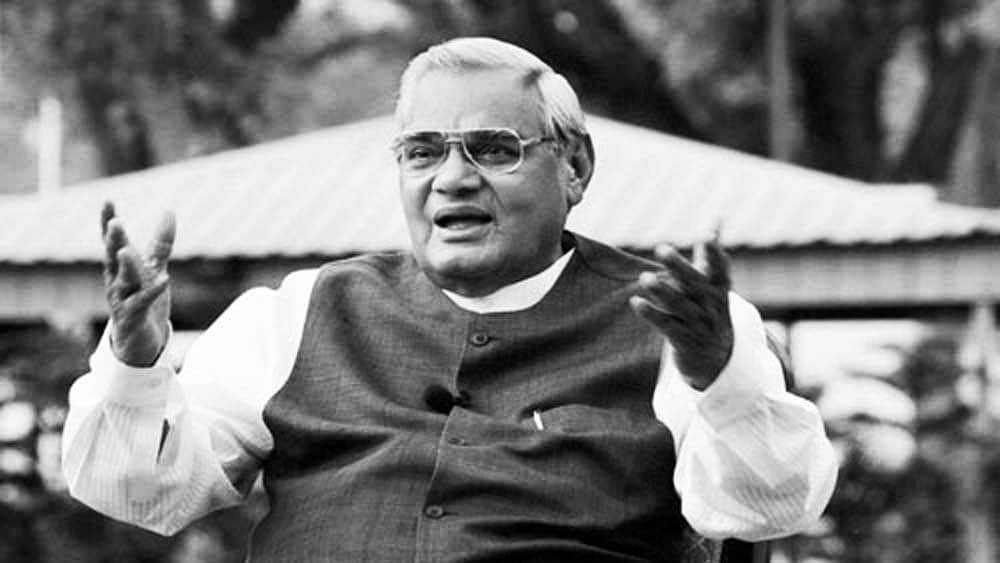
Atal Bihari Vajpayee Source: Flickr
India’s popular three-time PM Atal Bihari Vajpayee passed away on August 16 following a prolonged illness. He was instrumental in building bridges between India and Pakistan in 1999 by inaugurating -- with his Pakistan counterpart, Mian Nawaz Sharif -- the Delhi-Lahore Dosti Bus, which connects the two cities even today. Mr Vajpayee rode this bus across the Wagah-Attari border, which divides Punjab between India and Pakistan, in a historic gesture to help melt the decades-long ice that had accumulated between the neighbours, because of a sheer lack of will to thaw it.
The person who was tasked by Mr Sharif to be Mr Vajpayee’s Minister-in-waiting (a temporary post created to attend to a visiting state guest) during his stay in Lahore, was the then Pakistani federal minister for information and broadcasting, Senator Mushahid Hussain Syed.
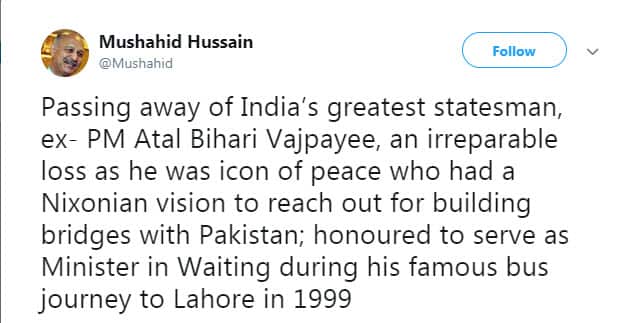
A snapshot of Mr Syed's tweet after the announcement of Mr Vajpayee's death. Source: Twitter/Mushahid Hussain Syed
Speaking with SBS Punjabi from Islamabad, Mr Syed had only the richest homage to pay to Mr Vajpayee. “Vajpayee saheb was the greatest statesman of South Asia,” he said, adding that he was comparable to former US President Richard Nixon, when he took the decision to warm up the chilled ties with China, which was then considered an extremely bold step for the US.
Mr Syed, a former journalist, also revealed how Mr Vajpayee told him that by visiting Minar-e-Pakistan in Lahore, he expected a backlash from the extreme-right wing or Hindutva circle of India, for “legitimising” or “putting a stamp of approval” on the idea of Pakistan, as this monument is built on the site where the Lahore Resolution of 1940 was passed and the need for a separate for India’s Muslims was discussed. “Despite that risk, which also happened to be Mr Vajpayee’s votebank, he bit the bullet, for which history will remember him”, Mr Syed added.
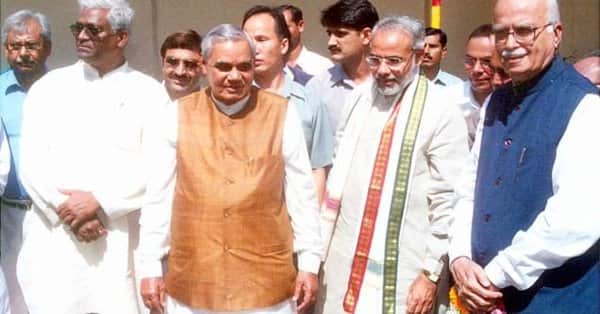
Former Prime Minister Atal Bihari Vajpayee (second L) with current Prime Minister Narendra Modi (in the centre) and veteran BJP leader L.K. Advani (Extreme R). Source: twitter/PMO
After Mr Vajpayee ceased to be India’s PM when the Bhartiya-Janata Party lost the Lok Sabha elections in 2004, Mr Syed went to meet him in New Delhi and he told him in his nonchalant manner that the people had told them they are free to go home now because the BJP thought “they had won everything”.
For more interesting anecdotes about the friendship Mr Syed had with Mr Vajpayee, listen to this interview in Punjabi.