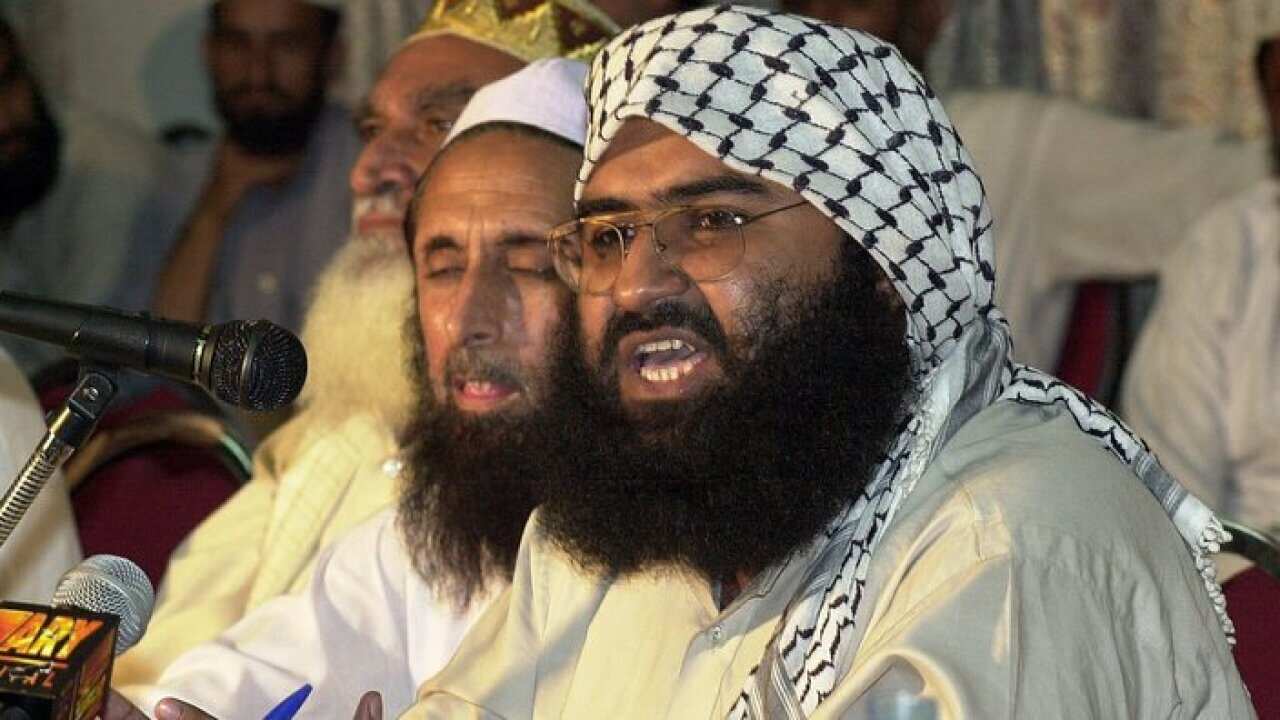
The listing of the JeM chief came on 1 May after China dropped its objection.
China, a permanent member of the UN Security Council and long-time ally of Pakistan, had repeatedly blocked India's moves to sanction the JeM chief since 2009.
In the wake of the UN action, Pakistan said it would immediately enforce the sanctions.
"Pakistan maintains that terrorism is a menace to the world, including the Indian state-sponsored terrorism against innocent Kashmiris," Foreign Office spokesman Mohammad Faisal said.
However, he rejected as "absolutely false and baseless" the Indian media's "attempts to build a narrative claiming it as a 'victory' for India and validation of its stance".
However, a report in centrist English-language daily The News noted that "Islamabad has watered down the development".
In a report titled "Did China take Pakistan into confidence?" the paper noted that the Foreign Office spokesman "in his hurriedly-called news conference" did not take the media "into confidence".
'Delinking of Kashmir' - A win for Pakistan?
A moderate English-language Pakistani daily, The Express Tribune, quoted a senior Pakistani official as saying that "Pakistan was able to convince the UNSC members to delink the listing of Masood from the Kashmir freedom movement".
"That was a major diplomatic victory," the official was cited as saying.
Analysts on prime-time TV shows in Pakistan on 1 May also contested the Indian media's stance of welcoming it as a "diplomatic victory".
Prominent journalist Kamran Khan on moderate Dunya TV noted that the initial resolution against Azhar had linked him with the "freedom movement in Kashmir" and the Pulwama attack.
"But due to Pakistan's diplomatic efforts and Chinese objections these references have been removed, which is being considered a diplomatic defeat for India," he said.
However, he added that the move "marked the end of some of the pressure on Pakistan" over the issue.
Similarly, expert Ahmer Bilal Sufi, on state-run PTV News, said the UN move was "not a diplomatic success for India" because it had failed to get Azhar linked to the Pulwama incident.
'Diplomatic win' for India ?
Indian media feel the listing of Masood Azhar as a "global terrorist", is a "diplomatic win" for the country.
Journalist Suhasini Haider writes in influential English-language daily The Hindu that the move "ends an anomaly and India's battle that has lasted two decades".
Some papers and television channels also focused on China's change in stance in their headlines.
Prominent television channel Times Now carried a caption "Modi makes Beijing bow on Azhar" while widely-read daily Hindustan Times led with the headline "China yields, UN labels Azhar a global terrorist".
Echoing the sentiment, Indian Prime Minister Narendra Modi termed the move a "big victory".
However, India's main opposition Congress party, while welcoming the move, said it was "disappointed" that the listing "does not mention Pulwama and Jammu and Kashmir".
Pulwama is a district in Indian-administered Kashmir which saw a massive suicide attack on Indian troops in February.
The attack was claimed by the JeM.
The development is also significant for domestic politics since it comes amid the ongoing Indian election.
"The electoral fallout of the UNSC decision cannot be emphasised enough," says a report on the website of Outlook magazine.
The UN move "allows the BJP [ruling Bharatiya Janata Party] to bolster its narrative of nationalist pride," it says, adding that "it is not good news for the opposition, particularly the Congress party".
A journalist on Hindi television channel ABP News concurred, saying "this big achievement is definitely not being digested very well by the opposition".
Analysts on India's prime-time TV talk-shows on 1 May hailed the move as "a moral victory" but also felt that the UN action is "largely symbolic".
Expert KC Singh, speaking on English-language channel NDTV, felt that there would have been "trade-offs".
"China must have discussed with Pakistan what is acceptable and what is the maximum they can concede. It is a psychological and a moral victory but in practical terms, it will have very limited effects," he noted.
Another analyst on the show, Brahma Chellaney, termed the action "largely symbolic" and one which "does not change the reality on the ground".
However, an anchor on private English-language news channel Republic TV, Deepti Sachdeva, disagreed. "It is not just a symbolic moral victory for India. It is actually something which will have an impact on the ground," she added.
'No objection' by China
China, which had previously blocked the moves on Azhar in 2016 and 2017, agreed to the proposal on 1 May.
"After careful study of the revised materials and taking into consideration the opinions of relevant parties, China does not have an objection to the listing proposal," said Chinese Foreign Ministry spokesperson Geng Shuang.
The mainland Chinese media, however, are yet to comment on the development. Most of their coverage is through factual news reporting.
Even the Chinese Foreign Ministry's statement on the issue seems to have been barely reported except on the ministry's own website.
However, in an article on 2 May, the Hong Kong-based newspaper South China Morning Post termed Beijing's decision to support the UN sanctions against Masood a "breakthrough" for India-China relations.
The paper said that the turn came after India "stepped up diplomatic efforts to convince the Chinese government that Azhar should be labelled a terrorist".
Follow SBS Urdu on Facebook and Twitter.
Also, listen to SBS Urdu radio program on Wednesdays and Sundays at 6:00 pm AEDT



