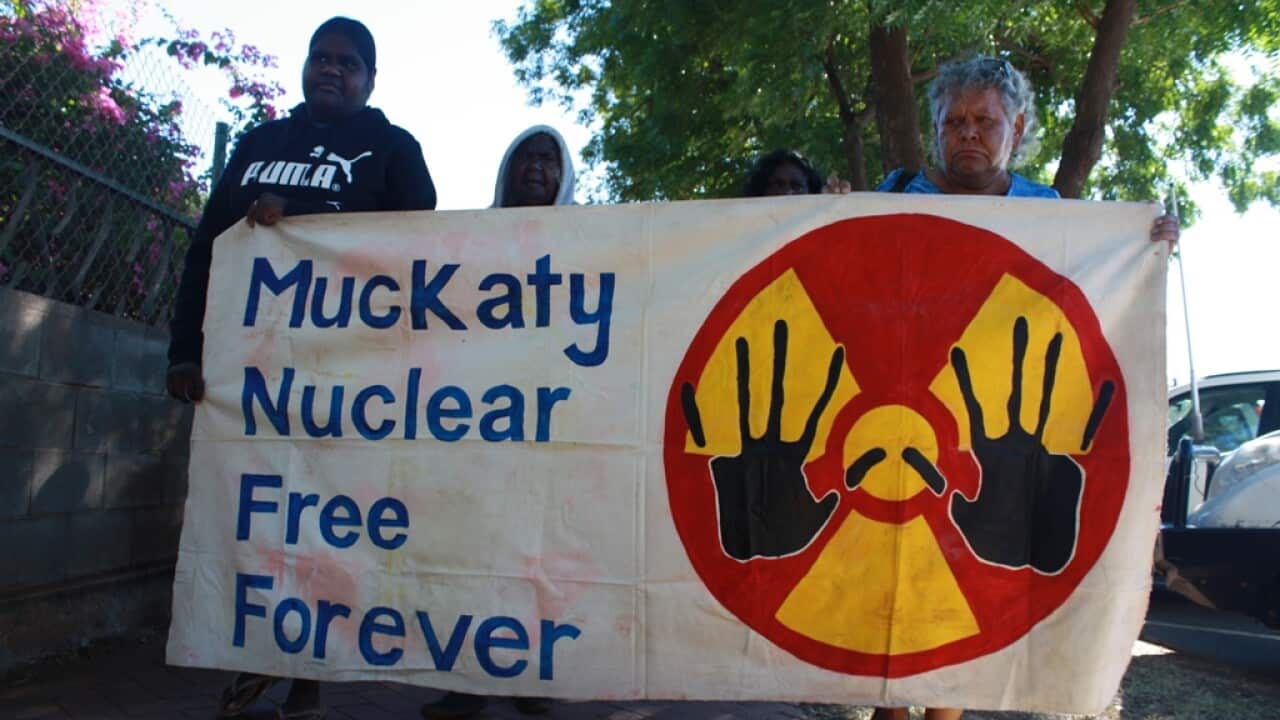
It’s now just two months since the federal government’s long held plan to relocate Australia’s radioactive waste to a remote site in the Northern Territory collapsed during a high profile Federal Court action bought by Aboriginal Traditional Owners opposed to a dump on their country.
After seven years of sustained and against the odds campaigning the people of Muckaty and Tennant Creek dodged a forever bullet, but the celebrations have been clouded by the continuing radioactive rumour mill.
NT Senator Nigel Scullion has joined Chief Minister Adam Giles and former Prime Minister Bob Hawke in banging the nuclear drum and are now actively promoting a new Territory dump site for Australia’s, and possibly the world’s, radioactive waste. A recent flying visit to Tennant Creek by Federal Industry Minister Ian Macfarlane has also raised renewed emotions and concerns about the dump push.
Like the waste itself, the issue is far from dead.
But all this political re-positioning continues to miss the central and long-standing question – what is the best thing to do with Australia’s radioactive waste?
News that makes sense
Your trusted source for staying up-to-date with the world around you. Get free daily news updates and analysis, straight to your inbox.
Compared with many countries Australia doesn’t have a serious nuclear waste problem, largely because we don’t have nuclear power reactors and the radioactive tailings left behind from uranium mining are classified as a mine waste to be managed at the mine.
Australia currently holds around 4000 cubic metres (m3) of lower level radioactive waste and 535 m3 of higher and more hazardous material.
A further 40 m3 of higher level Australian-origin waste is currently in France and the UK following reprocessing, a process that turns old nuclear fuel rods into uranium, plutonium and a cocktail of radioactive wastes. This material is due to be returned to Australia between 2015 and 2020.
This stockpile, which poses a significant but not insurmountable challenge, has been the source of a sustained policy meltdown.
For over two decades successive Australian governments have shared a common and failed approach – find a remote site for a central dump. This history is a litany in flawed policy and mismanagement.
In 1992, without independent evaluation, Australia adopted centralised remote dumping as the sole way to manage radioactive waste. Since then successive federal Ministers have tried to drive this forward, with varying degrees of energy and enthusiasm. All have crashed.
From the early 1990s until the election of the Howard government, Simon Crean was at the helm and scoping studies were the order of the day. In 1996 the Howard government brought a more aggressive approach to all matters nuclear and Nick Minchin and Peter McGauran began pushing for a dump in South Australia.
Eight years of staunch resistance from the women Elders of the Kupa Piti Kungka Tjuta, the wider SA community and the Labor state government saw the very real threat of the Liberals dropping seats in the 2004 election. John Howard overruled dump proponents and declared the plan dead.
A nervous Territory was then promised there would be no NT dump following the demise of the South Australian plan but in July 2005 Brendan Nelson informed our least politically powerful jurisdiction that the NT would become home to the nation’s radioactive waste.
This bad policy based on a broken promise found a champion in Martin Ferguson from 2007 to 2013 who, unlike his successor Gary Gray, repeatedly refused to even meet representatives of the Muckaty community.
Many years and countless column inches later, the nation is no closer to a lasting solution to nuclear pollution.
In the wake of the recent failure of the Muckaty plan, instead of going back to the map room for another round of political pin-the-tail games, our federal politicians should head back to the drawing board for an evidence based reappraisal of responsible radioactive waste management.
Australia has never had an independent and public assessment of the range of options available to manage radioactive waste. Remote centralised dumping is one option but it is not the only one and, as the past twenty years highlights, it is arguably not the best one.
As a nation, we need to avoid the divide-and-rule approach that sees compensation for the siting of a dump on Aboriginal land as a valid alternative to the provision of basic services and infrastructure.
Instead it is time to restore trust, credibility and common ground in relation to radioactive waste management based on good science, good process and acceptance that social and human concerns are valid and need to be addressed alongside technical criteria.
What is clear is that the approach taken to date has failed - and if it is simply tried again in another place it is likely to fail again. The government holds a duty of care to all Australians, including future generations, to get this issue right and the best start is through a dedicated National Commission into responsible waste management.
The approaches of the past – secret deals, top down announcements, emotive linking of the separate issues of nuclear waste and nuclear medicine, commercial-in-confidence ‘agreements’ and carrot and stick politics – have failed. We need a new approach to this old issue.
The message of Muckaty must not be lost. Only time can take the heat out of radioactive waste but trust, transparency and considered talk can help take the heat out of the radioactive waste debate.
Dave Sweeney is the Australian Conservation Foundation’s nuclear free campaigner.







